
Reducing compressed-air pressure by 1 bar typically saves about 4–8% of compressor energy, with the most credible working range spanning published estimates of 4–5% and approximately 8% [S2][S5].
The result applies to plant compressed-air systems where the pressure reduction preserves the minimum operating pressure of downstream equipment, and where compressor control and system demand allow the lower setpoint to be delivered efficiently [S2].
1 Bar Equals 14.5 PSI, Not a Fixed Energy Saving
One bar equals 14.5 psi, so a 1-bar reduction is materially larger than the 2-psi step cited in one compressed-air efficiency guidance [S1].
The published figures are not interchangeable.
These figures describe directional relationships rather than a universal coefficient. The realized saving depends on the initial pressure, compressor type, load profile, operating hours, flow, pressure-drop distribution and the extent to which production equipment remains functional at the reduced setpoint [S2].
Calculate the Saving From the Plant Baseline
For a rough screening calculation, multiply average compressor power in kilowatts, annual operating hours and electricity price in EUR/kWh to establish the baseline energy cost. If a 1-bar reduction is assumed to deliver a 5% power reduction, annual energy savings equal baseline cost multiplied by 0.05 [S2].
A worked example using 75 kW average power, 4,000 operating hours per year and EUR 0.18/kWh gives a baseline annual energy cost of EUR 54,000. A 10% power reduction would save EUR 5,400 per year; the same reduction would save EUR 3,600 at EUR 0.12/kWh and EUR 7,500 at EUR 0.25/kWh [S2].
At the narrower 4–5% estimate for a 1-bar pressure reduction, that same 75 kW and 4,000-hour baseline represents approximately EUR 2,160–EUR 2,700 in annual energy-cost savings before any maintenance, capital or tariff effects [S2][S5]. The calculation should use metered average power, not the motor nameplate rating, and the blended electricity price from utility invoices [S2].
Compare the Main Pressure-Management Methods
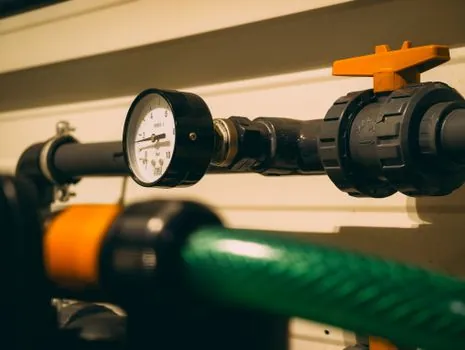
As many as 80% of manufacturers run their compressed-air systems at a higher pressure than necessary for their production processes, and reducing plant pressure may provide an opportunity for energy savings. This differs from a guaranteed 1-bar rule because equipment requirements, average pressure loss and system configuration differ by plant.
Fixing leaks can reduce run time and energy demand without reducing the required operating pressure.
The practical comparison is therefore direct. A 1-bar setpoint reduction saves 4–8% when all users can operate below the original pressure [S2][S5]. A 15–20 psi plant reduction saves 7–10% in typical manufacturing conditions [S4]. Leak repair reduces demand by addressing leakage rather than pressure, with potentially 20–30% of compressor output lost through leaks [S1]. Pressure-drop correction protects equipment performance and prevents unnecessary elevation of the plant setpoint [S4].
Verify That Equipment Can Run at the Lower Pressure
Reducing pressure is suitable for plants where the downstream load has a known minimum operating pressure and the compressor can maintain the lower discharge or system setpoint without impaired flow. Equipment may have a recommended operating pressure, a minimum pressure and a maximum pressure; maximum published pressure should not be treated as the required operating point [S4].
This method is not appropriate where reducing pressure causes production loss, unstable actuator performance, inadequate tool force, increased cycle time, equipment alarms or unstable downstream pressure.
Stage the Pressure Reduction and Measure the Response
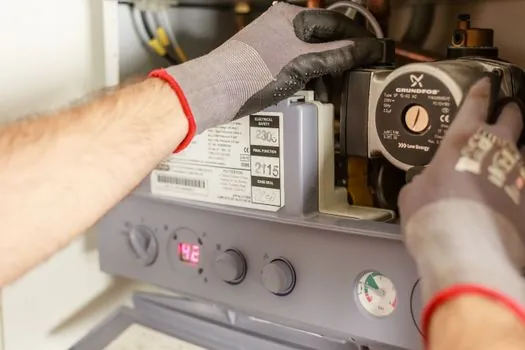
The defensible operating method is to reduce pressure in small increments and verify production performance before each further step. The 1-bar target can be treated as a test point, not as permission to remove 14.5 psi without equipment checks [S1][S4].
Measure compressor input power, flow in cubic metres per hour, pressure at the compressor, pressure at the point of use and production performance. Annual energy cost is calculated from average kilowatts, operating hours and EUR/kWh, while specific energy can be calculated as kWh/m³ when annual volume is known [S2].
Savings estimates should be expressed as a range because operating hours and demand variability commonly introduce 10–20% uncertainty [S2]. The same operating record also distinguishes a genuine pressure-reduction saving from a production reduction, because falling output may lower energy consumption without improving system efficiency [S2].
Control Parallel Losses Before Expanding the Project
Only 10–20% of the energy used to generate compressed air reaches the point of use, while a typical system can have overall efficiency as low as 10–15% [S1]. Pressure optimization therefore operates alongside leak control, variable-speed compressor selection and heat recovery, rather than replacing them [S2].
Leak economics can be substantial. Guidance gives annual wasted-energy costs of about USD 100 for an inaudible leak, USD 400 for a leak that can be felt but not heard, and USD 700 for a leak that can be both felt and heard; a 1/8-inch hole in a 100-psi system can cost more than USD 1,200 per year [S1]. An ultrasonic detector is useful where acoustic conditions make listening and soap testing unreliable [S1].
Heat recovery is another parallel measure because 80–90% of the electrical energy used by an air compressor can be converted to heat [S1]. For broader context, How Much Energy Do Compressed Air Leaks Waste? examines the separate contribution of leakage to plant energy demand.
Track Two Site-Specific Signals
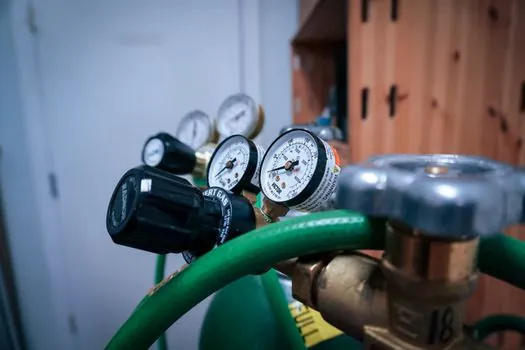
The first trackable signal is the ratio of metered compressor power before and after the pressure reduction. A 1-bar target should be tested against the published 4–8% range, while accounting for the 10–20% uncertainty associated with operating hours and demand variability [S2][S5].
The second signal is the minimum pressure at the point of use compared with the equipment requirement. If flow or production quality deteriorates, the header setpoint was not optimized for the load distribution, and the next action is to correct pressure drop or selective regulation rather than force a 1-bar reduction across the plant [S2][S4].