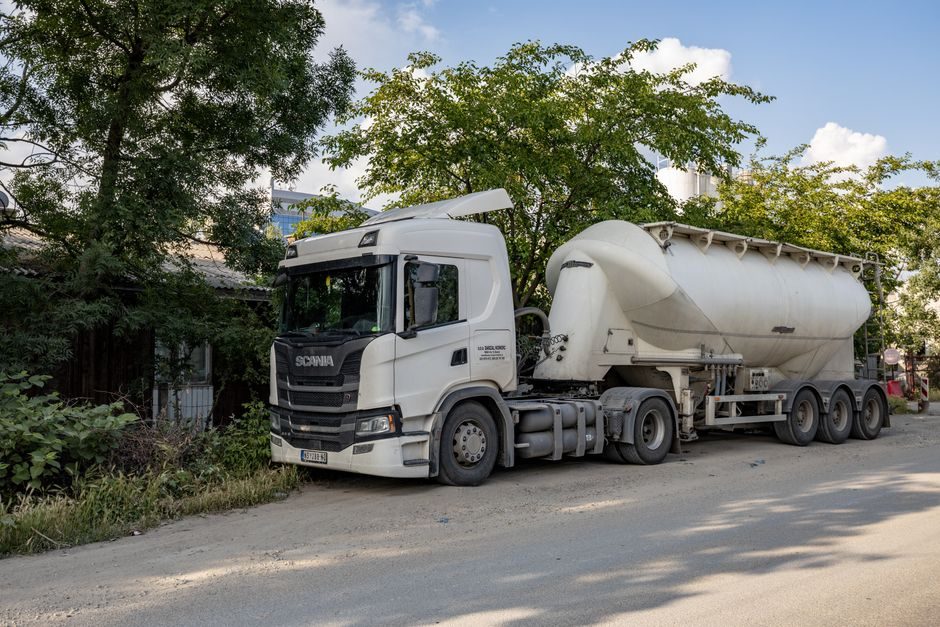
Concrete mixer trucks on the 2026 market are sold in drum-capacity bands of roughly 3 m³, 6 m³, 7-9 m³ and 10-15 m³, with motor options split between diesel and hydraulic drive [S1][S2][S3][S4]. The right truck is the one whose drum volume, axle configuration and discharge rate match the daily pour volume, the haul distance from batch plant to deck, and the legal GVW on the access road — not the one with the longest spec sheet.
Buyers in 2026 most often cross-shop a 6 m³ diesel transit mixer for urban low-rise work, a 9-12 m³ hydraulic drum on a 4-axle chassis for high-rise decks, and a compact 6 m³ underground-rated unit for mining and tunnel headings [S1][S2][S3][S4]. The selection mistake is treating drum size as a single number — drum geometry, blade pitch, drum tilt and roller count change the effective mixing and discharge behaviour at the same nominal cubic-metre rating.
Drum Capacity Bands and What They Actually Carry
Rated mixer-drum capacity on current production models runs from about 6 m³ (211.89 ft³) on compact and underground-class trucks up to 15 m³ (529.72 ft³) on heavy-duty road chassis [S1][S2][S3]. Mid-range highway mixers from 7 m³ to 12 m³ cover the majority of commercial and high-rise pours, while sub-7 m³ units dominate the mining, tunnel and confined-access niche [S3][S4]. One cubic yard equals 0.76 m³, so a 3 yd³ truck is roughly 2.28 m³ and a 12 yd³ truck is roughly 9.12 m³ — a translation that frequently trips up first-time importers.
Capacity choice is not independent of payload law. A 6 m³ transit mixer on a 4×2 chassis typically posts GVW around 11,970 kg and a top speed near 80 km/h, with drum geometry sized to keep the centre of gravity inside the rear-axle rating [S6]. Buyers overspec'ing a 12 m³ drum onto a 6 m³ chassis frame routinely fail the axle-load check at the weighbridge, even when the truck physically fits the pour schedule.
Diesel vs Hydraulic Drive: Torque, Output and Use Case
Diesel-powered mixer trucks are the workhorse of the road segment, with models such as the EMSUNTOUR WC6BJ (6 m³, diesel) and the Putzmeister Mixkret 6 (6 m³, diesel) targeted at general construction and underground coal-mine haulage [S1][S3]. Hydraulic-drive units from CIFA's HD series and SEMIX's SM9 are aimed at heavy-duty and lightweight truck-mounted applications, with the CIFA HD rated up to 15 m³ and an output of 560 l/min through the hydraulic circuit [S2][S4].
Selection rule of thumb: specify diesel when the truck spends most of its life on public roads and the cost-per-km of fuel is the dominant operating line; specify hydraulic when the truck is paired with a dedicated chassis that already runs a hydraulic PTO, or when the job is high-cycle batching with frequent drum reversals [S2][S4]. Underground and EX-rated zones add a separate constraint — explosion-proof diesel packages such as the WC6BJ exist specifically for coal-mine headings, with engine and electrical components enclosed to meet in-mine ignition rules [S1].
Discharge Rate, Drum Geometry and Cycle Time
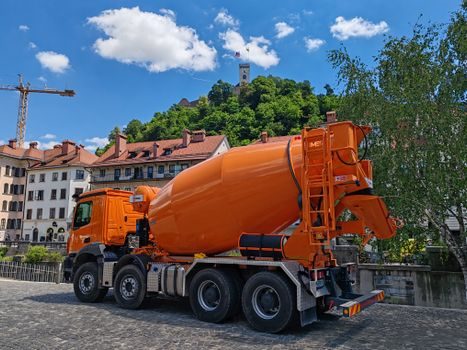
Output — the rate at which mixed concrete leaves the drum — is set by drum tilt, blade pitch, hydraulic flow and the chute geometry, not by drum volume. CIFA's HD series quotes 560 l/min output, which is the benchmark to compare against when a pour schedule lists "m³ per minute" [S2]. A 6 m³ truck with that output empties in roughly 11 minutes; a 12 m³ truck at the same output takes about 22 minutes, and pump-truck pairing has to absorb that window.
Residual concrete in the drum after discharge is a measurable spec: entry-level 6 m³ export mixers quote a discharge reside rate below 0.5 %, which is the figure auditors and batch-plant QA use to judge whether the truck is wasting mix or contaminating the next load [S6]. Heavy-duty OEM designs add wear-protected blades and single or double rollers with a sling bar to keep the drum stable off-road and to keep residual low across thousands of cycles [S2].
Chassis Match, Axle Layout and Compliance
Mixer trucks are almost always sold as "truck-mounted" packages, meaning the drum subframe bolts to a host chassis that the buyer (or the OEM) specifies. SEMIX's SM9 is explicitly a truck-mounted drum in the 7-12 m³ band, deliberately framed as a lightweight hydraulic package to keep the finished vehicle inside a 4-axle rating [S4]. EMSUNTOUR's WC6BJ, by contrast, is purpose-built on a mining-grade chassis with explosion-proof electrical gear and an underground-rated turning circle [S1].
Common axle layouts on a 6 m³ class are 4×2 with two axles, a maximum speed of 80 km/h, and a typical overall envelope near 8000 × 2490 × 3800 mm — these are the numbers a transport planner should have on the spec sheet before the truck is loaded onto a low-loader or routed under a low bridge [S6]. The encyclopedia entry on the concrete mixer truck family lists the same capacity bands and the same chassis-class split.
Who the Truck Is For — and Who It Is Not
A 6 m³ diesel transit mixer is the correct fit for a small or mid-size contractor running 20-60 m³/day, with 4×2 road access and standard 80 km/h haul routes [S6]. A 9-12 m³ hydraulic-drum unit on a heavy chassis is the correct fit for a high-rise deck pour or a ready-mix plant running more than 80 m³/hour through a single chute [S2][S4]. The 6 m³ underground or mining-class truck is the right answer for tunnel and mine headings where standard road chassis are illegal or unsafe [S1][S3].
It is not the right tool when the pour is sub-2 m³ (a static power mixer or sand mixer on a trailer is faster and cheaper), and it is not the right tool when the placement point is beyond chute reach and the site has no pump-truck access — in that case, the answer is a concrete pump truck or a truck-mounted concrete pump, not a larger drum.
Side-by-Side Comparison: 6 m³ Diesel vs 7-12 m³ Hydraulic vs Heavy-Duty 15 m³
For procurement teams running a structured RFQ, the comparison should line up against four decision criteria: drum capacity, drive type, output, and intended site class. On capacity, the EMSUNTOUR WC6BJ and Putzmeister Mixkret 6 sit at 6 m³ diesel, the SEMIX SM9 covers 7-12 m³ hydraulic, and the CIFA HD series reaches 15 m³ [S1][S2][S3][S4]. On drive, diesel wins for road use, hydraulic for chassis-PTO integration and high-cycle work. On output, only the CIFA HD publishes a number — 560 l/min — which is the benchmark to ask other vendors to match [S2]. On site class, the 6 m³ underground models are the only options that meet explosion-proof in-mine requirements [S1][S3].
For an export buyer reading Chinese OEM datasheets, a 6 cbm entry-level unit with ISO 9001:2000, CE and BV-SGS certification, electrically-hydraulic discharge control, air-pressure water supply and a 4×2 / 2-axle chassis is a representative baseline specification to anchor price discussions against [S6].
Standards, Certification and QA Signals
Concrete mixer trucks are not pressure-bearing vessels in the ASME sense, so the headline certifications on the data plate are typically ISO 9001:2000 quality-system registration, CE marking for the European market, and third-party inspection marks such as BV or SGS for export [S6]. Mine-rated variants add explosion-proof enclosure certifications tied to the in-mine ignition standard governing diesel equipment in the operating jurisdiction [S1].
The discharge reside-rate figure of under 0.5 % appears as a quantitatively auditable performance number on the 6 cbm transit-mixer data sheet [S6]. Buyers should also weigh axle-load distribution data, drum rotational speed range, and water-tank capacity for wash-down, since these determine how the truck behaves at the batch plant gate and on the return leg.
Sourcing and Procurement Levers
2026 sourcing for transit mixers is dominated by Chinese OEM clusters exporting through Alibaba, Made-in-China and direct OEM channels, with European brands such as CIFA and Putzmeister anchoring the high-duty and specialised mining segments [S2][S3][S6]. For buyers building a fleet decision tree, the practical levers are: (a) drum capacity matched to daily pour volume, (b) drive type matched to chassis and haul cycle, (c) axle configuration matched to local GVW law, and (d) certification package matched to the end-customer's project specification. The cross-reference on concrete mixer truck selection is a useful spec-side companion; for fleet-class equipment that runs alongside the mixers, the dump truck encyclopedia entry covers the haul-truck side of the same pour cycle.
Trackable next signals to watch: drum-capacity offerings above 12 m³ on 4-axle chassis from Chinese OEMs (a 2026 capacity creep signal), explosion-proof diesel mixer approvals for hard-rock as well as coal mines, and OEM-published discharge rates on mid-range hydraulic units, which would let buyers benchmark 560 l/min against a broader field [S1][S2][S4][S6].
For related coverage, see Best Pile Driver for Data Center Sites: 2026 Sourcing Map.