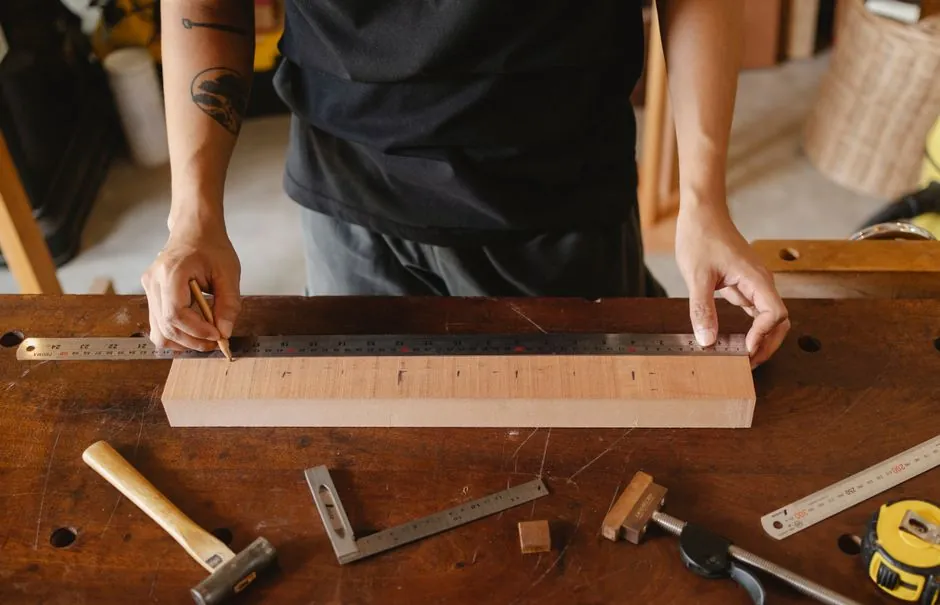
Gauge blocks are precision-ground and lapped length standards, available in metric or inch sets, used to build any dimension in a 0.001 mm (or 0.0001 in) step range by wringing blocks together [S2]. A 30-block metric set alone can build 1,000 discrete lengths between 3.000 and 3.999 mm; a typical 81-piece HFS(R) set covers 0.1001 in to 4 in [S2][S4].
Selection boils down to four decisions: grade, material, system (metric vs inch), and piece count. The grade fixes the length tolerance and parallelism limit; the material sets wear rate, thermal expansion, and cost; the system must match the prints you check; the piece count must cover the stack combinations your shop actually builds [S1][S2].
What "Grade" Really Buys You (ISO 3650 vs ASME)
Gauge block grades (also called tolerance classes) are defined by the maximum permissible deviation from nominal length and the parallelism limit between the two measuring faces, calibrated at 20 °C (68 °F) [S2]. ISO 3650 historically defines grades K, 0, 1, 2, and 3; K is the tightest (calibration laboratory), grade 2 is the typical shop-floor reference, and grade 3 is the workshop/instructional tier.
NIST calibration work in the U.S. documents the same hierarchy under the Federal standard and the older CS 8-60 nomenclature, with grade K holding the tightest uncertainty bound and grade 2 used for general machine-shop dimensional work [S1]. Tolerances for a 10 mm block scale roughly as follows: K ≈ ±0.05 µm + 0.0 µm/m, 0 ≈ ±0.10 µm + 0.0 µm/m, 1 ≈ ±0.20 µm + 0.2 µm/m, 2 ≈ ±0.40 µm + 0.4 µm/m, with parallelism limits relaxing in the same direction [S1][S2].
Steel, Tungsten Carbide, or Ceramic: Pick the Material for the Environment
Standard grade blocks are hardened steel alloy; calibration-grade blocks are often tungsten carbide (WC), chromium carbide (CrC), or ceramic (SiO2-based) for hardness and wear resistance [S2]. Steel is the cheapest and most common, takes a clean wring film, and is fine for most machine-shop and inspection-room use at 20 °C.
Tungsten carbide has a lower coefficient of thermal expansion than tool steel (closer to the workpiece in many cases) and resists wring-film loss and face damage in heavy shop use, but it costs several times more per block and is brittle if dropped. Ceramic (zirconia-based or similar) is the most thermally stable and corrosion-proof, preferred in temperature-sensitive labs and cleanrooms; it is the hardest of the three but the most expensive and the most fragile on impact [S2].
Set Composition and Wringing Math

Wringing is the sliding process that lets two ultra-flat gauge faces cling with only a ~25 nm lubricant film between them, so each block's nominal stamped length already includes one wring film [S2]. A 3-block stack is generally preferred over a 5-block stack: each added block adds its own tolerance and parallelism error, and the NIST handbook quantifies the resulting bias growth from historical deviation data per block [S1].
Sets come in different piece counts: a 30-block "mm-microset" generates lengths 3.000 to 3.999 mm in 0.001 mm steps; an 81-block set adds longer blocks (0.1001 in to 4 in) for shop-floor versatility [S2][S4]. Long-block sets (e.g. 125–500 mm in 8 pcs) require a trolley case and are usually purchased only by calibration labs [S2].
Who Should Skip the Mainstream Option
A grade 2 steel set is the default for most machinists, but it is the wrong choice for: a calibration lab holding ISO 17025 accreditation (use K or 0 in carbide), a metrology room that runs at non-20 °C conditions (specify ceramic for lowest thermal expansion drift), or a field inspector who needs dust/moisture tolerance (request the calibration certificate and a sealed carrying case rather than chasing tighter grade) [S1][S2].
Buying a budget "grade economy" set without an ISO 17025-accredited calibration certificate is also a false economy for a toolmaker: a stamped grade on the case is not the same as a measured deviation report per block, and NIST-style measurement assurance programs (MAP) use the historical deviation of each block, not the nominal, to compute the actual stack bias [S1].
Comparison: Material × Grade Trade-off

For a 10 mm block at 20 °C, three realistic options line up against cost, wear, and thermal behaviour as follows: hardened steel grade 2 (typical cost, low wear in light shop use, ~11.5 µm/m/°C thermal expansion); tungsten carbide grade 1 (3-5x cost, very low wear, ~4.5-5.5 µm/m/°C, brittle on impact); ceramic (zirconia) grade 0 (8-15x cost, near-zero wear, ~6-9 µm/m/°C, best for labs, fragile to shock) [S2].
Selection rule of thumb: spend the budget on grade first (every step up roughly halves the length tolerance), then on material second (only upgrade from steel when thermal drift or face wear, not tolerance, is the bottleneck). For comparison context on a related dimensional tool, see the dial indicator selection map at dial indicator sizing and selection and the automotive indicator setup at best dial indicator setup for automotive work.
Care, Calibration, and Recalibration Interval
Blocks ship coated in petroleum jelly or oil; users must clean and re-wring each time, because the ~25 nm wring film is part of the calibrated length [S2]. Wear blocks (often in tungsten carbide) are wrung to each end of the stack to protect the calibrated faces from damage; missing wear blocks is the most common cause of "drift" in a shop set.
Recalibration requirements under U.S. Federal and ISO practice call for periodic re-measurement, with the interval set by the grade (K/0 typically annual, grade 1-2 typically 1-3 years depending on use) and the measurement assurance program, not the calendar [S1]. A useful background on the dimensional metrology context is the related casting mold selection map, which shares the same heat-treatment and tolerance thinking.
Shortlist Logic and What to Verify Before Purchase
Match the grade to the worst stack you build: a 5-block stack in grade 2 will compound roughly 5x the per-block deviation budget, so for stacks of 3 or fewer, grade 1 is usually sufficient; for stacks of 4 or more, or for stacks feeding a CMM or optical comparator, jump to grade 0 [S1][S2].
Verify four things before paying: the set carries an ISO 17025-accredited calibration certificate with measured deviation per block (not just a grade stamp); the material and thermal expansion coefficient are documented for the use temperature; the wring film thickness is included in the stated length; and the case is foam-lined to prevent face contact during transport [S1][S2]. For a broader view of how this dimensional reference fits into a wider industrial buying workflow, see the safety barrier supplier map.
Next trackable signal: watch for ISO 3650 revisions and any tightening of grade K uncertainty bounds from national metrology institutes, as these will cascade into commercial calibration pricing. Also track the rising availability of ceramic grade 0 sets at lower price points, which is gradually closing the cost gap with tungsten carbide for mid-tier labs.
For component-level specifications, see gauge block, aac block, and block brick.
