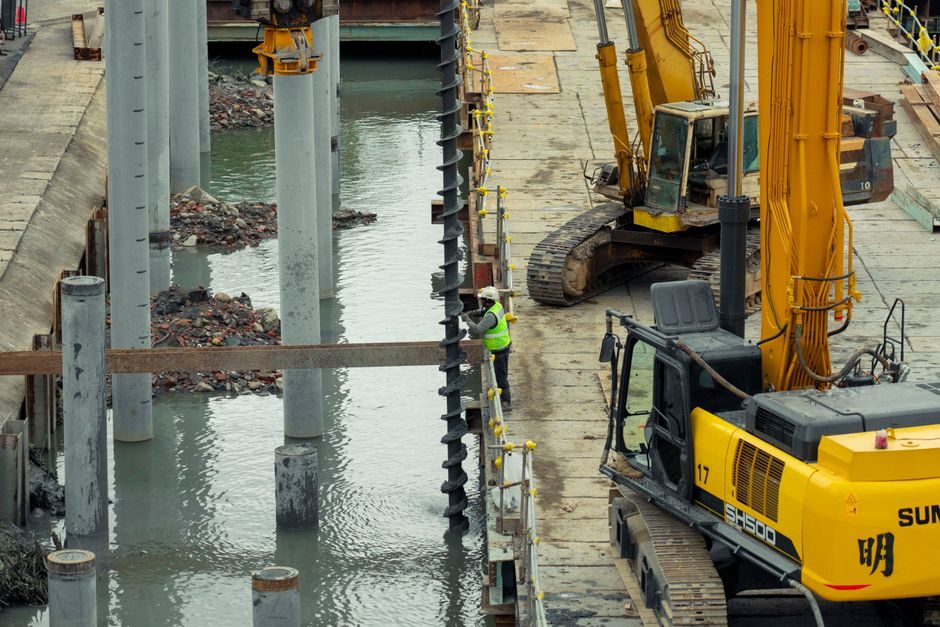
Specifying a rotary drilling rig is a four-axis decision: torque class (kN·m), max hole diameter, single-pass and total drilling depth, and engine power — all of which must clear the ground-condition and transport envelope before any brand comparison begins [S9].
Recent OEM data on index models shows just how wide that envelope is: RTDrill's RTD28 quotes 95–152 mm (3.7–6 in) hole range, 287–309 kW (390–420 hp) engine power and a 24,500 kg (54,013 lb) operating weight on a CAT C13 platform meeting Tier III / Tier 4f / Tier V [S3], while its RTD45 pushes to 127–165 mm (5–6.5 in) holes, 30.97 m (101.6 ft) total depth, 403 kW (547.93 hp) and 24,948 kg (55,000 lb) [S2]. Chinese builder rigs.com.cn markets a TR60 self-erecting rotary unit built around advanced hydraulic loading-back technology, illustrating the same template applied to higher capacity piling work [S5].
Start With the Four Spec Gates, Not the Brand
First-pass selection should fix torque, hole diameter, depth and engine power in writing before any vendor list is opened. The Chinese national standard GB/T 21682-2019 explicitly segments rotary rigs into size classes by these same parameters — small units around 100 kN·m torque, 170 kW engine power, 0.5–1 m hole diameter, ~40 m depth and ~40 t machine mass being the entry band [S9]. A spec that overshoots those baselines on any one axis tends to force a step up in the next two (more torque needs a heavier base, more weight needs a larger carrier), so the four gates are coupled, not independent.
Concretely: a 100 kN·m-class rig is sized for cast-in-place piles under 1 m diameter in soft overburden, while 200–400 kN·m machines take over once hole diameter exceeds 1.5 m or depth passes 50 m. The published RTD45 envelope of 165 mm / 30.97 m at 403 kW is a useful upper benchmark for mid-class rotary work [S2], whereas the TR60 self-erecting format suits job sites where mast assembly time on a 25 t+ crane support chain is unacceptable [S5].
Match Rig Class to Ground and Job, Not the Other Way Round
Ground conditions — soft overburden versus weathered rock versus hard formation — drive the choice between rotary, down-the-hole (DTH) and auger modes more decisively than any brand loyalty. RTDrill publishes the RTD28 explicitly in the DTH configuration, with engine options 287 kW and 309 kW (390.21 hp and 420.12 hp) reflecting the higher steady-state load a down-the-hole hammer places on the power pack [S3].
For purely dry soft-soil piling with no rock, an auger-format rig keeps cycle time down and fuel burn flat; see the rotary auger category for a broad product spread (Alibaba lists current global models for that sub-segment) [S7]. The same drilling platform is sometimes re-deployed for geothermal work, where direct and reverse-circulation capability becomes the deciding factor — geothermal rig lines such as the SPS2600 add reverse-circulation as a stated feature for that reason [S8]. Selecting by ground type first typically removes two-thirds of catalogue entries from contention.
Engine, Emission Tier and Hydraulic Load Are Now Bought Together
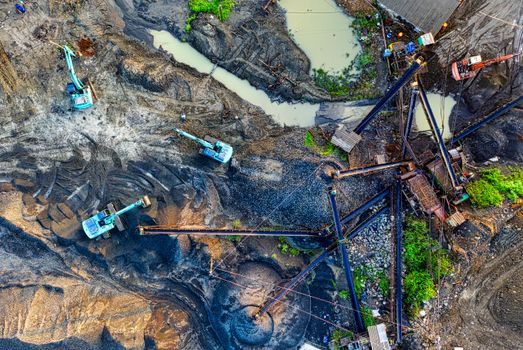
The CAT C13 fitment on the RTD28 is offered in three emission tunes — Tier III, Tier 4f and Tier V — on a single engine platform at 287 kW / 309 kW [S3]. The drilling envelope and the weight do not change between the three tunes; only the aftertreatment does.
Hydraulic load is the second-order consequence. Rotary rigs use hydraulic loading-back on the mast to feed the rotary head under crowd force, and the structural integrity of the mast under that force depends on where the main winch is mounted — a research paper on rotary drilling rig mast strength models axial force and bending moment for two winch mount positions (platform vs lower mast), concluding that mast stress distribution changes materially with that geometric choice [S6]. In plain terms, two rigs with the same torque and engine rating can deliver different mast life and hole-straightness performance based on the loading-back geometry alone — verify this in the OEM's structural datasheet, not the marketing brochure [S6].
Decision Comparison: Three Reference Builds Side by Side
Three index builds from the current manufacturer pool show the spread a 2026 buyer will actually face. Compare them on the four gates plus weight and emission tier: [S1]
— RTDrill RTD28 (DTH rotary): 95–152 mm hole, 287–309 kW CAT C13 (Tier III/4f/V), 24,500 kg. Best for hard-rock DTH work in mid-range diameters [S3].<br/>— RTDrill RTD45 (rotary): 127–165 mm hole, 30.97 m depth, 403 kW, 24,948 kg, 7.62 m (25 ft) pipe. Best for deeper straight-rotary holes at mid-large diameter [S2].<br/>— TR60 self-erecting rotary (rigs.com.cn): advanced hydraulic loading-back mast, self-erecting architecture for reduced crane time. Best for urban piling where mobilisation hours dominate cost [S5].
On torque per tonne, the RTD28 and RTD45 sit in a similar band — both near 1 t/kN·m in their class — but the RTD45's higher absolute engine power is what allows the deeper 30.97 m total / 8 m single-pass figure [S2][S3]. The TR60's competitive edge is not in raw torque but in set-up time, which is a labour-and-crane-cost lever rather than a hole-spec lever [S5].
Where the Catalogue Numbers Come From, and What They Don't Tell You
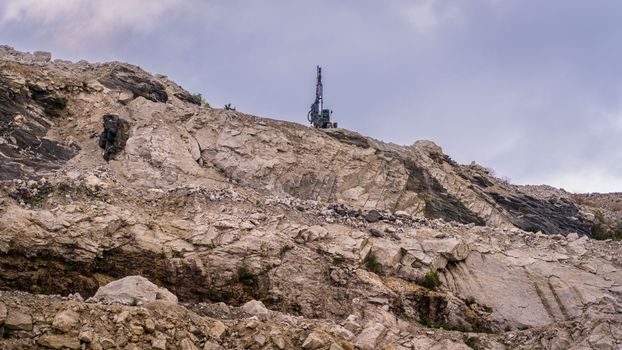
The DirectIndustry manufacturer index for crawler drilling rigs lists 52 companies and 409 products (as of 2026-05-17), with the long tail dominated by Chinese OEMs (Changsha Heijingang, Changsha Tianhe, plus the European and US majors such as BAUER, CASAGRANDE, Caterpillar and Sandvik) [S1]. The mining drilling rig sub-index lists 12 companies and 37 products, led by Epiroc, Furukawa Rock Drill, Komatsu, MAIT and Sandvik Mining and Rock Technology [S4]. Those counts are the floor of the addressable supply, not the ceiling — they exclude many regional builders.
Catalogue numbers are also optimistic by design. The "max drilling depth" on a spec sheet usually requires a tall mast extension, light tooling, and idealised ground; the real-world achievable depth is typically 70–85 % of the headline number, and the max hole diameter assumes short intervals in soft soil. The classification rule in GB/T 21682-2019 explicitly uses torque, engine power, hole diameter, hole depth and machine mass as the five-axis taxonomy, which is the right mental model even when the buyer is outside China [S9].
Who This Selection Path Is For — and Who Should Bypass It
The four-gates workflow fits mid-range commercial and infrastructure buyers: piling contractors, geothermal and water-well drillers, and mine-exploration teams that need to match one platform to multiple job sites. It also fits procurement engineers building a multi-rig fleet who need a comparable evaluation template across brands [S1][S4].
It is the wrong framework for one-off mega-projects (deep foundation shafts over 3 m diameter or depths past 80 m) where the OEM should be engaged on a custom-engineering basis, and for shallow agricultural or geotechnical work where a much smaller skid-steer or trailer rig is the cost-effective answer — those segments are outside the rotary drilling rig taxonomy and would be a misuse of the four-gates model. The selection logic also assumes a buyer with at least rough ground-condition data; without a soils report, even a perfectly spec'd rig will underperform.
Final selection check before any purchase order: torque class must be sized to the hardest expected 10 % of the work, not the median — undersizing kills bits and slows cycle time faster than any other single error. Engine tier must match the delivery jurisdiction (Stage V / Tier 4f for the EU and most US states in 2026, Tier III still common in much of Africa, South America and parts of Southeast Asia) [S3]. Mast geometry and winch-mount style should be confirmed against the OEM's structural calculation rather than its marketing render, because that single choice changes mast fatigue life materially [S6]. For related driveline sizing logic on torque-class equipment, the working-engineer spec guide on cycloidal reducer ratio and torque selection follows the same load-first methodology and is a useful cross-check.
For component-level specifications, see rotary drilling rig, rotary encoder, and rotary hammer.