Specifying a truck-mounted concrete pump in 2026 comes down to four hard numbers: theoretical peak output in m³/h, concrete cylinder pressure in bar, vertical reach in metres, and folded transport mass on the carrier chassis [S1][S3][S4][S6]. CIFA's K38L sits at 160 m³/h with 53/80 bar switching on a 6×4 chassis with a 4,750 mm wheelbase [S1], while Schwing's SPTO 1250 sits at 73 m³/h and 65 bar in a compact mobile package [S3], and Putzmeister's M20-4 reaches 150 m³/h and 83 bar in a hybrid-drive 4-arm boom configuration [S4].
Across the active OEM set tracked on DirectIndustry — CIFA, Putzmeister, Schwing, SANY, XCMG, EISTER and others — outputs cluster between roughly 70 and 160 m³/h, with pumping pressures between 53 and 83 bar and boom reaches typically from 20 m up to 56 m on the 5-section RZ-folding designs XCMG offers on the HB56 platform [S1][S2][S3][S4][S6]. The realistic decision is therefore not whether to buy, but which combination of those four numbers matches the pour volume, line length and site access you actually face.
Output and Pressure: Matching the Pour Window
The first citable technical assertion: a higher m³/h figure is only useful if the site can supply that volume of mixed concrete, and a higher bar pressure is only useful if the boom length or pumping distance actually demands it [S1][S4]. The CIFA K38L delivers 160 m³/h but the cylinder pressure switches between 53 bar and 80 bar depending on stroke mode [S1]; the Putzmeister M20-4 holds 78–83 bar across its 110/150 m³/h output steps [S4]; the Schwing SPTO 1250 holds a flat 65 bar / 73 m³/h pairing for steady-state pours [S3].
For a contractor pouring <100 m³ in a shift, a 70–80 m³/h class unit (Schwing SPTO 1250) is generally sized correctly; for high-rise decks and large mat pours, a 130–160 m³/h class with 80+ bar high-pressure mode is the right band [S1][S3][S4]. The diesel-versus-hybrid question is real on Putzmeister's M20-4, which is offered as a hybrid truck-mounted mixer-pump and trades prime-mover type for fuel and emissions profile on urban sites [S4].
Boom Geometry, Reach and Folded Footprint
Boom section count and folding pattern (Z-fold vs RZ-fold) drive both the working envelope and the unfolded clear-space required around the truck on tight sites [S1][S6]. CIFA's K38L uses a 4-section Z-folding boom packaged for "contained stabilisation dimensions" on a 6×4, 4,750 mm wheelbase truck [S1]; XCMG's HB56 uses a 5-section RZ-folding boom that reaches 55.7 m vertical placing height on a Volvo FM440 8×4 carrier [S6]; Putzmeister's M20-4 uses a 4-arm boom specifically engineered for low unfolding height on constrained sites [S4].
Reach bands matter because every additional metre of boom length costs transport mass, counterweight, and a more capable (and heavier) carrier chassis — a 56 m HB56 is a fundamentally different logistical object than a 20 m M20-4 [S4][S6]. The cross-tying: if the maximum pour height is below 30 m, a 4-section Z-fold typically gives a better weight-to-reach ratio; above 40 m, a 5-section RZ-fold on a heavier 8×4 or 10×4 chassis is the conventional answer [S1][S6]. For related chassis and drum-volume decisions on the wet-side fleet, see concrete mixer truck sizing: drum capacity, drive type and chassis match.
Chassis Match, Wheelbase and Roadability
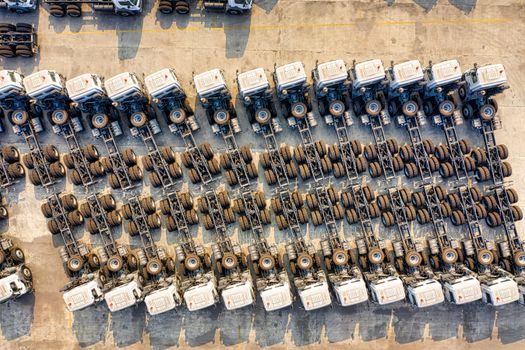
The carrier chassis is not a free choice — it must legally carry the upper structure plus payload, and the wheelbase must fit the outrigger spread the boom needs to deploy [S1][S6]. CIFA's K38L is built around a 6×4 chassis with a 4,750 mm wheelbase specifically to "contain stabilisation dimensions" for tight European and urban sites [S1]; XCMG's HB56 sits on a Volvo FM440 8×4 platform because the 55.7 m reach and counterweight exceed what a 6×4 can legally carry on Chinese and export road sets [S6].
For a related discussion of how chassis and body selection propagate through the rest of a construction fleet — including boom trucks, mixer drums and reach-style material-handling units — truck-mounted crane configuration choices follow the same wheelbase/axle logic, and dump truck tipper-body weight limits are a useful sanity check on what a 6×4 will carry over the road. Practical rule: a 4-section Z-fold on a 6×4 tops out around the K38L's 38 m class; beyond that you step to a 5-section RZ on an 8×4 or 10×4 [S1][S6].
OEM Field: CIFA, Putzmeister, Schwing, SANY, XCMG, Zoomlion
The active European and Chinese OEM field tracked on industrial indexes in mid-2026 is led by Putzmeister, Schwing and CIFA on the high-pressure / European side, with SANY, XCMG, Zoomlion, Lovol and Shantui on the Chinese high-reach side [S1][S2][S3][S4][S6]. Within that set, output and pressure clusters are visible: 70–90 m³/h compact (Schwing SPTO 1250 at 73/65) [S3]; 110–160 m³/h mid-to-high (Putzmeister M20-4 at 110–150/78–83, CIFA K38L at 160/53–80) [S1][S4]; and the 130+ m³/h 5-section RZ class on heavy 8×4 chassis (XCMG HB56 at 55.7 m reach) [S6].
The decision between European OEM and Chinese OEM is increasingly a question of after-sales coverage, emissions tier, and preference for control architecture — Schwing's SCT II control system on the SPTO 1250 with in-cab and on-pump feedback plus an integrated back-up camera is a representative example of where European OEMs differentiate on operator interface [S3], while Chinese suppliers compete on reach-per-dollar with the 5-section RZ-folding HB-class. Sourcing-route impact is non-trivial: Shandong and other Chinese OEM clusters can ship concrete placing booms and truck-mounted units on a 20-working-day delivery basis with FOB terms, with a single set minimum order typical of the segment [S5][S8].
Operational Limits, Failure Modes and Selection Cautions
The realistic failure modes that drive selection — not marketing — are: (1) outrigger footprint on tight urban sites, addressed by short-wheelbase 6×4 packaging like the CIFA K38L [S1]; (2) boom fatigue on long-reach 5-section RZ booms, addressed by design (the HB56 explicitly lists "longer service life" on the optimised RZ mechanism) [S6] and by control-algorithm work using ADAMS flexible-body simulation of arm start/stop dynamics [S7]; (3) hydraulic overheating on high-pressure long-stroke pours, addressed by the 80/53 bar two-mode switching on the CIFA K38L [S1] and the 78/83 bar dual-step on the Putzmeister M20-4 [S4]; (4) emissions and fuel cost on urban sites, addressed by hybrid-drive offerings like the Putzmeister M20-4 hybrid [S4].
Who a concrete pump truck is NOT for: sites with daily pour volume consistently under 30 m³ (a trailer pump plus placing boom is usually the lower-capex answer) [S5]; sites where ground bearing capacity cannot take a fully-loaded 6×4 plus outrigger pads; sites where the maximum placement height is under ~15 m (a boom-truck with smaller reach is more economical). Who it IS for: high-rise decks, bridge piers, large mat pours, tunnel linings, and industrial yards with high repetition [S1][S4][S6]. A useful cross-reference for buyers also looking at the wet-side fleet (and to compare drum volume against pump output) is concrete mixer truck suppliers 2026: drum capacity bands, chassis options and sourcing.
Sourcing, Standards and Trackable Signals
On the sourcing side, the verifiable levers in mid-2026 are: (a) OEM coverage map (CIFA/Putzmeister/Schwing in EU; SANY/XCMG/Zoomlion/Lovol/Shantui in CN) [S1][S2][S3][S4][S6]; (b) Chinese supplier delivery terms at 20 working days for placing booms and 1-set minimum order on truck-mounted units [S5][S8]; (c) industrial-supplier index counts, with Schwing GmbH appearing with 2 indexed models and SANY with 9 in the latest mid-2026 manufacturer listings [S2]. A standalone point on boom-design methodology: ADAMS-based flexible-body simulation of pump-boom arms under start/stop control has been formally published and is in engineering use as a design-validation tool [S7].
Trackable signals to watch over the next procurement cycle: (1) hybrid and electric-drive truck-mounted pump offerings expanding from the Putzmeister M20-4 base [S4] into other OEM lines; (2) 5-section RZ-folding reach creep above 60 m on Chinese OEM HB-class platforms building on the XCMG HB56's 55.7 m benchmark [S6]; (3) tighter integration of in-cab and on-pump control electronics — Schwing's SCT II with back-up camera is a representative direction [S3]. For procurement teams comparing OEM quotes on output (m³/h), pressure (bar), reach (m) and folded mass, the four-number matrix above is the minimum dataset that survives a spec-vs-price review.