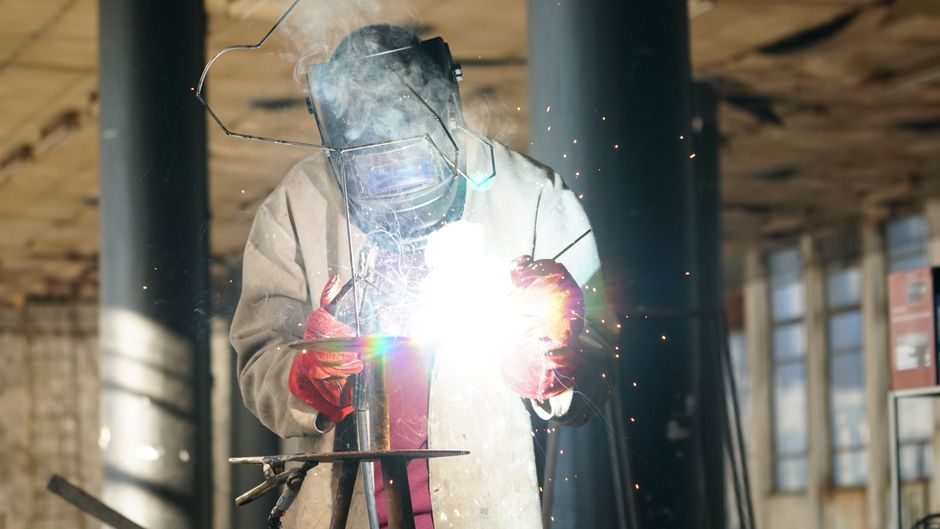
An arc welder is selected by welding current range, duty cycle at rated output, electrode diameter capability, and input supply — inverter models from China cluster around 120–250 A for portable MMA work, while transformer AC sets in the 300–500 A bracket remain the default for heavy plate fabrication [S1][S3][S5].
Published 2026 wholesale bands on Made-in-China run from US$34 per piece for entry-level 100 A inverter MMA units to US$14,800–296,300 per set for automated inverter welding systems with integrated wire feed and CNC interfaces, with most industrial-class 250–400 A units landing in the US$425–7,000 FOB range [S3][S5].
Current, Duty Cycle, and Electrode Diameter as the First Filter
Continuous output current is the single most useful filter when sizing a stick welder, because it caps both plate thickness and rod diameter in one number [S1].
Entry-level digital inverter ARC welders in the 120–200 A bracket cover 1.6–3.2 mm rutile and basic electrodes on 1.5–6 mm steel, with stated duty cycles of 60% at 200 A on the upper end of consumer-grade product listings [S6]. Mid-range industrial sets at 250–350 A handle 2.5–5.0 mm electrodes and 6–15 mm plate at 60% duty cycle or better, and heavy fabrication AC transformer sets at 400–500 A support 4.0–6.0 mm electrodes and continuous plate work above 15 mm [S3][S4]. Digital inverter ARC welders at the 120–200 A tier are explicitly listed for hobby and light fabrication, not for production cells, while 250–400 A inverter sets are common in job-shop and shipyard repair service [S6].
Look for duty cycle stated as a percentage at a stated current (e.g. 60% at 250 A at 40 °C ambient) — a bare "200 A welder" without a duty rating is a red flag, because the thermal limit is what actually limits real productivity on long seams [S1][S6].
Transformer AC vs Inverter DC: A Criteria Comparison
Choosing between AC transformer and DC inverter technology is the first fork in the arc welder decision tree, and the two architectures trade off four things — weight, efficiency, electrode compatibility, and unit cost. [S1]
AC transformer arc welding machines listed on Made-in-China cluster at US$425–7,000 per piece at 1-piece MOQ from Diamond-Member audited Chinese suppliers, suited to heavy industrial use with stick electrodes, and weigh significantly more per amp than inverters [S3]. Inverter are welding machines from the same marketplace range from US$34 per piece at 100-piece MOQ for entry consumer models, through US$597 per set at 2-piece MOQ for mid-range industrial units, up to US$14,800–296,300 per set for automated inverter welding systems with wire-feed and CNC interfaces [S5].
Direct comparison: AC transformer sets weigh 80–150 kg for a 300 A class unit and tolerate generator input and harsh site conditions, but consume roughly 1.5× the input kVA per amp of weld output compared with an inverter, and do not support DC-only processes such as cellulose 6010 pipe welding at high quality [S3][S5]. Inverter DC sets weigh 5–25 kg across the 120–250 A portable class, hit 80–85% electrical efficiency versus 50–60% for transformer sets, and support a wider electrode mix (6010, 7018, 308L, low-hydrogen) at cleaner arc stability [S5][S6]. Decision rule: pick AC transformer for shipyard, structural, and field use above 300 A where weight is not the limiter; pick inverter for portable, low-spatter, and DC-only process work below 350 A [S1][S3].
Matching the Welder to the Process: MMA, MIG, TIG, SAW, Plasma
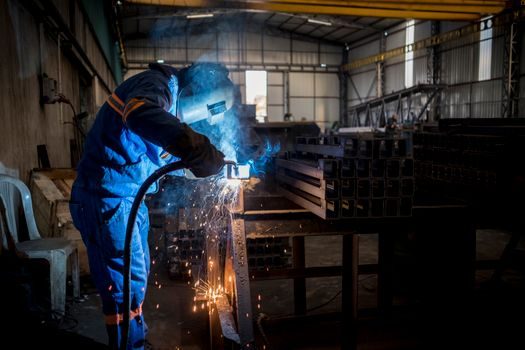
Process fit is the second filter — the same physical unit can be MMA-only, MIG-only, or multi-process, and the price band shifts sharply with each added process [S4].
Indian manufacturer APS Welding (Advanced Power Sources Limited) lists five product groups — TIG, MIG, SAW, ARC welding machines, and plasma cutting machines — at 2+ years of manufacturing, 2,450+ machines installed, and 1+ satisfied-customer count from a single audited company page; their scope reflects a typical industrial welding OEM product line covering DC TIG for stainless and aluminium, MIG/MAG for production sheet and structural, SAW for thick-plate vessels, MMA for field work, and plasma for cutting adjacent to welding cells. The "Arc Welding System" category page on coldrollformingmachinery.com notes that high-frequency-excited heavy-duty arc welding robot systems cover "almost all areas of welding production, including automotive vehicles and spare" components, with quoted coverage that includes MIG/MAG robotic cells in automotive and general fabrication [S4].
For a buyer specifying the equipment side, the practical decision is: pure MMA (stick) at 200–400 A for site repair, MIG/MAG with separate wire feeder for production sheet, DC TIG (HF start) for stainless and aluminium sheet, and SAW for 10–50 mm thick plate vessels and pressure equipment where deposition rate dominates [S4]. The same fabrication shop will often specify two or three process sets side-by-side rather than one multi-process unit, because dedicated sets deliver better arc performance per process and faster changeover on a job-by-job basis.
Input Power, Cooling, and Site Constraints
Single-phase 220–240 V input, three-phase 380–415 V input, and generator compatibility are the second-tier filters that eliminate a lot of units before duty cycle and price are even compared [S1][S3].
Portable inverter ARC welders in the 120–200 A class are typically single-phase 220 V with generator-friendly input tolerance (±15% voltage), making them the default for site work, agricultural repair, and small fabricators [S6]. Industrial 250–500 A inverter sets are usually three-phase 380 V / 50 Hz or 415 V / 50 Hz, with some dual-voltage designs that accept 220 V single-phase at derated output; AC transformer sets are predominantly three-phase because single-phase transformer welding sets in this current class are impractical [S3][S5]. Cooling method — fan-cooled (F) versus water-cooled (most SAW and heavy submerged-arc heads) — is the third filter, and the coldrollformingmachinery.com scope page on arc welding systems flags heavy-duty and high-frequency-excited cells as needing external cooling when duty cycle exceeds 60% continuous [S4].
A common field failure on underspecified inverter sets is input voltage drop on long extension leads causing the unit to trip or to de-rate current silently — for site use above 50 m of cable from the supply, step up to a three-phase input or a generator-rated 220 V inverter with explicit generator mode in the spec sheet [S1][S6].
Standards, Safety, and Operator Protection
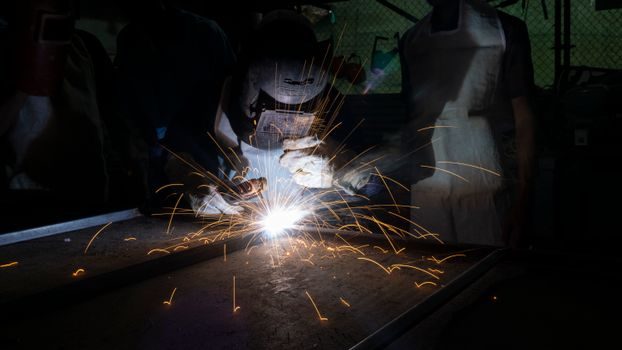
Welding equipment safety is governed by region-specific standards that every serious spec sheet should reference — IEC 60974-1 for arc welding equipment safety, IEC 60974-10 for electromagnetic compatibility (EMC), and the operator-side respiratory and eye protection standards EN 175 / ANSI Z87.1 for helmets and filters [S1][S3].
Verified Made-in-China and Alibaba listings for 2026 commonly cite "CE" and "CCC" markings on the datasheet for export to Europe and to domestic Chinese buyers; for hazardous-area or shipyard use, additional rules under IEC 60974 and classification rules for the welding environment (e.g. confined space, marine) apply on top of the equipment standard [S3][S5]. Look for the standard reference on the nameplate or the datasheet — a CE-only mark without a declared IEC 60974-1 compliance line is a soft signal that the unit has not been type-tested to the equipment safety standard [S3].
For operator side, fume extraction (per OSHA welding fume standard 1910.252 and EU Directive 2017/2398 on CMR substances including stainless steel welding fume containing hexavalent chromium) is no longer optional in any well-run shop — specify a portable fume extractor or tip-extraction MIG gun as part of the welding cell, not as an accessory added later [S3]. Auto-darkening helmets in shade 9–13 cover the arc brightness range of 100–500 A stick and MIG work; a shade 11–13 variable helmet covers most production work and is the de-facto minimum for an industrial operator [S1].
Sourcing, MOQ, and Logistics in 2026
Wholesale arc welding machine sourcing in 2026 runs through three main channels — DHgate for small-quantity import of consumer-grade 120–200 A inverter sets, Made-in-China and Alibaba for industrial-class 250–500 A sets at 1–2 piece MOQ from Diamond/Gold-Member audited suppliers, and direct from manufacturer-OEM pages such as APS Welding for buyers wanting single-point aftersales support [S1][S3][S5].
Verified price points as of July 2026: 100-piece MOQ entry inverter MMA at US$34–37 from Zhejiang Lingba; 1-piece MOQ AC arc welding machine at US$425–475 from Jiangsu and US$515–620 from Shanghai Sanyu; Bcamcnc at US$3,000–7,000 per piece at 1-piece MOQ for higher-amperage sets; Guangdong Hangao at US$14,800–296,300 per set for fully automated inverter welding systems at 1-set MOQ [S3][S5]. DHgate lists 376 wholesale arc welding machine results in a single search page, and the cheapest consumer-class units on that page sit under US$200 in small bulk [S1]. For any cell above US$5,000 per set, request a factory audit (or use an audited Diamond-Member supplier), ask for the IEC 60974-1 test report, and confirm the warranty terms and local service network before placing the PO [S1][S3].
Adjacent items on the same PO will typically include a welding cart — SucceBuy 3-tier welder carts with swivel wheels and tank storage sit at US$50.49, 2-drawer heavy-duty carts at US$123.49, and 4-drawer rolling carts at US$99.99 on AliExpress listings dated April 2026 — and a plasma cutter if the cell needs to cut before welding, which is why multi-product suppliers like APS Welding bundle plasma cutting machines alongside arc welders on a single product page [S2]. Selecting a compatible electrode oven (110 V, 5–50 kg capacity, 120–200 °C set point) and a fume extractor sized to the cell airflow (typically 1,000–2,000 m³/h for a single-station stick cell) closes the equipment package without scope creep [S2][S3].
For buyers stepping into a larger shop planning exercise, the same spec-driven selection discipline is applied across adjacent process equipment, from coding machines for date and lot marking on welded sub-assemblies to cutting machines and filling machines on the production line downstream of the welding cell.
For related coverage, see Coding Machine Selection 2026: Substrate, Speed, Code-Durability Bands.