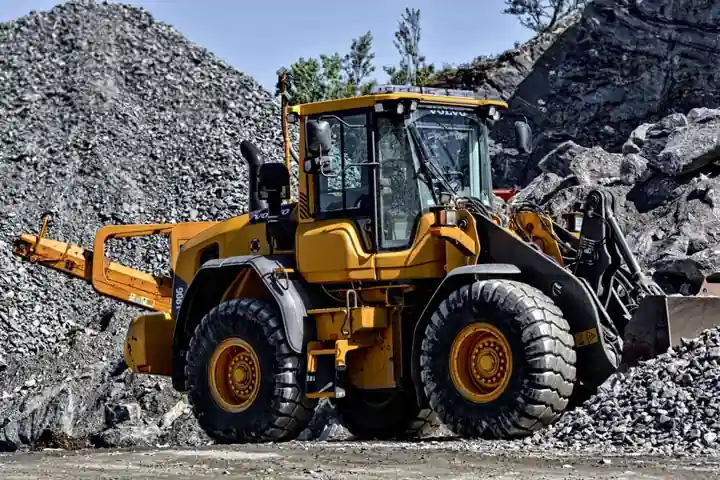
A dozer blade should be sized so its rated capacity exceeds the loose volume needed per pass, with the margin adjusted for material density, swell, push distance, and field losses.
The calculation starts with required bank cubic yards, converts bank volume to loose cubic yards, then compares the result with manufacturer blade capacity and the bulldozer operating class.
Define Volume in Bank and Loose Cubic Yards
Blade capacity is normally expressed in loose cubic yards, while project quantities are often written in bank cubic yards, so the two units must not be compared without a conversion. One cubic yard equals 27 cubic feet, and loose volume exceeds bank volume because excavated or pushed soil expands after disturbance [S3].
A field method for checking production is to carry or collect a measured load, place it on level ground, raise the blade while pulling forward slightly, and leave the material in place for measurement [S2]. For a pile aligned parallel to the blade, the cited calculation is Blade load, LCY = 0.0139 × H in feet × W in feet × L in feet [S3]. That method measures the actual loose load produced by the machine rather than relying only on a brochure value.
Convert the Required Push Quantity
For a known required volume in bank cubic yards, use V_bank = V_loose / swell factor. If the project requires 100 loose cubic yards per pass, the required blade capacity is 100 cubic yards before allowing for imperfect loading, spillage, or uneven pile shape [S3].
For example, if the required loose volume is 100 yd³ and the selected material has a swell factor of 1.25, the equivalent bank volume is 80 yd³. The blade must then carry at least 100 loose cubic yards in the planned pass, or more if the operator cannot consistently form a full blade load. The swell factor must come from the material specification, not from a generic machine chart [S3].
A practical sizing rule is to compare the calculated loose volume with published blade capacity, then add a controlled allowance for field conditions. The allowance should be tied to measurable factors such as push distance, grade, material compaction, and the proportion of material that rolls around the blade ends. It should not be an arbitrary percentage added without a production basis.
Match Blade Geometry to the Work
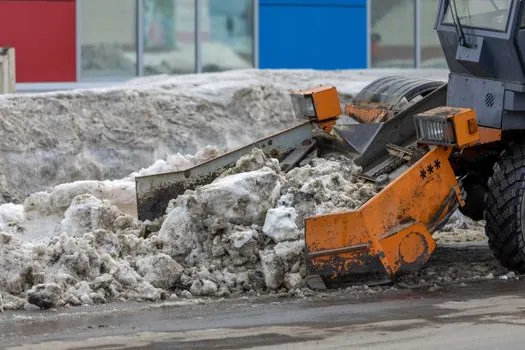
Universal blades with wings are intended for moving larger volumes over longer push distances, while straight blades provide finer grading and ditching control [S4][S5]. Semi-U blades combine the penetration of a straight blade with higher capacity and are used for pioneering and production dozing; angle blades redirect material sideways for backfilling and drainage work [S5].
The main comparison is capacity versus control, not simply “larger is better.” A U-blade is the stronger choice for large-volume pushing when the material is loose or friable and the route is long. An S-blade is more suitable where finish grade, ditch geometry, and operator control matter more than maximum bulk capacity. A semi-U blade is the compromise when the job includes both bulk movement and penetration into material [S4][S5].
The machine must also support the blade. A blade that is too large or heavy can overload the hydraulics, reduce maneuverability, and increase fuel consumption, while an undersized blade can require repeated passes [S5]. Check the manufacturer’s approved blade width and capacity for the exact model before making a selection.
Use Machine and Blade Data for the Decision
Blade width and blade capacity are separate specifications, and the material-handling result depends on both. The CASE 650M is listed with operating weight of 16,839 lb, 68 hp, blade width from 90 to 120 inches, capacity from 1.58 to 2.15 yd³, and ground pressure from 4.1 to 6.0 psi [S1]. By comparison, the CASE 2050M is listed at 84,733 lb, 214 hp, blade width from 135 to 157 inches, and capacity from 4.94 to 7.98 yd³ [S1].
Those figures show why operating weight alone is not a blade-sizing method. The 2050M configuration has a listed loose blade capacity of 4.94–7.98 yd³, compared with 1.58–2.15 yd³ for the 650M configuration. A broader reference for bulldozer sizing should combine blade width, capacity, operating weight, horsepower, and ground pressure rather than selecting on one rating.
Ground pressure remains a constraint when the work area contains soft or wet soil. A small CASE 650M configuration is listed from 4.1 to 6.0 psi, while a larger CASE 2050M configuration is listed from 5.4 to 7.3 psi [S1]. The lower-pressure configuration may be more suitable where bearing capacity is marginal, but the final choice must balance that constraint against the required push capacity.
Validate Capacity in the Field
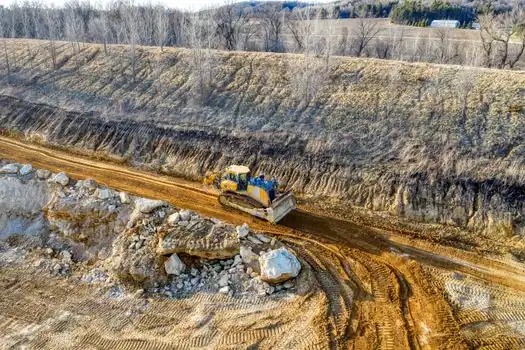
Field validation should use a measured load, a fixed push route, and repeatable passes, because blade nameplate capacity does not guarantee the same production in every material [S2]. The level-ground load method described by Cat provides a practical check of the material actually retained ahead of the blade [S2]. The pile-length calculation provides a second check when the pile is measured parallel to the blade [S3].
Record the number of passes, push distance, route grade, material condition, and time for each pass. If the blade repeatedly reaches its geometric limit before the route is completed, the practical solution may be a larger approved blade, a different blade geometry, or a shorter push distance. If the blade carries only a partial load, investigate operator technique, material compaction, blade condition, and unsuitable blade geometry before increasing capacity.
Inspect cutting edges, end bits, and moldboard alignment because wear can reduce effective capacity and increase fuel consumption [S5]. For grading-sensitive work, compare straight-blade control in the article Six-Way vs Straight Dozer Blades: Control Compared, then retain the geometry that meets both the production target and the finish requirement.
Apply the Selection Sequence
Start with the required production rate, divide by the planned cycle time, and calculate loose cubic yards needed per pass. Then apply the material swell factor, add a defensible allowance for field losses, and compare the result with the manufacturer’s approved blade capacity for the bulldozer. [S4]
The final selection must satisfy four criteria at once: adequate loose capacity, acceptable push distance and ground pressure, approved machine compatibility, and the required grading control. Verify the chosen combination with a measured field load and monitor actual passes per route before committing the machine to production work.