
A mobile batching plant contains motors, conveyors, compressors, and pumps that create significant startup loads, so generator sizing must account for those loads [S3].
The calculation should cover three-phase power, production equipment, compressed air, controls, and the operating hours available for refuelling [S2][S3].
Start with the electrical load, not plant throughput
A batching-plant generator should be selected from the connected electrical load, not from the label on a generic mobile plant. Concrete plants normally use three-phase power for central mixers, aggregate conveyors, cement screw conveyors, skip hoists, water pumps, dust collection and lighting [S1][S2][S3].
These figures establish a screening range, not a final procurement rating.
The plant supplier must provide the connected motor list, nameplate kW, rated current, voltage, phase, starting method and any standby loads. Sizing from the full nameplate total can overstate demand when motors never run together, but omitting nonproduction loads understates it [S3][S6]. The concrete batching plant nameplate data and the production sequence are the first two documents the sizing engineer should obtain.
Compare the main generator choices
Three generator arrangements fit mobile batch plants: a dedicated genset, a grid-backed package with generator backup, and a hybrid genset with battery buffering. The decision should compare steady capacity, motor-starting behaviour, operating duration and electrical integration. [S2]
Diesel is the direct option for a remote site without a reliable grid, while a grid-backed arrangement reduces runtime and fuel exposure but does not eliminate the need to define critical loads. A battery-buffered system can reduce generator oversizing where transient motor demand dominates, but its control response and sustained power must be engineered together rather than treated as a substitute for plant capacity [S4][S6].
Allow for motor starting and sequencing
Batching plants contain multiple motors, conveyors, compressors, and pumps that create significant startup loads, which must be considered when selecting a generator [S3]. That transient is the main reason a generator selected from average consumption can fail during production.
This is a screening allowance, not a substitute for the motor-starting study. The concrete mixer truck may remain outside the generator load for a dry-mix transit operation, while a stationary central mixer and its conveyors remain connected [S2].
Use the plant’s control sequence to prevent avoidable simultaneous starts. Start the largest motor first, allow voltage to recover, and then start conveyors, pumps, compressors and auxiliary drives in a defined order. The generator must still tolerate the worst permitted combination, including the compressor and dust collector if they can start with a production motor [S3][S6].
Match voltage, frequency and controls
The generator, alternator, distribution board and motors must match at the site boundary. The main electrical grid or a heavy-duty diesel generator supplies three-phase power to the plant [S2].
Three conditions require confirmation before ordering: the plant supply voltage, the generator’s rated voltage and frequency, and the required system earthing arrangement. The generator frame also needs adequate transient support for the motor-starting method selected by the equipment supplier [S1][S6].
Plant control requires more than a motor socket. A dedicated UPS supports the PLC and sensitive automation equipment, while the air compressor supplies pneumatic actuation for discharge gates [S2]. A load-shedding arrangement can keep the PLC, controls, lighting and critical instruments energized while shedding nonessential drives when the generator reaches its operating limit.
Size around production profiles and site limits
These bands are for planning and should be checked against the actual connected load.
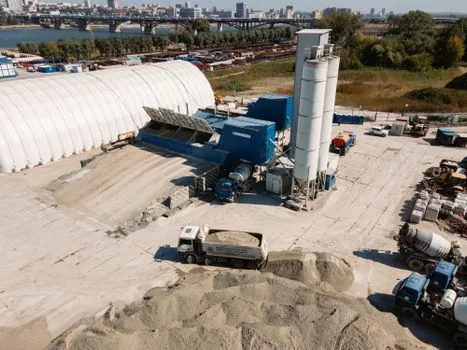
Transit-mix plants generally use less on-site power because mixing occurs in the truck, while wet-mix central plants require the high-torque stationary mixer motor [S2]. Dust collection and other auxiliary loads must be included in the generator-sizing assessment [S2][S3].
The off-grid service interval must be calculated from fuel consumption, available tank volume and refuelling access. For off-grid systems that also recharge batteries, generator capacity depends on both the battery charging demand and the required charging rate, not only on the connected household or plant load [S4]. A generator that meets the plant’s kW demand can still be unsuitable if its fuel autonomy ends before the next delivery.
Choose the system for the operating duty
This sizing method suits a temporary or mobile plant serving road construction, mining, airports and commercial development where the installation must operate without a dependable grid [S3]. It also suits early site works, remote settlements and locations where connection dates cannot be tied to concrete production.
It is not the best route for a permanent plant with firm grid capacity, continuous urban production or a duty cycle dominated by standby rather than generation. Those cases benefit from a site-specific load study because generator economics, emissions controls, parallel operation and maintenance support become more important than a portable rating [S6].
A concrete pump truck should not be placed inside the plant generator load unless its pump is electrically powered and deliberately connected to the same distribution system. Likewise, a generator carried by another vehicle should not be treated as part of the plant’s normal electrical supply without matching controls and protection.
Verify the order before commissioning
The procurement specification should state the required output in kVA, voltage, frequency, phase, starting method, minimum continuous load, allowable voltage dip, fuel autonomy, ambient design conditions and alternator protection. Industrial generator selection also requires the equipment purpose, electrical demand, motor-starting method and environmental conditions to be documented before a rating is accepted [S6].
Before acceptance, run a staged commissioning sequence: no-load voltage and frequency checks, individual motor starts, the normal production sequence, compressor and dust-collector starts, control and UPS transfer tests, and a full-load run at the defined fuel condition. Record voltage recovery and generator frequency rather than accepting a machine that starts but trips under the plant’s actual duty.
The next trackable signal is a signed load schedule that reconciles the plant nameplate total, the largest motor-start allowance and the generator’s continuous kVA rating. The automatic versus semi-automatic batching control comparison becomes relevant if sequential load management is being considered, because the control strategy must enforce the same starting sequence used in the power model.