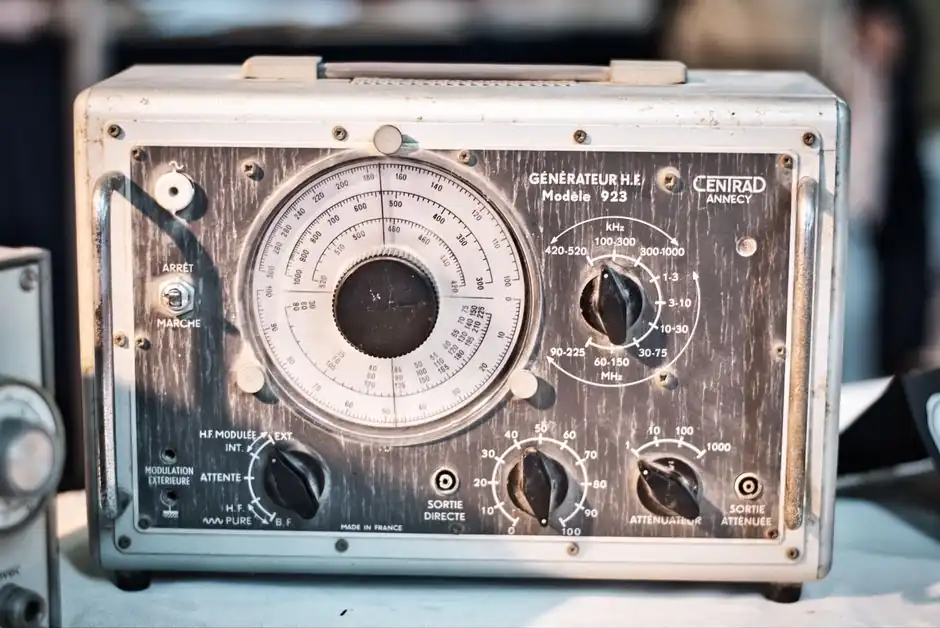
Four parameters are mandatory on any spectrum analyzer: center frequency, span, reference level, and resolution bandwidth, and every measurement on the instrument reduces to a plot of power versus frequency derived from these settings [S2].
Spectrum analyzers divide into three architecture families: the swept superheterodyne SA, the vector signal analyzer (VSA) that digitizes a passband into memory, and the real-time spectrum analyzer (RSA) that can trigger on and capture transient events, with the swept SA limited to one frequency point at a time and therefore only valid for stable, unchanging input signals [S5].
Frequency Range and Resolution Bandwidth: The First Two Cuts
Frequency range is the first cut: the analyzer's coverage must include both the lowest and highest tones the user expects to see, and a working rule is to choose a span that is at least 2x the bandwidth of the signal of interest so the carrier and at least one full modulation sideband fit on screen [S7].
Resolution bandwidth (RBW), measured in hertz, is the narrowest filter window the analyzer can slide across the span, and it governs the ability to separate two closely spaced signals; tighter RBW improves selectivity but lengthens sweep time, so the buyer must trade selectivity against measurement speed for the specific signal class being measured [S2][S4].
Center and span together define the displayed window: a 840 to 860 MHz band is equivalent to a center of 850 MHz and a span of 20 MHz, and most engineers enter center plus span because zooming is faster than retyping start/stop [S2].
Reference Level, Dynamic Range, and Sensitivity
Reference level is the top edge of the graticle and represents the maximum expected power at the RF input; setting it too high shrinks dynamic range and hides small amplitude changes, while setting it too low pushes the trace above the screen and can drive the input mixer or amplifier into compression, creating distortion that ruins the measurement [S2].
Dynamic range is the difference between the largest input signal the analyzer can handle and the smallest signal it can resolve, while sensitivity is the lowest signal level that can be detected consistently; a wider dynamic range lets the user pull weak signals out from under strong ones, which is the typical EMC and interference-hunting scenario [S4].
Behind the RF input a variable input attenuator is placed ahead of the sensitive front-end stages, and the reference level value is what the analyzer uses to set that attenuator and the IF gain automatically; users who override the attenuator manually must verify that the displayed level still tracks the true input power, otherwise compression will read out as a spur [S2].
Architecture Tiers: Swept SA vs. VSA vs. Real-Time RSA
The swept-tuned superheterodyne SA downconverts the signal and walks it through the RBW filter one frequency point at a time, giving high dynamic range but only valid results for stable inputs because the instrument is effectively blind between sweep steps [S5].
The VSA digitizes the full RF passband into memory and preserves both magnitude and phase, which DSP then uses for demodulation and modulation-domain analysis; the limitation is that batch processing leaves the VSA blind to events that occur between acquisitions, so single or infrequent transients can be missed [S5].
The real-time spectrum analyzer (RSA) is built to discover short-duration events, trigger on them, and capture them into memory for analysis in the frequency, time, modulation, statistical, and code domains, which is the workflow required for burst transmissions, switching transients, and intermittent interferers [S5].
Decision rule from the research: if the signal is controlled and static, a swept SA delivers the best dynamic range per dollar; if the signal carries digital modulation and needs demodulation, a VSA is the right class; if the goal is to catch rare, short-duration, or masked weak signals, only an RSA will reliably trigger on the event [S5].
Selection Criteria: Matching Instrument to Application
Application drives the architecture choice: telecommunications and broadcasting work that involves compliance verification of transmitted power generally maps to a swept SA or VSA, while RF signal monitoring for continuous interference hunting maps to an RSA so transient offenders are not missed [S3][S5].
A useful working comparison across the three tiers on the criteria that actually drive a purchase: swept SA scores high on dynamic range and low on cost, VSA scores high on modulation analysis and medium on cost, RSA scores high on transient capture and lowest on raw dynamic range per dollar, so the buyer should rank transient capture against modulation depth against raw dynamic range before picking a class [S5].
For field work where the instrument is carried to a tower, ship, or remote site, a handheld form factor trades raw performance for battery and weight, and buyers should expect narrower frequency range and lower dynamic range than a bench unit in the same price tier [S1].
Who Should NOT Pick the Mainstream Swept SA
Engineers chasing intermittent interferers, burst transmissions, glitches, or switching transients should not buy a swept SA, because the swept architecture only calculates amplitude for one frequency point at a time and the instrument is effectively blind between sweep steps, so single or infrequent events will not be discovered reliably [S5].
Engineers who only need to look at digitally modulated signals and demodulate them should also look past the swept SA: a swept analyzer does not preserve phase, so it cannot perform vector demodulation, and the VSA or RSA tiers are the only ones that retain the in-phase and quadrature information required for EVM and constellation work [S5].
Buyers on a tight budget who must measure only known stable carriers (for example, a service loop checking a known transmitter at a known frequency) are the population for whom the swept SA is still the right tool, and overspending on an RSA in that case burns money on transient-capture circuitry that will never be used [S5].
Operator Settings That Drive Every Measurement
Beyond the four mandatory settings, video bandwidth (VBW) sits downstream of the RBW filter and is used to smooth the displayed trace; lowering VBW reduces the noise floor visible on screen but slows the trace update, so it is a trade the operator makes for every sweep [S2].
Automated measurements such as AM modulation depth, third-order intercept, occupied bandwidth, and adjacent channel leakage ratio (ACLR) are built into modern analyzers because doing them manually is slow and error-prone; ACLR in particular is essentially impossible to do by hand on a live signal, so the operator should confirm the target analyzer has the specific measurement personality key required for the standard being tested [S2].
Trace math (max hold, average, clear/write) is the third axis of operator control alongside the four mandatory parameters, and for any compliance or EMC pre-compliance run, max hold over a defined dwell is the standard way to catch intermittent spurs that a single sweep will miss [S2][S5].
Shortlist Logic and Sourcing Standards
Shortlist logic in three steps: first, lock the frequency range with at least 20% headroom above the highest expected tone; second, pick the architecture tier (swept SA, VSA, or RSA) from the signal-stability criteria above; third, verify that the candidate unit's RBW, dynamic range, and measurement personalities (ACLR, OBW, phase noise) meet the worst-case signal you expect to see at the input [S4][S5][S7].
For EMC pre-compliance, the spectrum analyzer sits inside a spectrum analyzer measurement chain that also includes LISN, near-field probes, and a defined ambient scan; the analyzer alone does not constitute an EMC test, so buyers planning pre-compliance work should budget for the full chain rather than just the instrument [S3][S4].
Adjacent selection problems worth tracking: marine RF service has its own frequency-allocation and vibration profile, mapped in the marine spectrum analyzer spec guide, while bench stimulus chains feeding the analyzer are covered in the function generator selection logic and EMC pre-compliance accessories (LISN, near-field probes) cross over with the industrial gas for water treatment supply chain only on the calibration-gas side, which is the kind of cross-reference a procurement engineer should sanity-check before signing the PO [S3][S4].
Spec-level background on the components involved: linear guide, and crossed roller guide.