
Thermocouples and infrared thermometers are both common on plant floors, but they are not interchangeable: thermocouples sense a discrete junction — typically K, J, T, R, or S type — seated in or on the target, while infrared thermometers infer surface temperature from emitted thermal radiation, requiring a clear line of sight and an emissivity setting to be accurate [S4].
Direct-industry product listings from 2026 catalogue refreshes show 58 manufacturers offering 142 thermocouple-thermometer variants versus a comparable spread of handheld IR units from suppliers such as PCE and Omega, with several dual-input instruments now shipping K-type thermocouple plus IR in the same housing [S2][S3][S5]. That convergence is the clearest signal that procurement teams need a structured decision rather than a brand pick.
Sensor Physics and What Each Device Actually Measures
Thermocouples generate a millivolt-level Seebeck voltage proportional to the temperature difference between a measuring junction and a reference (cold) junction, and that voltage–temperature mapping is defined per ISA-style type-letter tables — K-type, for instance, is the most common industrial grade for oxidizing atmospheres up to roughly 1260°C [S4]. The reading represents the junction itself, not the bulk surface, and the wire itself is the sensor.
Infrared thermometers collect broadband thermal radiation (commonly 8–14 µm in handheld industrial units) and back-calculate a blackbody-equivalent temperature via a configurable emissivity factor; products like the Omega OS543 specify –30 to 550°C with emissivity fixed at 0.95 for a fixed-target simplified workflow [S2]. The reading represents the surface the lens can see, weighted by spot size, distance, and any obstruction in the optical path.
Accuracy, Response Time, and Calibration Differences
Thermocouple accuracy is dominated by type, wire gauge, sheath integrity, and cold-junction compensation; handheld K-type probes with 0.1% electronics accuracy — such as the Omega HHC201 dual-thermocouple meter — are typical for portable verification work [S5]. Response is governed by the physical junction mass, with exposed-bead junctions responding in fractions of a second and sheathed industrial probes taking several seconds to stabilise [S4].
Infrared accuracy is dominated by the emissivity assumption, the distance-to-spot (D:S) ratio, and ambient reflections; handheld units like the PCE-894 explicitly combine a laser pointer with a multi-channel interface so the operator can confirm the target geometry before each reading [S3]. For both technologies, field calibration against a certified reference is non-negotiable before any audit-grade measurement.
Selection Criteria: Match the Tool to the Measurement Geometry
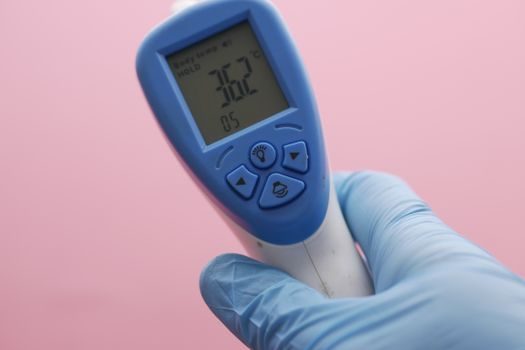
Pick a thermocouple when the measurement point is internal, submerged, inside a bearing housing, or in any environment where a wired probe can be physically installed and held in thermal equilibrium with the target; pick an infrared thermometer when the target is moving, energised, sterilised, or otherwise physically inaccessible and surface emissivity is reasonably well known. The reference frame in our thermocouple selection guide and the infrared thermometer selection guide walk through probe-style versus optical-style trade-offs in more detail. [S1]
For bearing and winding monitoring where the sensor is permanently installed, a Pt100 RTD or sheathed thermocouple is the standard fit — see the RTD-versus-thermocouple comparison at Pt100 RTD response time vs thermocouples and thermistors. For moving webs, molten metal surfaces, or live electrical busbars, IR is the only safe option; an infrared level meter uses a closely related optical principle for non-contact level sensing.
Side-by-Side Comparison Against Four Decision Criteria
On contact requirement, thermocouples must touch the target; infrared thermometers never do — a hard binary driven by sensing physics [S4]. On measurement zone, a thermocouple averages over its physical junction footprint; an IR device averages over a distance-dependent spot — Omega's dual-laser 75:1 narrow-field unit is a typical example of a tightly defined spot, while wider-field units are available for bulk targets [S2].
On upper temperature, standard K-type thermocouples reach roughly 1260°C in oxidising service and higher in noble-metal types, well beyond the 550–2200°C span of most handheld IR units — the OS540 series is rated –30 to 550°C, while higher-end industrial IR pyrometers extend further [S2]. On environment, thermocouples tolerate immersion, vacuum, and corrosive fluids inside a sheath; IR tolerates dust, vapour, and steam only when the optical path is clean and the emissivity assumption still holds. Dual-instrument housings such as the PCE-894 effectively let a technician carry both options on one body [S3].
Use Cases and Industry-Specific Patterns

Process plants specify K-type sheathed thermocouples in thermowells for reactor and pipework temperature loops, and use handheld IR for quick scans of motor housings, switchgear, and bearings during predictive rounds [S1][S4]. The Tecpel DIT-515K — described by the vendor as containing "2 most reliable" temperature-measurement methods in a single mobile unit — illustrates how the same technician can use IR for a fast scan and a K-type TPK-03 probe for a confirmatory contact reading [S1].
Validation and sterilisation lines favour fixed thermocouple probes routed through the load, with portable IR used only for spot checks of exterior surfaces; a more detailed walkthrough is in selecting temperature recorders for validated steam sterilization lines. HVAC, electrical inspection, and food-service work lean heavily on handheld IR for speed and non-contact safety, often with dual-laser aiming to reduce operator error [S3].
Limits, Failure Modes, and Common Misreadings
The classic IR failure mode is the wrong emissivity: a polished metal surface measured with a 0.95 default will read low, sometimes by tens of degrees, and field correction is the only remedy. The classic thermocouple failure mode is the open or shorted junction, leading to an off-scale low or room-temperature reading; periodic replacement and sheath inspection are standard practice [S4].
Steam, dust, oil films, and even a thin layer of condensation will distort an IR reading; a thermocouple immersed in the same stream will read correctly but may drift over time due to sheath corrosion or contamination. For non-contact level measurement in similar harsh conditions, the infrared level meter family uses comparable optical principles with target-specific optics. The dual-instrument approach — IR for scan, thermocouple for confirm — is the most common engineering defence against either class of error [S1][S5].
Standards, Safety, and Buying-Checklist References
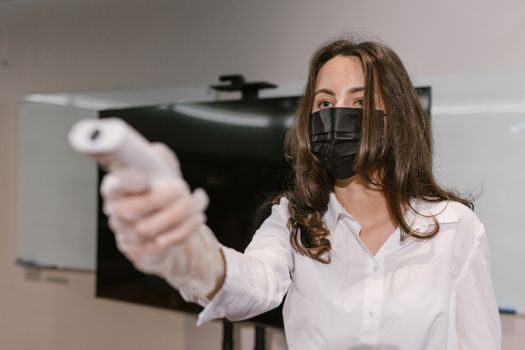
Industrial thermocouple installations are commonly specified against ANSI/ISA MC 96.1 / IEC 60584 tolerance classes, while infrared thermometer optical performance is typically described using D:S ratio, spectral band, and emissivity range rather than a single harmonised test standard; portable units with laser aiming are usually classified under the same laser-safety regime as alignment lasers. Hazardous-area deployments add ATEX/IECEx markings and ingress protection class — the same selection logic that applies to pressure transmitters in flammable-service skids. [S2]
For broader plant-instrument selection beyond temperature, the pressure transmitter buying guide 2026 and the wastewater flow meter selection guide follow the same match-the-physics-to-the-process discipline applied here. Next signal to watch: the June 2026 catalogue refresh on DirectIndustry lists 58 thermocouple-thermometer manufacturers with 142 products, and the handheld IR category is broadening with Bluetooth-equipped models — both numbers are worth re-checking on the next quarterly supplier update [S2][S3].