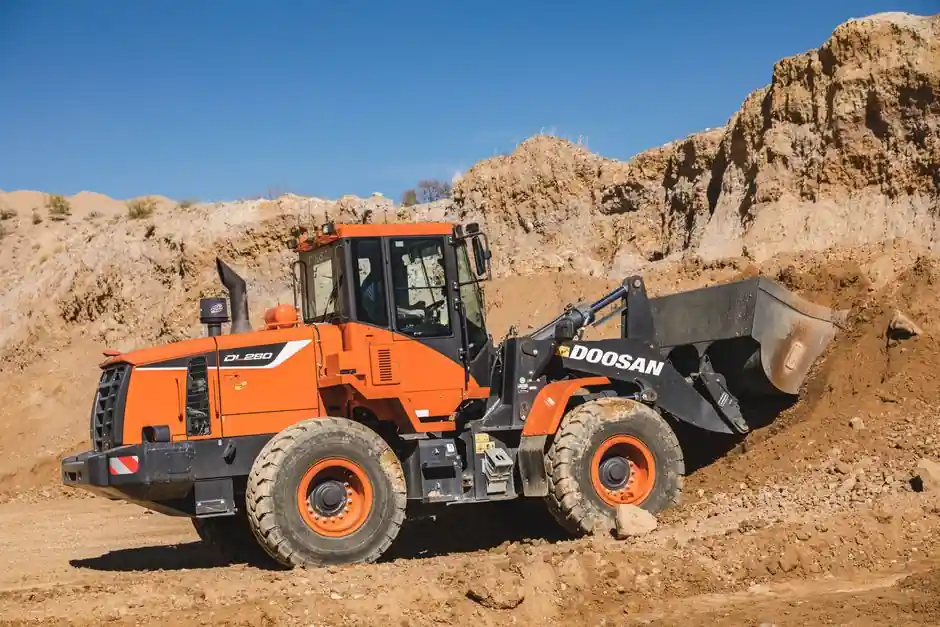
A wheel loader RFQ for a material handling line must resolve five decisions before any price is quoted: size class, linkage type, bucket vs attachment, hydraulic flow, and duty cycle, because each of these drives the machine's operating weight, engine power, and ultimately its cost.
The baseline document structure follows a standard Request for Quote pattern: basic information, bid submission process, delivery point, and FOB terms, exactly as municipal buyers use when issuing a wheel loader tender [S2]. A municipal spec sheet for a 2022 tender to the Town of Swan River shows how lean an RFQ can be: reference number, issuing organization, delivery point at 440 Valley Road, and FOB destination, with no technical line items filled in by the buyer, which is exactly why vague RFQs produce requote cycles.
Size Class and Operating Weight
Wheel loaders are commonly split into three size bands, and the band you write on the RFQ line determines engine power, bucket capacity, and maneuverability before any other spec is read [S4]. Compact wheel loaders are built for landscaping, small construction sites, and agricultural work in limited spaces. Midsized models balance mobility and lifting for medium-duty earthmoving and material handling tasks. Large wheel loaders are designed for quarries, mines, and large-scale infrastructure projects, with reduced mobility but higher horsepower, reach, and bucket capacity [S4].
For a material handling line that feeds palletized goods, packaged block, or bulk aggregate into a fixed conveyor or loader, the mid-size class is the typical default. A buyer should write the target operating weight range and the maximum single-pass payload, not just the model name, since vendors will substitute differently rated machines inside the same nameplate if the envelope is left open.
Linkage Type: Z-bar vs Parallel-lift Tool Carrier
Linkage geometry is the single most consequential line on the spec, and it should be called out explicitly because factory conversion between the two is not generally feasible once the machine ships [S1]. Standard wheel loaders use a Z-bar linkage that places the hydraulic cylinder directly in the center of the operator's field of vision, and that geometry delivers greater bucket breakout force with fewer moving parts to maintain. Parallel-lift tool carriers use an in-line linkage that improves down visibility and keeps the load level as it rises, which is the working profile you want for pallet forks and clamp work [S1].
The decision rule from the field is simple: if the machine will dig into piles and load trucks more than 50 percent of the time, a Z-bar wheel loader is the right call for the additional breakout force and reach into high-sided trucks. If the cycle is 60 to 70 percent pallet loading, unloading, and movement, a tool carrier is the better pick because the operator can see the forks and the truck bed, and the load stays level through the lift [S1]. Writing a generic "wheel loader" line and letting the dealer choose is the most common cause of mis-sized machines on handling lines.
Bucket Capacity vs Material Density

Buyers should always spec the bucket in cubic meters or cubic yards together with the bulk density of the material, because the same bucket rating behaves very differently across coal, aggregate, topsoil, and scrap [S7]. When specifying a wheel loader, buyers need to take into account the density of the material to be moved and the trucks that will be loaded, and the working payload should land inside the machine's stability envelope rather than at the raw bucket nameplate [S7].
Oversized buckets create equipment instability, so a bucket must fall within the loader's safe operating weight to protect the operator and equipment. Lift height and tipping load tell you how high the bucket can reach and how much weight the machine can carry before losing stability [S4]. If the spec only quotes nominal bucket volume and skips density, vendors will either bid the largest legal bucket (oversized, unsafe) or default to a smaller one (under-utilized) to stay inside their own stability margin, and either path triggers a requote.
Engine Power and Hydraulic Flow
Engine horsepower and hydraulic flow are two separate lines, and they should not be combined on the RFQ. Horsepower determines how effectively the loader can lift heavy loads, operate attachments, and perform over long days, with too little power leaving the equipment unable to perform adequately or safely with the necessary attachments [S4]. Standard-flow hydraulics handle basic wheel loader attachments, while high-flow systems are essential for demanding work like snow blowing, mulching, and rotating grapples [S4].
For dedicated handling lines that swap between forks, buckets, and clamps, write the hydraulic flow requirement in liters per minute or gallons per minute at a stated pressure, then list every attachment that must run off that circuit. Specialized hi-rail and material-handler loaders in the rail market use pressure-compensated, load-sensing hydraulics comparable to European knuckle-boom crane standards, a benchmark that conventional wheel loaders do not match out of the box, so the RFQ should say which hydraulic architecture is acceptable [S5].
Attachments and Quick-Coupler Interface
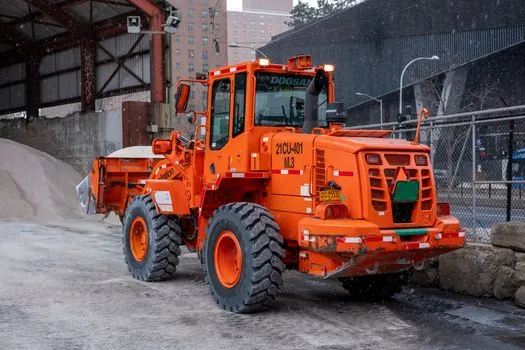
The attachment list drives both the coupler spec and the hydraulic auxiliary circuit spec, and these two should be written as a pair. Wheel loaders can be configured with a permanently fixed bucket, or with quick-change attachments for forks, grapples, clamps, and buckets, and operators can adjust the load position in mid-air during operation, optimizing the use of material weight to improve overall efficiency [S3]. On a handling line, common attachments include pallet forks, block clamps, log grapples, slag buckets, and waste-handling booms, so the coupler must accept the ISO-style interface the operation already runs.
Buyers should list the attachments they need by name, describe the work each is expected to perform, and account for the density of the material to be moved and the trucks that will be loaded. A blank "various attachments" line forces the dealer to assume the worst-case hydraulic demand and price it in.
Duty Cycle, Site Constraints, and Documentation
Site constraints belong on the RFQ even though they look like logistics: aisle width, door height, surface type (concrete, asphalt, compacted gravel), ambient temperature range, and dust or corrosive atmospheres all swing the recommendation. Wheel loaders are wheeled machines, so they offer good maneuverability on roads and do not cause damage to asphalt or concrete surfaces, but tracked loaders are still preferred on soft, uneven terrain such as muddy or rugged surfaces [S3]. A handler working inside a covered warehouse with limited overhead clearance is a different spec from a quarry loader, and conflating them in the RFQ produces an unusable bid.
Documentation should also be explicit: required operator manuals and parts books, training scope, in-service orientation commitment (vendors like CTE always try to go to the field once the trucks are delivered for an in-service orientation, ensuring operators have firsthand contact with the company and safe operation of the equipment [S5]), warranty terms, and delivery date. Standard public-sector RFQs close inside 21 days of publication, with a single physical bid submission deadline and no online question channel, so the buyer's spec must be complete on day one or the bid will reflect the dealer's assumptions, not the operation's needs [S2].
Common RFQ Mistakes That Force Requote Cycles
Three mistakes show up across nearly every failed wheel loader RFQ on a handling line. First, leaving the linkage type open, which lets the dealer pick Z-bar by default even when pallet work dominates the cycle [S1]. Second, quoting bucket capacity without material density or target payload, which makes the safety margin unreviewable until the machine is on site [S7]. Third, omitting hydraulic flow and pressure, which forces a standard-flow bid and a later retrofit when the high-flow attachment is added [S4].
A useful cross-reference for buyers writing similar spec sheets on other heavy equipment is the fettling grinder RFQ line-by-line spec, which uses the same logic of writing each operating parameter with its units and tolerance rather than as a model name. For a buyer also responsible for adjacent site safety, the emergency stop button buying guide covers the control-side hardware that often ships alongside a new loader. Floor marking and area delineation around the loader path can be cross-checked against the warning tape selection guide when the RFQ expands to cover the full handling bay.
The next trackable signal is the closing-date math: with a 21-day public-sector window from publication to bid close, the spec draft, internal review, and publication must be locked three to four weeks before delivery is needed, and any addition of an attachment mid-cycle should trigger a written addendum, not a phone clarification, to keep the bid pool comparable [S2].
The underlying component specifications are covered under wheel loader.