
EN ISO 13850 and IEC 60947-5-5 are the two standards buyers should anchor an E-Stop purchase on in 2026, with most machinery applications realistically requiring PLd per ISO 13849-1 or SIL 2 per IEC 62061 [S7][S8].
An emergency stop is a complementary protective measure under ISO 12100, not a substitute for guards, interlocks, or light curtains, so the right button choice depends on the hazard category of the host machine, the surrounding environment, and the required safety performance level [S6][S4].
What an E-Stop Must Do, and What It Is Not For
An emergency stop is defined as a manually triggered, latching function that brings a machine to a safe stop in the shortest time reasonably possible, and that requires a separate manual reset before the machine can restart [S4][S10]. The actuator must be a red mushroom-head button on a yellow background, must be easy to reach from the operator's normal working position, and must remain latched in the actuated position until deliberately released by either a twist, pull, or keyed action [S4]. Typical operating force sits in the 50-70 N range, with industrial-grade units rated for over 1,000,000 mechanical cycles at contact ratings of 10 A resistive and 6 A inductive across 24 V DC to 600 V AC [S2].
An E-Stop is not a normal stop, not a maintenance disconnect, and not a primary safeguard. ISO 12100 treats it as a complementary protective measure that reduces harm once a hazard has already occurred, which is why the same standard requires the function to be triggered by a single human action, override all other commands, and remain effective at all times [S6]. If the buyer is looking for energy-isolating lockout for servicing, the correct device is a padlockable disconnect switch, not a mushroom button.
Category 0 vs Category 1 Stop: Pick Before You Pick a Vendor
Stop category 0 is uncontrolled immediate removal of power, typically realised by contactors opening the motor feed so the drive coasts to a stop, while category 1 is a controlled stop where the drive is first commanded to ramp down (often via SS1 or STO on a servo or VFD) and only then has power removed by contactors [S4][S7]. The category is selected at the risk-assessment stage under ISO 12100 and ISO 13849-1, not at the parts list, because a category 1 stop on a vertical axis without a holding brake is a known recipe for a load-drop hazard [S4].
For most conveyors, packaging machines, and pumps, category 0 with two contactors in series gives PLd/SIL 2 and is the cheapest correct answer, whereas for high-inertia rotating equipment, presses, and robots a category 1 controlled stop driven by the safety controller is the engineering baseline [S4][S7]. Buyers who try to standardise on a single category across an entire plant tend to overspend on simple lines and underspecify the dangerous ones.
Mechanical Form Factors: Panel, Cable-Pull, Foot, and Enabling
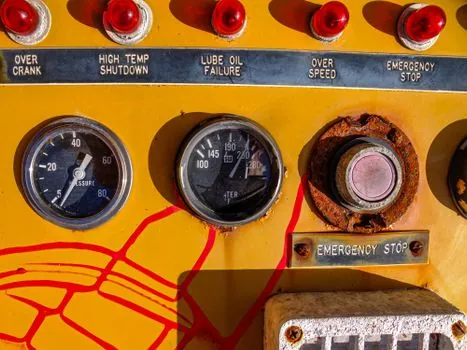
Panel-mount mushroom buttons in 22.5 mm or 30.5 mm cut-outs remain the workhorse form factor, offered in plastic (typically PBT or polyamide, self-extinguishing) or AISI 316 stainless steel for hygienic and outdoor duty, with optional 1NC, 2NC, 3NC, or 2NC+1NO contact blocks using positive (forced) opening per IEC 60947-5-1 [S2][S5]. Cable-pull E-Stops are specified on long conveyors where the operator may be anywhere along the line; a single pull anywhere on the cable must latch the system, and the cable tension window is typically a few hundred newtons depending on the model [S3].
Foot-operated and three-position enabling devices are not substitutes for an E-Stop; a foot switch is a normal start/stop, and an enabling device is a hold-to-run for teach-mode robot work where the operator must be inside the safeguarded space [S3][S6]. Buyers should treat these as separate product lines and not blur them into the same parts catalogue search.
Environment and Sealing: IP65 vs IP67 vs IP69K
Ingress protection is decided by the washdown, dust, and chemical exposure on the line, not by the E-Stop datasheet's headline rating. General factory panels typically need IP65 at the panel face, food, beverage, and pharmaceutical lines with daily CIP/SIP washdown need IP67 minimum and usually IP69K on the operator face, and outdoor or marine sites need UV-stable housing and IP66/IP67 with stainless steel hardware [S5][S2].
IP69K specifically means resistance to close-range high-pressure, high-temperature jet spray (typically 80-100 bar, 80 °C water) and is the rating buyers should demand for hygienic zones, not just IP67 [S5]. Impact resistance matters as well: IK07 to IK08 is the typical mechanical-impact band, and AISI 316 with mirror polishing (Ra4 or better) is the de facto choice in pharmaceutical and dairy cleanrooms [S5].
Material and Contact Selection: Plastic vs Stainless vs Metal

Plastic E-Stops using self-extinguishing PBT or polyamide suit most chemical labs and wet areas, weigh less, and cost the least; metal-housed versions in stainless or nickel-plated brass suit heavy machinery and high-vibration environments where impact and heat are the dominant failure modes [S2][S5]. For hazardous-area (potentially explosive atmosphere) sites, an ATEX/IECEx-certified E-Stop with the same red/yellow colour scheme and PLd/SIL 2 is mandatory, and the certification number on the body must match the zone rating on the datasheet [S5][S8].
Contact configuration should be chosen on safety logic, not on habit. A single NC contact can only achieve up to PLc under ISO 13849-1, while two NC contacts monitored by a safety relay or safety PLC routinely reach PLd or PLe depending on the diagnostic coverage and contactor choice [S4][S7]. An NO auxiliary contact is useful as a status signal to the PLC but must never carry the safety function on its own.
Electrical Ratings, Wiring, and Safety Relay Integration
Industrial E-Stop contact blocks are typically rated 24-690 V AC/DC at up to 10 A, with forced (positive) opening per IEC 60947-5-1 to guarantee that the contacts cannot weld shut under fault current [S5]. The wiring must land on a safety relay, a safety PLC (e.g. Siemens SIMATIC F-CPU, Allen-Bradley GuardLogix), or a redundant contactor pair; tying E-Stop contacts into a standard PLC digital input without a safety-rated evaluation device drops the achievable PL back to PLc and is a common audit finding [S4][S7].
For higher PL levels, the loop must include cross-fault monitoring and a dedicated reset button, since automatic reset after E-Stop is not permitted under ISO 13850 when the operator may not be in a position to confirm the safe state [S4][S10]. Standard practice is one reset button per control station, mounted outside the hazard zone, and a separate acknowledgement lamp on the HMI.
Placement, Compliance, and the Buyer Checklist

Placement rules under EN ISO 13850 and IEC 60204-1 require the E-Stop to be reachable from every normal operating position without reaching past a hazard, and additional stations are required where the machine is long (typical spacing around 10-20 m for conveyors), where multiple operators share a cell, or where a guard door can isolate the operator from the original E-Stop [S4][S10]. For conveyor applications, complementary pull-cord E-Stops are typically the second layer, not a replacement [S3].
The buyer shortlist logic for 2026 is straightforward: (1) confirm stop category from the risk assessment, (2) fix the required PL/SIL, (3) match the IP and material to the environment, (4) select 2NC positive-opening contacts plus a safety relay, (5) verify the E-Stop carries EN ISO 13850 and IEC 60947-5-5 markings and, for explosive atmospheres, a valid ATEX/IECEx certificate. Buyers who skip the risk-assessment step and start at the parts catalogue almost always overpay for category 1 hardware on simple lines and under-specify category 0 contactors on dangerous ones. Related downstream considerations, like warning-tape substrate choice around the guarded cell, are covered separately in this chemical plant warning tape spec map, and the broader operator-PPE chain including respirator fit and filter class for the same shift is mapped in this respirator buying guide. For background reading on how E-Stop integration sits inside wider factory electrical builds, the industrial barcode scanner selection guide covers adjacent control-panel spec logic in 2026.
The underlying component specifications are covered under emergency stop, emergency stop button, and linear guide.