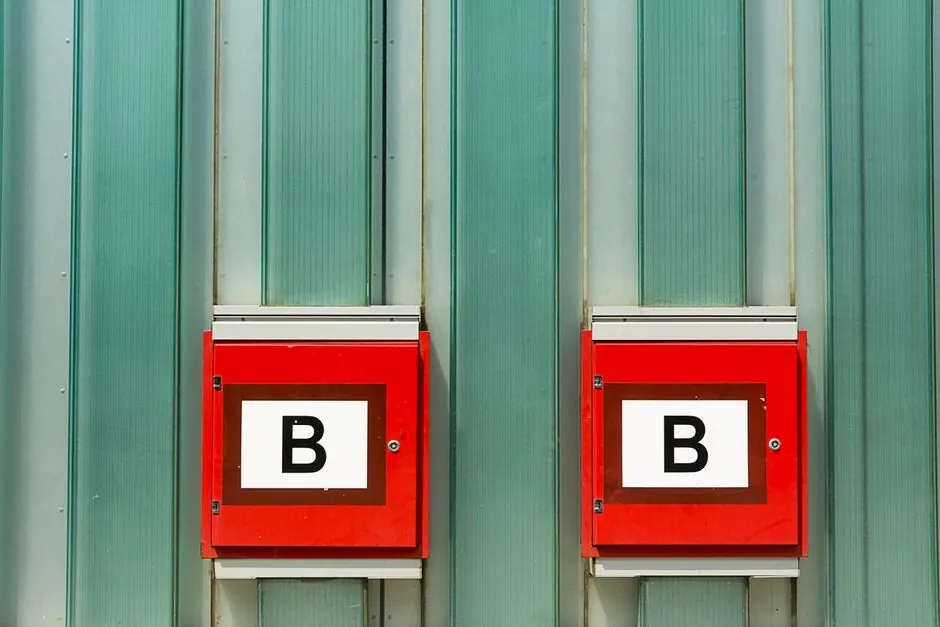
A UL-listed portable extinguisher carries a code such as 2-A:10-B:C, and every letter-plus-number segment on that nameplate is a direct, traceable result of a single document: UL 711, "Rating and Fire Testing of Fire Extinguishers," currently published as Edition 8 (2018) [S2].
Class A ratings scale with the size of a standardized wood crib the unit can extinguish, and Class B ratings scale with the surface area of a square n-heptane pan fire, while the Class C suffix is a pass/fail dielectric test, not a capacity number [S1][S2][S3]. The system is referenced directly by NFPA 10 for minimum extinguisher sizing by hazard class and travel distance [S3][S4].
Class A test fires: wood cribs, not panels of lumber
Class A rating wood-crib fires are built from dry lumber in two standard stick geometries, 1½ in × 1½ in (38 mm × 38 mm) or 1½ in × 3½ in (38 mm × 89 mm), stacked into cribs whose length and stick count scale with the rating the manufacturer is targeting [S4].
For example, a 3-A rated extinguisher must extinguish a crib of 144 sticks of 1½ in × 1½ in × 29 in lumber under the UL 711 protocol [S4]. The 1-A step corresponds to roughly 1¼ gallons of water equivalent on a Class A fuel package, 2-A to about 2½ gallons, and 4-A to roughly 5 gallons, with the scale running 1-A through 40-A on the highest-capacity portable units [S3]. Supplemental wood-panel and excelsior fires are run alongside the crib to confirm the unit holds up across the Class A fuel mix, not just one geometry [S3]. The Class A number on a nameplate is therefore a water-equivalent capacity number, not a unit weight in pounds.
Class B test fires: square n-heptane pans with a defined attack pattern
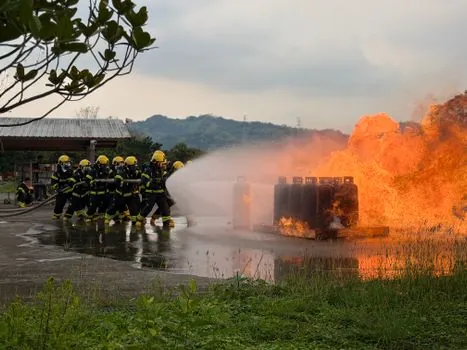
Class B ratings come from liquid fuel fires in square steel pans at least 8 in deep, with a 2 in layer of n-heptane (a gasoline surrogate) and a defined operator attack pattern that must extinguish the fire inside a set time window, repeated by multiple operators to confirm repeatability [S3][S8].
The Class B number on the label is the square footage of heptane fire a non-expert operator can put out with the unit, so a 10-B is a 10 ft² pan, a 40-B is a 40 ft² pan, and an 80-B is an 80 ft² pan, with the certified test fires sized larger than the consumer rating to absorb operator variability [S3]. A concrete worked example from the NFPA technical blog: a 10-B rated extinguisher must extinguish a fire of 31 gallons of heptane in a 25 ft² square steel pan, more than 2× the labeled square footage, which is why end users should not assume the rating equals the worst-case fuel area they will face [S4]. Class B fuels explicitly include gasoline, diesel, oils, greases, tars, solvents, lacquers, alcohols, and flammable gases, and Class B extinguishers are required anywhere those fuels are dispensed, transferred, or stored [S4][S7].
Class C, D, K suffixes: what the letters really mean
Class C ratings have no numerical component; they are a pass/fail dielectric test confirming the agent is non-conductive and safe to apply to energized electrical equipment, which is why the C is appended to a Class A or Class B rating rather than standing alone [S3][S4][S7]. This behavior is consistent with how portable extinguishers are designed and listed across the industry, where the C suffix is an electrical-safety overlay on top of an existing fuel-class capacity number. Class D covers combustible metals (magnesium, titanium, zirconium, sodium, lithium, potassium) and Class K covers cooking-media fires (vegetable or animal oils and fats) [S4]. Class K and the related residential-cooking test are governed separately by UL 711A (issued 21 July 2005 for portable hand-held extinguishers intended for residential cooking equipment) rather than the main UL 711 wood-crib / heptane-pan protocol [S5]. The dual-listed UL 711 / ULC-S508 standard is the joint U.S. and Canadian basis used for code-compliant extinguishers crossing the border [S6].
Selection criteria by hazard and minimum unit size
UL 711 ratings, not unit weight, drive extinguisher selection under NFPA 10, so the right starting point is the hazard classification (light, ordinary, extra) and the maximum travel distance to the nearest unit [S3][S4]. For light-hazard offices a 2-A:10-B:C or 3-A:40-B:C in a 5 lb ABC dry-chemical form is the typical baseline; for ordinary-hazard shops, warehouses, and mechanical rooms a 4-A:80-B:C in a 10 lb ABC is common; for high-hazard industrial and fuel-handling areas a 10-A:120-B:C in a 20 lb ABC is the typical step-up; and 10-B:C rated CO₂ units serve server rooms and electronics bays where clean agent and zero residue matter [S3]. For commercial vehicles, including placarded and non-placarded trucks, a 1-A:10-B:C in a 2.5 lb ABC dry-chemical is the configuration that satisfies 49 CFR §393.95 [S3]. Anyone comparing portable fire hardware against fixed systems will also want to understand the construction machinery and equipment listings, because the same rating codes show up on wheeled and skid-mounted units for site fire trucks.
Comparison of Class A vs Class B test methods under UL 711
The two main rating tracks under UL 711 are best read side by side: the test fuel, the test geometry, the operator criterion, and the meaning of the printed number are all different, which is why one extinguisher can carry both numbers at once [S3][S4].
Class A under UL 711 uses standardized wood-crib fires (1½ in × 1½ in or 1½ in × 3½ in dry lumber, calibrated moisture content, supplemental wood-panel and excelsior tests) with a water-equivalent number where 1-A ≈ 1¼ gal, 2-A ≈ 2½ gal, 4-A ≈ 5 gal, scaling 1-A through 40-A; the printed number is extinguishing capacity for an ordinary-combustible fire [S3][S4]. Class B under UL 711 uses a square steel pan at least 8 in deep, a 2 in n-heptane layer, a defined attack pattern and time window, repeated across multiple operators, with the printed number equal to the square-foot pan area the unit can handle (10-B = 10 ft², 40-B = 40 ft², 80-B = 80 ft²), and the test fire actually run in the lab is larger than the labeled area to absorb operator variability [S3][S4][S8]. The Class C suffix is neither fuel nor capacity, only a dielectric pass/fail on energized equipment [S3][S4].
Limitations, failure modes, and what the rating does not tell you
The UL 711 number is an extinguishing-capacity number, not a duration, not a discharge time, and not a re-ignition resistance rating, so a 10-B unit is not automatically a "10-minute" or "10-gallon" extinguisher [S3][S4]. A Class B test fire in the lab is a heptane pan, so the rating does not certify performance on polar solvents (alcohols, ketones), three-dimensional fuel spills, pressurized fuel leaks, or running fuel, all of which require either a different agent class (e.g. alcohol-resistant foam) or a different hazard analysis [S3][S4][S8]. A Class A test fire is a wood crib, so the rating does not directly certify performance on deep-seated smoldering combustibles (e.g. baled cotton, stacked cardboard, smoldering upholstery), which can reignite after the surface is knocked down [S3][S4]. CO₂ units carry no Class A number because CO₂ does not provide the cooling needed to prevent wood/paper reignition, so a 10-B:C CO₂ extinguisher in a server room is correct for electrical fires but is not a substitute for a Class A unit in adjacent office space [S3]. The rating is also a one-time pass at the listed pressure, agent, and hardware configuration; any field modification, refilling with non-matching agent, or use outside the listing conditions voids the UL 711 rating regardless of what the nameplate says [S1][S3].
Standards, sourcing, and traceability
Underlying test method: UL 711 Ed. 8 (2018), "Rating and Fire Testing of Fire Extinguishers" [S2]. Companion U.S./Canadian standard: UL 711 / ULC-S508 [S6]. Residential cooking test method: UL 711A (21 July 2005) [S5]. Code citations that pull these ratings into real installations: NFPA 10 for portable extinguisher selection, sizing, and placement; 49 CFR §393.95 for vehicle-carried extinguishers [S3][S4]. Certification is administered by UL Solutions (and equivalent NRTLs), and the test program covers Class A, B, C, D, and K fires as defined in UL 711 [S1][S2]. Specifiers who need to cross-check the rating against the installed hardware should also verify the unit carries the current UL listing mark and a nameplate that matches the rating code printed for the specific hazard zone [S1][S3].
8 has been the active edition since 2018 and a successor edition would shift both the wood-crib and heptane-pan test geometries), and any NFPA 10 cycle changes that re-anchor minimum Class A and Class B sizing for emerging hazards such as lithium-ion battery storage, which currently is not directly covered by the UL 711 wood-crib or heptane-pan test protocols.
Spec-level background on the components involved: checking and testing apparatus.
Background reading: Killed vs Semi-Killed vs Rimmed Carbon Steel: Deoxidation, Yield, and Selection.