For 2026 structural and heavy-equipment plate procurement, the decision between HSLA (high-strength low-alloy) and quenched & tempered (Q&T) alloy plate is set by four binding criteria: required yield strength, section thickness, low-temperature toughness, and weldability, and Q&T plate generally wins where any one of the first three is high, while HSLA wins where weldability and formability dominate [S1][S2][S4].
HSLA-65 class plate produced via Q&T routes shows the smallest property scatter in thick gauges, per a peer-reviewed comparison of HSLA plate processing routes [S4]. For buyers sourcing structural steel plate against ASTM plate specifications, the choice is therefore rarely a brand-versus-brand call: it is a heat-treatment route versus a microalloy-plus-thermomechanical route, with each route tied to a specific ASTM designation family.
Process Routes and What Each Plate Actually Is
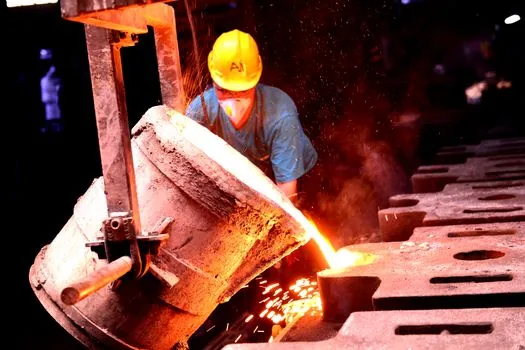
Q&T alloy plate starts with a full austenitizing soak at roughly 800–950°C, a rapid quench in water, oil, or polymer, then a sub-critical temper at 150–700°C, and the result is tempered martensite with high strength plus restored toughness [S1][S6]. The end-state microstructure is fundamentally different from a hot-rolled or normalized plate, which is why Q&T grades (ASTM A514 / T-1, A710) carry yield values that hot-rolled carbon plate cannot reach at equivalent thickness [S1][S3].
HSLA plate, by contrast, is a low-carbon (typically ≤0.20% C) steel microalloyed with Nb, V, Ti, and/or Mo, often processed by thermomechanical controlled processing (TMCP) to refine the grain and boost strength without going through a full quench [S4][S8]. A656, A572, A709, and A945 all sit in this family, and the same peer-reviewed source notes that direct-quench variants of HSLA-65 narrow property scatter in heavier plate [S4][S7]. When evaluating general steel plate options, treat HSLA as the formable, weldable baseline and Q&T as the strength-and-toughness upgrade.
Spec Range and Mechanical Property Comparison
Q&T plate grades cluster at 690–760 MPa (100–110 ksi) minimum yield, with matching tensile strength in the 760–895 MPa band and Charpy V-notch values specified at low temperatures (commonly -40°C / -46°C, sometimes -60°C for offshore and cryogenic service) [S1][S2][S3]. A514, the workhorse of this family, is qualified as a structural steel for cranes and other heavy-load machinery and is explicitly called out as suitable at low temperatures [S1]. A710, a low-carbon age-hardened Q&T grade, is selected where weldability and machinability matter alongside the strength gain, with applications including construction equipment, rail cars, truck frames, piping components, and shipbuilding [S1].
HSLA plate typically lands at 290–450 MPa (42–65 ksi) yield depending on grade, with 345 MPa (50 ksi) HSLA-65 being a common structural and line-pipe anchor; the A945 specification explicitly limits carbon and sulfur to improve weldability, formability, and toughness for welded applications [S4][S8]. Direct-quench + temper processing has been shown to give superior mechanical properties versus reheat-quench + temper in the same base composition, which is one technical reason the Q&T route is being grafted onto HSLA chemistries [S7].
The criteria-based comparison for procurement reads: Q&T wins on yield (690–760 vs 290–450 MPa), on low-temperature CVN (specified -40°C and below, vs typically ambient to -20°C for HSLA), and on through-thickness property uniformity in heavy gauges; HSLA wins on weldability (lower CE, lower carbon), on formability for brake-pressed shapes, and on cost per tonne for non-critical sections [S1][S2][S4][S8].
Standards and Designation Mapping
ASTM A514 is the dominant quenched & tempered alloy plate specification in North America, equivalent to the historical T-1 grade and used where high strength and weldability both have to coexist, with Kloeckner Metals and Trinity Products listing A514 as a primary Q&T product, alongside abrasion-resistant AR400F, AR450F, AR500F, and A829 4130/4140 [S1][S3]. ASTM A710 is the low-carbon precipitation-hardened Q&T grade used when weldability is a primary constraint [S1].
HSLA plate is covered by A572 (high-strength low-alloy structural, common 50 ksi grade), A656 (improved formability), A709 (bridge), A945 (low-carbon, restricted sulfur for welded applications), and the Canadian CSA G40.21 44W/50W/50A series [S3][S4]. The ABS / API 2H Grade 50 marine and offshore plate grades overlap with the HSLA family and are also routinely stocked alongside Q&T for shipbuilding and offshore structure work [S3]. For construction machinery and equipment builders, the practical shorthand is A514 (or AR500) for the wear-and-impact zones and A572/A656 for the chassis and boom structures.
Where Q&T Is the Right Pick
Specify Q&T when at least one of these is true: required yield is above 550 MPa (80 ksi), service temperature is below -30°C, plate thickness is above 50 mm and uniform through-thickness properties are required, or the application involves high-cycle impact (mining, crane booms, heavy haul truck bodies, structural components for offshore modules) [S1][S2][S3][S4]. AR500F in the abrasion-resistant family runs at higher hardness (~477–534 BHN range is the typical AR500 band) and is chosen for bucket liners, dump body floors, and ground-engaging tools where wear life dominates over weldability [S3].
Heavy-lift mobile crane chord members, ship hull plating in ice-class service, and rail-car structural members are the canonical A514 / A710 use cases called out by both service-center and mill literature [S1][S2][S3]. Trinity Products also bundles A514 with AR400F/AR450F/AR500F and AISI 4130/4140 (via A829) into a single "structural alloy, Q&T, high-strength and abrasion resistant" category, which is the typical inventory pattern for plate distributors serving mining and construction OEMs [S3].
Where HSLA Is the Better Fit
Specify HSLA when the priority is welding and forming, not peak strength: building columns, transmission pole structures, bridges (A709), truck frames, rail-car sidewalls, agricultural equipment, and the long bent chords of off-highway equipment where brake forming is part of the build [S3][S4][S8]. A945 specifically restricts carbon and sulfur to enable field welding without preheat in many sections, which is the technical reason it is chosen over Q&T for heavy civil welded structures [S4].
For line-pipe and offshore tubular applications the adjacent API 5L X-series grades borrow heavily from HSLA metallurgy, and the same microalloying + controlled-cooling logic that drives HSLA plate drives linepipe [S4]. The relevant takeaway for the plate buyer is that HSLA is the field-friendly default; the moment CVN at -40°C or yield above 550 MPa enters the datasheet, the conversation should shift to a Q&T grade.
Cost, Lead Time, and Fabrication Tradeoffs
Q&T plate costs more per tonne than HSLA at the same thickness because of the second heat-treat cycle, the alloy additions (Cr, Ni, Mo, B in A514), and the tighter property tolerances that drive higher mill reject rates; A514 plate availability is also thinner in the distribution channel than A572/A656, and lead time on cut-to-size A514 plate typically runs longer than on commodity HSLA [S1][S3]. Welding Q&T plate requires more discipline: preheat, controlled interpass, and often post-weld stress relief, which adds field labor that the procurement cost-per-tonne comparison does not capture [S1][S8].
HSLA plate fabricates more like mild steel: lower preheat (often none below 25–30 mm), better cold-form behavior, and the option to galvanize without the risk of hydrogen embrittlement that comes with the higher-carbon Q&T grades [S4][S8]. In construction machinery and equipment builds, that fabrication delta is often the deciding factor: chassis and boom sections in A572, wear zones and impact zones in A514 or AR500, with no preheat or PWHT on the bulk of the weldment.
Selection Rule of Thumb for 2026 Plate Orders
Default to HSLA (A572 Gr 50, A656, A945, A709, CSA G40.21) when yield ≤ 450 MPa, ambient to mild-low service, and field welding without PWHT is in scope. Switch to Q&T (A514, A710) when yield ≥ 550 MPa, CVN required at -40°C or below, or thickness above ~50 mm with tight through-thickness property scatter. Pick AR500 / AR450 / AR400F when surface wear dominates the failure mode, not bulk impact. For buyers cross-referencing rebar grade tradeoffs on the same project, the same logic applies: Q&T for high-stress or cold-service structural members, HSLA-class material for routine welded assemblies. [S3]
Next signal to watch: how the A514 and A710 stock programs at major service centers (Kloeckner, Trinity, and equivalents) read in Q4 2026, since A514 availability and lead time have been the binding constraint for heavy-equipment OEMs more often than price over the past several plate cycles [S1][S3].
For component-level specifications, see orifice plate flowmeter.