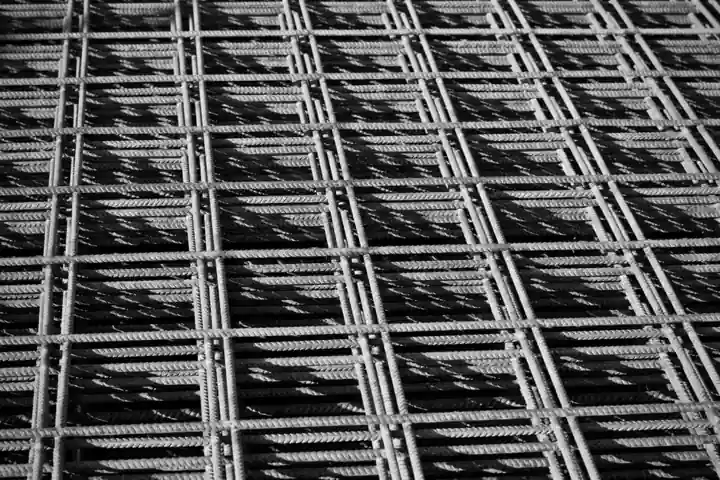
Grade 60 rebar delivers a minimum yield strength of 60,000 psi (roughly 420 MPa), Grade 75 hits 75,000 psi, and Grade 80 reaches 80,000 psi, with the grade number on a bar reading as the minimum yield strength in ksi [S2][S5].
Across North America, Grade 60 is the most commonly used rebar grade in everyday reinforced concrete, while Grade 75 and Grade 80 are specified where higher capacity allows bar-count reduction or where seismic detailing demands the tighter chemistry controls of ASTM A706 [S4][S1].
How Rebar Grade Numbers Map to Minimum Yield Strength
The grade designation equals the minimum yield strength in ksi, so Grade 60 = 60,000 psi, Grade 75 = 75,000 psi, and Grade 80 = 80,000 psi [S3]. Bar markings on the rib face confirm the grade: a single line denotes Grade 60, two lines denote Grade 75, and three lines denote Grade 80 or Grade 100, with the number of ribs separating 60 from 75 visually at the receiving dock [S5]. Yield strength is the threshold at which steel begins to permanently deform, not the point of fracture; tensile strength runs higher and is reported separately on mill certs.
For carbon-steel rebar governed by ASTM A615, Grades 40, 60, 75, and 80 have all been published at various times: A615 first listed Grades 40, 60, and 75 in 1968, then added Grade 80 in the 2009 edition, which ACI 318 adopted in its 2011 edition [S4]. Grade 75 itself was published in 1959 under ASTM A431, predating the 1963 ACI 318 acceptance of 60,000 psi yield [S4][S7].
ASTM A615 vs ASTM A706: When Grade 80 Is Allowed
ASTM A615 is the commodity carbon-steel spec used for general reinforced concrete, and ASTM A706 is the low-alloy spec with controlled chemistry, tensile-to-yield ratio, and elongation that seismic detailing requires [S1][S4]. The WSDOT Bridge Design Memo of February 14, 2012 states explicitly that "ASTM A706 Grade 60 reinforcement remains the preferred reinforcing steel type for WSDOT bridges and structures," while permitting A706 Grade 80 only under defined limits [S1].
Per the same memo, A706 Grade 80 may be used in Seismic Design Category (SDC) A for all components, but in SDC B, C, and D it is restricted: it cannot be used in elements and connections proportioned and detailed for significant inelastic deformation where moment-curvature analysis sets the plastic moment capacity, nor in oversized shafts where in-ground plastic hinging is part of the Earthquake-Resisting System, nor as transverse reinforcement resisting torsion [S1]. For seismic hooks specifically, the design yield strength fy "shall not be taken greater than 75 ksi" even when A706 Grade 80 material is supplied [S1].
Strength and Ductility Tradeoffs at Higher Grades
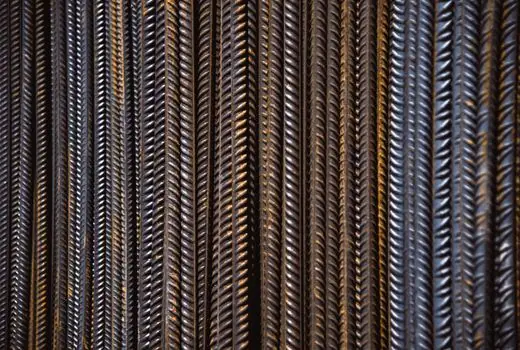
As yield strength climbs, three other mechanical properties tend to fall: tensile-to-yield strength ratio, elongation at tensile strength, and length of the yield plateau [S4]. A well-defined yield plateau is clearly visible on Grade 60 stress-strain curves; for some Grade 100 bars the curve is "round house" or continuously yielding, with fy defined by the 0.2% offset method rather than a flat plateau [S4]. That is why ACI 318 caps usable yield strength in many detailing applications and why seismic-grade rebar has to meet a minimum tensile-to-yield ratio and elongation band.
The practical effect: switching from Grade 60 to Grade 75 buys 25% more yield capacity, and Grade 80 adds another 7% on top of that, but a designer trading up must verify that ductility, splice development lengths, and hook limits are not being penalized by the higher fy in the same equation. In high-seismic regions, ACI 318 also caps usable yield for confinement reinforcement in some cases and requires the A706 chemistry/weldability package rather than the commodity A615 stock.
Selection Criteria: Pick by Element, Not by Maximum Strength
For slabs, footings, walls, and beams in low-seismic commercial work where no special ductility is required, Grade 60 A615 remains the default, and pushing to Grade 75 or 80 generally adds cost without a real design payoff [S2][S4]. For heavy foundations, bridge piers, columns, and other elements where bar congestion is the controlling limit, Grade 75 lets designers reduce bar count and improve concrete placement without leaving the standard A615 chemistry envelope [S6].
Grade 80 belongs on the spec when the project specifically calls for higher yield at plastic-hinge-adjacent capacity-protected members, or when an engineer wants the extra 7% over Grade 75 to hit a moment target on a heavily loaded member, with the caveat that A706 Grade 80 carries the SDC restrictions noted in WSDOT 03-2012 [S1]. Engineers should also remember that for capacity-protected members next to plastic hinges, the WSDOT memo fixes usable strain at 0.090 for #10 and smaller and 0.060 for #11 and larger when using the 80 ksi yield, with resistance factors of 0.90 for shear and 1.0 for bending [S1].
Cost, Availability, and Field Reality

Grade 60 dominates U.S. mill output and is what distributors stock in #3 through #18 sizes, with the largest standard bar being #18 at 2.257 in. diameter, 4.000 in² nominal area, and 13.600 lb/ft [S3]. Grade 75 is stocked by most rebar distributors serving commercial and infrastructure work but typically with longer mill lead times on non-stock sizes, and Grade 80 is generally a special order unless the project sits on an active seismic or transportation megaproject.
Material selection flows into the rebar and rebar tool decisions on site: a switch to higher-grade stock does not change the rebar cutter or rebar bender tooling, since all three grades cut and bend on standard equipment, but Grade 80 often pulls harder on bender pins and requires verified bend diameters per the project spec. Splicing methods also have to be re-evaluated; switching to a higher grade typically means re-checking rebar coupler rated strength against the new fy, because most mechanical splices are matched to a specific grade band.
Standards Reference and Decision Matrix
The relevant specs for this comparison are ASTM A615 (carbon-steel deformed bars, Grades 40/60/75/80), ASTM A706 (low-alloy deformed bars, Grades 60/80), and ACI 318 (Building Code Requirements for Structural Concrete) for the design-side limits, with AASHTO LRFD referenced for bridge work [S1][S4]. The WSDOT memo of 14 February 2012 is a public, state-level example of how a transportation authority restricts Grade 80 in seismic categories, and it is a useful template for any agency writing its own Grade 80 policy [S1].
For quick spec decisions, the matrix is straightforward: choose Grade 60 A615 as default; choose Grade 75 A615 when higher capacity reduces bar congestion in heavy foundations, piers, or columns; choose Grade 80 A706 only when the project seismic category and element type match the SDC-A or capacity-protected allowances of A706, and confirm that ACI 318, AASHTO LRFD, or the local authority does not impose a tighter cap on usable fy in the controlling limit state [S1][S4]. Engineers specifying rebar straightener throughput for higher-grade coiled stock should also confirm that the straightener can meet the tighter radius and residual-stress limits that higher-strength bars demand.
Trackable signals to watch on the next spec cycle: any revision to ACI 318 Table 20.2.2.4a on Grade 80 usage in SDC D members, and any A706 revision that changes the Grade 80 tensile-to-yield ratio floor, since both directly control whether Grade 80 can substitute for Grade 75 on a given bridge or building element. For comparison context on a parallel materials spec, see how EHS vs Common Grade Galvanized Guy Strand: Spec, Termination, and Field Tradeoffs breaks down a similar grade-vs-grade decision in another steel product category.