Hydraulic accumulators store pressurized fluid using a nitrogen gas charge, then release it on demand to dampen pulsation, absorb shock, supplement pump flow, or hold emergency reserve [S1]. The dictionary definition is blunt: "an apparatus in which gas, usually air, is used as a cushion or shock absorber in a hydraulic system" [S3]. That cushion is the entire reason selection gets contentious — pick the wrong type or precharge and the cushion either bottoms out or starves the system.
Selection in 2026 is still driven by five engineering gates: accumulator type, maximum working pressure, effective gas volume, precharge pressure ratio, and response speed. HYDAC groups its product line under hydraulic accumulators within a broader hydraulics and filtration catalogue that also covers hydraulic pumps, hydraulic motors, hydraulic cylinders, and hydraulic valves, and the same logic of matching hardware to duty cycle applies across all of them [S1]. For mobile forestry equipment, the part can be as light as 1 kg, per the Hiab 464-7976 specification, showing that small-format piston and bladder units dominate the after-market [S2].
Accumulator Types and Where Each One Fits
Three main constructions dominate the spec sheet: bladder, piston, and diaphragm [S1]. Bladder accumulators use a flexible elastomer bladder inside a forged or drawn steel shell; they are the workhorse for general industrial hydraulics, with fast response and a broad size range from roughly 0.1 L to over 50 L of gas volume. Piston accumulators use a floating piston with seals and run to the highest pressures and largest volumes, often specified where nitrogen loss must be minimized over long service intervals. Diaphragm units are the smallest, typically used for pulsation damping on pump outlets and for compact OEM builds.
For very high cycle rates on machine tool hydraulics, diaphragm designs tolerate fast cycling with minimal wear. For offshore or subsea hydraulic reservoirs where buoyancy and footprint matter, piston accumulators in larger volumes are common because they accept higher precharge stability. The trade-off is always the same: bladder gives speed, piston gives capacity and seal life, diaphragm gives size advantage. Each type pairs with a different hydraulic pump characteristic, so the choice ripples back into the upstream specification.
Precharge Pressure, Volume, and the Gas-to-Oil Ratio Rule
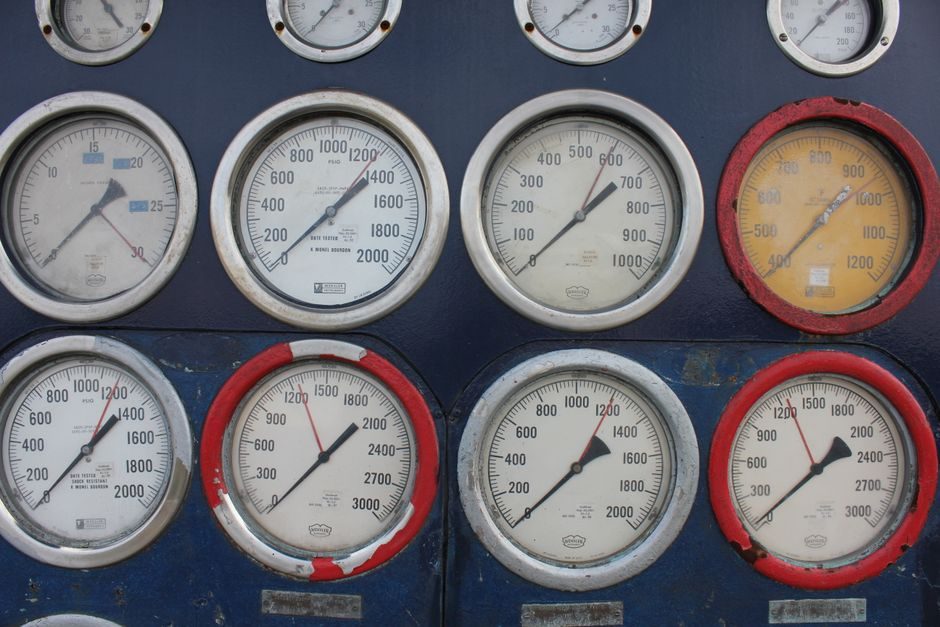
Precharge is the single most common selection error. As a general engineering rule, precharge (P0) is set at roughly 70–90% of the minimum working pressure (P1) for energy-storage duty, and well below P1 for shock-absorber or pulsation-dampener duty where the gas must never bottom out. Going outside that band either wastes stored volume or destroys the bladder on the first stroke. The gas volume V0 is sized to deliver a usable oil volume ΔV between P1 and P2 using the polytropic relation for nitrogen (n ≈ 1.4 adiabatic, 1.0 isothermal for slow discharge). [S1]
A first-pass sizing for an energy-storage circuit is ΔV ≈ V0 × P0 × (1/P1 − 1/P2) × (1/n). HYDAC lists accumulator products across pressure ratings and sizes so the engineer can match V0 and ΔV to the hydraulic actuator demand [S1]. On forestry cranes and truck loader cranes, the demand window is small but fast, which is why a 1 kg bladder or piston unit such as the Hiab 464-7976 is common in the spares catalogue [S2]. The 1 kg shipping mass is also a useful sanity check — anything that small belongs in the pulsation or emergency-brake circuit, not in a primary hydraulic power unit reservoir.
Pressure Rating, Certification, and Standards Gates
Pressure rating is non-negotiable. Industrial bladder and piston accumulators are typically PED 2014/68/EU pressure equipment for the European market and ASME BPVC Section VIII for North America, and most reputable suppliers publish a maximum allowable working pressure (MAWP) with a 4:1 or higher burst-to-working safety factor on the shell. For oil and gas duty, NACE MR0175 metallurgical limits apply to wetted parts in H₂S service, and ATEX 2014/34/EU plus IEC 60079 series govern units installed in Zone 1 or Zone 2 hazardous areas. [S1]
Selection therefore has to clear four certification gates: pressure-vessel code, hazardous-area classification, fluid compatibility, and national registration (e.g. China special-equipment list). A unit that passes PED but fails NACE is wrong for a sour-service accumulator charging skid; a unit that passes both but lacks ATEX is wrong for a refinery hydraulic power unit. Standards naming here is kept at the code level only and not pinned to a specific revision date, since revision dates change independently of product releases.
Comparison: Bladder vs Piston vs Diaphragm Across Four Selection Criteria
The three main types line up against four buyer-facing criteria as follows. Cost per litre of gas volume: diaphragm is cheapest at small sizes, bladder is mid-range, piston is most expensive once you go above 10 L. Maximum working pressure: piston units are routinely rated to 350 bar and beyond, bladder units commonly to 350 bar with specials higher, diaphragm units typically capped at about 250 bar. Response speed: diaphragm is fastest because of low moving mass, bladder is next, piston is slowest due to seal friction. Service life: piston leads on cycle count and gas retention, bladder is good with periodic gas-top-up, diaphragm is limited by elastomer fatigue and is usually treated as a sealed service item. [S1]
A useful shortlist logic: choose diaphragm for compact pulsation dampening under 250 bar and sub-4 L sizes; choose bladder for the general industrial energy-storage and emergency-stop duty from 0.1 L to 50 L at pressures up to 350 bar; choose piston for high-pressure (350 bar+), high-volume (50 L+), or long-retention service where infrequent gas checks are an operational advantage. This three-way rule is consistent with how HYDAC positions its bladder, piston, and diaphragm families in the same product group [S1]. For an existing hydraulic cylinder circuit, the accumulator type is usually already implicit in the response and pressure profile of that cylinder.
Who Should NOT Pick the Cheapest Bladder Option
Bladder accumulators are the default, and the default is wrong in several specific cases. A buyer who needs gas retention for more than 12 months between checks should not pick a standard bladder; nitrogen permeation through the elastomer will bleed precharge below the working band. A buyer with high-cycle pulsation duty above roughly 60 cycles per minute should not pick a standard bladder either, because bladder flex life becomes the limiting factor. A buyer in subsea or low-temperature duty below roughly −30 °C should not pick a standard nitrile bladder; the elastomer stiffens and crack risk rises. A buyer in food or pharmaceutical duty needs FDA-grade bladder compounds and specific surface finishes that not every line carries. [S1]
These exclusion cases are exactly where a piston or diaphragm alternative earns its premium. They are also where the hydraulic valve manifold and hydraulic motor pairing downstream must be re-examined, since changing the accumulator type changes the dynamic response of the entire loop. If the existing specification was built around a bladder's response curve, swapping in a piston without re-running the stability analysis is a known source of hunting and pressure overshoot.
Sizing, Installation, and Failure-Mode Discipline
Installation discipline is half the selection. The accumulator must be mounted as close as practical to the actuator it feeds, with a charging valve and gauge block on the gas side, a manual or automatic drain on the fluid side, and a relief valve sized to the full pump flow. The gas precharge must be checked with the system at zero fluid pressure — reading precharge while the system is pressurized gives a false value and is the most common commissioning error. A 5% precharge drop below the design P0 will already cost roughly 10–15% of effective ΔV in a typical energy-storage profile, so gas-side maintenance is a real engineering task, not paperwork. [S1]
Two common failure modes to spec against: gas-side permeation loss (spec a lower permeation bladder compound and a longer gas-retention warranty where it matters), and fluid-side contamination (spec an accumulator-compatible filtration upstream — the bladder or piston will trap particles and become a built-in strainer, which is why the broader HYDAC product line explicitly couples accumulators with filter technology [S1]). The most damaging failure mode is incorrect precharge on a shock-absorber circuit, where the gas can bottom out and the fluid冲击 the end cap; a pressure gauge on the gas side is the cheapest insurance available.
Shortlist Logic and What to Verify Before Issue
Run this gate before releasing the purchase order. Verify MAWP ≥ 1.25× the maximum system pressure with the standard 4:1 burst margin. Verify the gas volume V0 and ΔV at the actual P1/P2 duty points, not at the catalogue nominal points. Verify precharge P0 against the duty: 0.7–0.9 × Pmin for energy storage, 0.5–0.7 × system pressure for pulsation dampening. Verify PED or ASME code stamp, plus ATEX/IECEx zone rating if installed in hazardous areas, and NACE MR0175 if the fluid contains H₂S. Verify bladder compound, seal material, and fluid compatibility against the actual hydraulic fluid, not a generic mineral oil assumption. For mobile forestry and loader-crane spares, the example part 464-7976 weighs 1 kg, which signals a compact bladder or piston unit suited to the duty [S2].
Two trackable signals to watch through 2026: tightening of PED 2014/68/EU conformity-assessment modules for higher-volume units, and continued displacement of standard nitrile bladder compounds by HNBR and butyl for better gas retention in higher-temperature circuits. For a complementary view on system-level sizing, the Hydraulic Accumulator Selection for Structural Fabrication guide covers fabrication-shop duty cycles, while the Hydraulic Power Unit Selection: Pressure, Flow, and Duty-Cycle Criteria piece addresses the upstream unit that the accumulator is sized to support.