Industrial hydraulic actuators in 2026 are specified across roughly 70-350 bar working pressure bands, with bore sizes commonly 25-200 mm and force outputs from 5 kN up to more than 2,000 kN for heavy press and injection-moulding duties [S1][S3].
The 2026 buyer has to lock four decisions before quoting: actuator topology (linear cylinder vs quarter-turn rotary vane), acting mode (single-acting with return spring vs double-acting), pressure-fluid cleanliness class (NAS 1638 / ISO 4406 18/16/13 to 21/19/16 is the typical envelope), and hazardous-area certification where petrochemical, mining or marine service demands it. Skipping any one of those is how actuators end up oversized, undersized or rejected by the end client's QA team.
Definition, Topology and Where Hydraulic Actuators Sit in a Loop
A hydraulic actuator is a fluid-power device that converts pump-supplied pressure energy into linear force-and-stroke (cylinder) or rotary torque (vane / rack-and-piston) work, returning fluid through a directional-control valve to tank [S2]. The force law for a double-acting cylinder is F = p · A on the bore side and F = p · A − p_rod · A_rod on the rod side, while a single-acting spring-return unit holds the piston at its initial position until applied pressure overcomes spring preload, after which displacement grows linearly until stroke is reached [S3].
Linear hydraulic actuators are conceptually simple: pressure on a piston drives motion in one direction, with the rod end either spring-returned (single-acting) or pressure-driven in reverse (double-acting), as Mackereth's standard textbook phrasing puts it [S2]. Rotary hydraulic actuators — typically vane-type for 90° or 270° quarter-turn service, or rack-and-piston helical designs for higher torque — follow the same F = p·A logic on a curved or rack-driven piston face.
Selection Criteria: Pressure, Bore, Rod, Mounting and Stroke
For linear service the spec chain is: required working force F (kN) → bore area A = F / (p · η_mech) → standard bore from the 25/32/40/50/63/80/100/125/160/200 mm ladder → rod diameter at 0.5-0.7 × bore for double-rod-class buckling safety → stroke from the machine kinematics, then cushion length at 10-20% of stroke for high-cycle duty. Common industrial pressures sit at 160 bar (machine-tool clamp), 210 bar (mobile), 250 bar (injection moulding clamp) and 350 bar (heavy press); going above 350 bar usually means a custom cylinder. [S1]
Rotary vane actuators in process-valve duty are sized in Nm at a stated supply pressure — a 250 bar unit with 50 cm² vane area on a 100 mm swing radius delivers roughly 1,250 Nm theoretical, derate to ~1,000 Nm after seal friction. For higher torque per envelope, rack-and-piston helical rotary actuators out-pull vane units by 3-5× at the same pressure because piston area is multiple times the vane area.
Single-Acting vs Double-Acting: When Spring Return Is the Right Call
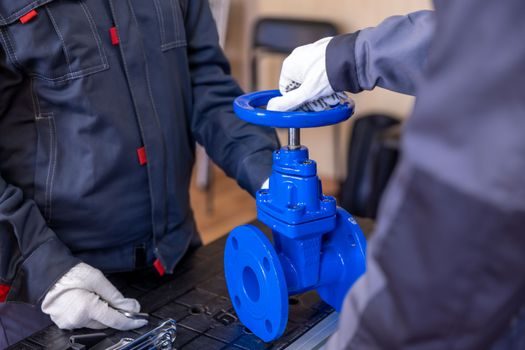
Single-acting spring-return actuators are the right call when the process demands fail-safe return to a known position on loss of supply pressure — typical in ESD (emergency shutdown) gate-valve duty on oil & gas pipelines, where the spring strokes the valve closed if hydraulic power fails [S3]. They are mechanically simpler, cheaper and easier to certify because there is no rod-side porting to leak, but stroke is limited (typically 50-150 mm) by the uncompressed-to-compressed spring length.
Double-acting actuators give you full force in both directions, longer strokes (up to 2,000 mm in industrial tie-rod cylinders) and tighter position control with servo or proportional valves, at the cost of needing a 4/3-way directional valve and a position sensor if you want closed-loop accuracy. For servo-driven press and injection-moulding clamp lines, the four-pressure-driven double-acting cartridge-valve topology is now the default simulation primitive in mainstream fluid-power libraries [S1].
Hydraulic actuators live or die by fluid cleanliness. The realistic 2026 envelope for industrial mobile and stationary service is ISO 4406 18/16/13 (equivalent to NAS 1638 class 7) for general machine duty and 16/14/11 (NAS 6) for servo systems, with finer targets quoted by aerospace and subsea OEMs. Barrel material is typically honed seamless carbon steel (ST 52.3 / E355 +N) with a Ra ≤ 0.4 µm bore finish, or hard-chrome plated rod in 17-4PH / 316L for corrosive service; piston seals are usually a PTFE-based composite or polyurethane, with nitrile backup at temperatures below 100 °C and Viton/FKM above. [S2]
Specifiers running actuator units in chemically aggressive or salt-laden atmospheres should also price a stainless rod upgrade early — the stainless steel cost picture for 2026 makes the rod upgrade a known line item rather than a mid-project surprise. Likewise, where weight matters (mobile crane booms, aerospace ground support) the alloy steel vs aluminium alloy trade-off governs end-cap and clevis material choice, and titanium actuator bodies are still a 4-8× premium over aluminium.
Hazardous-Area Certification: ATEX, IECEx and the Zone Question
Where the actuator sits on a valve in a Zone 1 or Zone 2 hazardous area, the whole assembly has to carry ATEX 2014/34/EU (EU) or IECEx (rest of world) marking, and the solenoid/positioner enclosure is usually Ex d IIB T4 or Ex ia IIC T6 depending on gas group and temperature class. The actuator body itself is typically non-electrical and falls outside the ATEX equipment scope, but the integrated solenoid, LVDT and junction box drag the whole unit into certification. [S3]
For buyers in process plants, a useful 2026 rule of thumb is: if the actuator is a stand-alone hydraulic cylinder in a non-classified area with no integrated electrics, you do not need ATEX/IECEx on the actuator; if it carries solenoids or position feedback, the integrator (not the cylinder maker) carries the certification scope. Verify with the certification body's notified-body number on the actuator nameplate rather than relying on a vendor's "ATEX-ready" sales claim.
Comparison of Common Hydraulic Actuator Types
Across the four most common 2026 industrial types — single-acting spring-return cylinder, double-acting tie-rod cylinder, rotary vane actuator, rack-and-piston rotary actuator — the decision pivots on four criteria: force/torque density, fail-safe behaviour, stroke or rotation envelope, and unit cost per kN. [S1]
Single-acting spring-return cylinders are cheap (baseline) and inherently fail-safe, but stroke tops out around 100-150 mm; double-acting tie-rod cylinders cost 30-50% more for the same bore but give 1,500-2,000 mm strokes and bidirectional force. Rotary vane units are the cheapest way to get 90° quarter-turn torque up to ~2,000 Nm at 210 bar, while rack-and-piston rotary actuators cost 2-3× a vane unit but deliver 3-5× the torque in the same envelope and tolerate pressures up to 350 bar.
Common Failure Modes and How to Spec Against Them

The four most common 2026 warranty claims on hydraulic actuators are: (1) rod-seal blow-by from contaminated fluid or side-load-induced rod scoring, (2) internal leakage past worn piston seals after 50,000-100,000 cycles, (3) end-cap thread fatigue on tie-rod cylinders at high cycle rate, and (4) cushion-valve adjustment drift causing water-hammer spikes above 1.5× working pressure. Each one is addressable at spec time — specify NAS 6 cleanliness, derate side load to ≤ 5% of bore pressure force, use fatigue-rated tie-rod material (grade 10.9 or higher), and lock cushion valves with thread-locker after commissioning. [S2]
A useful internal reference is our hydraulic cylinder design notes for bore-to-rod ratio and buckling limits, and the broader hydraulic actuator entry for actuator-vs-motor-vs-pump system partitioning. Where the actuator drives a rotary load, the hydraulic motor page covers the speed/torque envelope that distinguishes an actuator from a continuous-rotation motor.
Standards, Sourcing and 2026 Lead-Time Reality
The governing standards for industrial hydraulic actuators in 2026 remain ISO 6020 (tie-rod cylinders), ISO 6022 (mill-duty cylinders), ASME B30 (mobile), and for servo/precision duty, ISO 10100. Material traceability falls under EN 10204 3.1, with 3.2 required for nuclear and most offshore. For process plants, API 6D and API 6FA fire-test requirements cascade down to valve-mounted actuators on hydrocarbon service. [S3]
2026 sourcing reality: catalogue tie-rod cylinders in 25-100 mm bore are 4-6 weeks ex-works Asia and 8-12 weeks ex-Europe; large-bore (160-200 mm) or custom-stroke units are 14-20 weeks. For non-standard alloys, expect a nickel-alloy surcharge per the 2026 bands on top of actuator base price. The cleanest 2026 buying move is to lock bore, stroke, pressure, mount type, fluid cleanliness class and certification in the RFQ, and reject any quote that comes back without all six.