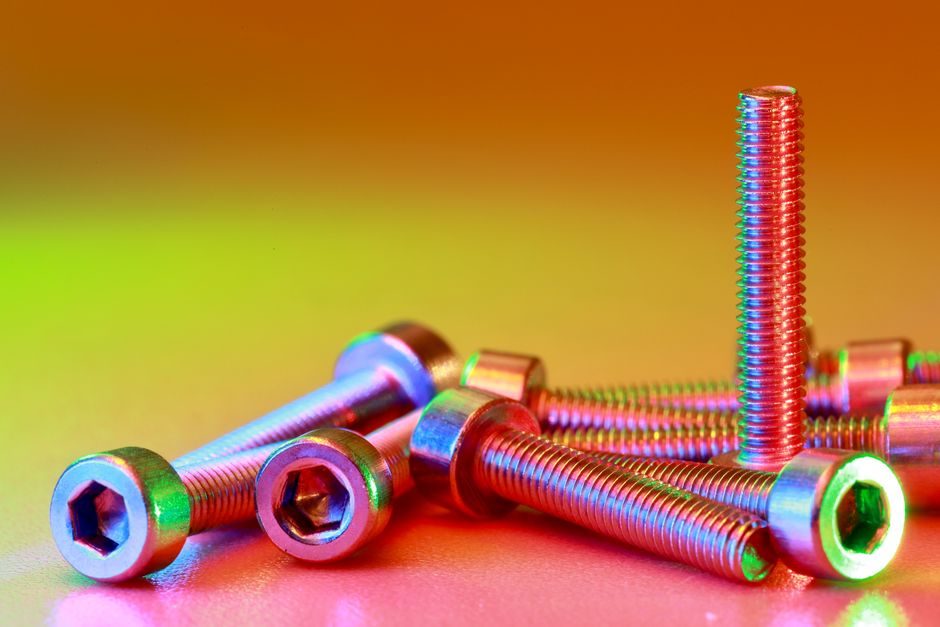
For a tensile-strength band of 200–1400 MPa, titanium alloys and alloy steels are direct substitutes on paper, but their effective specific strength, corrosion envelope and unit cost sit in different tiers — titanium at roughly 4.5 g/cm³ versus alloy steel near 7.85 g/cm³, with TiN surface nitriding pushing titanium surface hardness to 900–1100 HV0.05 [S3].
The engineering question in 2026 is no longer "which is stronger" but "where does each material buy its performance back" — and the answer hinges on density-driven mass budgets, chloride exposure, and the cost of hot work and surface engineering. The same high-tensile envelope is reachable both ways, but the bills for machining, forging windows, and corrosion mitigation are not comparable.
Density, Specific Strength and the Weight-Driven Case
Titanium alloys run at roughly 4.5 g/cm³ versus alloy steel at 7.85 g/cm³, so a Ti Grade 5 (Ti-6Al-4V) part at ~900 MPa tensile delivers almost twice the specific strength of a 4140 quenched-and-tempered part of the same rating [S3]. For aerospace, racing, marine hardware and any rotating component, that density gap is the dominant selection lever.
Alloy steel only catches up on raw strength-per-dollar and on hardenability through the full section. Where mass is on the spec sheet, titanium wins; where it is not, the cost ratio (commonly 5–10× per kg for finished Ti versus AISI 4140/4340 bar) decides the build.
Corrosion Envelope: Seawater, Chlorides and Galvanic Risk
TA2 (commercially pure Grade 2) welded joints in seawater piping show a three-zone structure — weld metal (WM), base metal (BM) and heat-affected zone (HAZ) — each with its own erosion and galvanic-corrosion behaviour, and TA2 is widely selected for ship and seawater systems precisely because it tolerates chloride-rich service with minimal wall loss [S2].
Alloy steel in the same chloride envelope needs coatings, cathodic protection, or a stainless upgrade; even then, chloride-induced pitting and stress-corrosion cracking remain on the inspection list. The catch with titanium is galvanic coupling: paired with carbon steel or copper alloys it drives the noble metal and corrodes the steel, so isolation joints and bi-metallic transitions are mandatory at any Ti-to-steel interface in piping or hull fittings [S2].
Mechanical Range and Heat-Treat Response

The combined titanium-alloy / alloy-steel tensile envelope covers 200–1400 MPa; titanium spans this through α/β chemistry (CP Ti, Ti-6Al-4V, Ti-6Al-4V ELI, Ti-10V-2Fe-3Al) and thermomechanical processing, while alloy steels cover it through quench-and-temper grades such as 4140, 4340, 300M and tool-steel cousins [S3].
For titanium the heat-treat window is narrow: hot work is generally performed at lower temperatures than for steels, and the alpha/beta phase balance must be controlled closely to keep fatigue and toughness on spec. For alloy steel, hardenability (the Jominy curve) is the controlling parameter, and section thickness drives the choice between 4140, 4340 and deeper-hardening grades.
Surface Engineering: Nitriding, Cladding and Wear
Thermo-chemical nitriding of titanium and titanium alloys produces a TiN diffusion layer 1–3 µm thick at 900–1100 HV0.05 surface hardness, addressing titanium's well-known galling and adhesive-wear weakness on sliding contacts [S3]. The layer is thin, so the substrate must carry the bulk load, and the process temperature must stay below the beta-transus to avoid degrading the core microstructure.
Titanium-clad stainless-steel plate is produced to GB/T 8546, with documented revisions including the 2007 and 2017 versions classifying this as a titanium-faced stainless-steel product. For alloy steel the equivalent surface treatments are carburizing, nitriding, induction hardening or hard-chrome plating — each with a thicker case and lower process cost than Ti nitriding.
Machinability, Forging Window and Lead Time

Titanium machines at roughly 30–50% of the cutting speeds used for alloy steel, with sharp, carbide tooling, high-pressure coolant and aggressive chip-load control required to avoid work-hardening and tool notching. Forging of titanium uses temperatures "somewhat lower" than for steels, with press and hammer routes both applied and tight control of the beta-transus to keep grain size and fatigue on target. [S1]
Alloy steel is the easier shop material: faster feeds, broader forging window, water-quench or oil-quench hardenability, and a global stockholder base for bar, billet and plate in 4140, 4340 and 8620. Lead time on titanium plate, bar and billet is typically weeks longer, and minimum-order quantities from mills in China (Qilu Special Steel, Shaanxi North Steel and similar) and international mills can bind small buyers to stockholder remnants [S5].
Standards, Clad Plate and Cross-Border Sourcing
Titanium-clad stainless-steel plate is governed by GB/T 8546 (2007 and 2017 revisions both indexed in 2026 catalogs) and is widely used to combine a titanium corrosion face with a carbon-steel structural backer in pressure vessels and chemical reactors. For monolithic titanium, ASTM B265 (plate/sheet), B348 (bar/billet) and B381 (forgings) are the dominant spec bases; for alloy steel, AISI/SAE grade designations and ASTM A29/A322 define bar stock. [S2]
On the supply side, Chinese mills including Qilu Special Steel, Shaanxi North Steel and Asiaalloy (also authorized for Haynes International nickel alloys) produce titanium, nickel and stainless stock for global export, while Indian stockholders such as Harsh Steel cover the stainless and nickel-alloy capillary-tube segment that often parallels titanium instrumentation tubing [S5][S6]. For specifiers, the practical move is to fix a standard designation and a delivery form, then qualify two to three mills against that exact spec.
Who Each Material Is For — And Who It Is Not
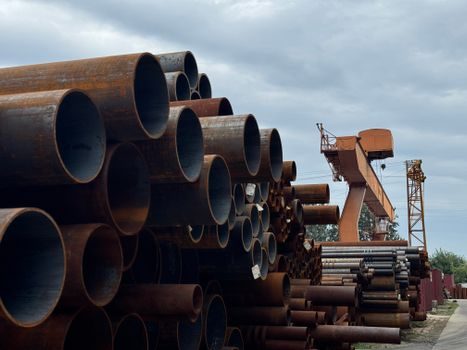
Pick titanium alloys when the spec lists chloride or seawater exposure, mass budgets (aerospace, marine, rotating equipment), galvanic isolation is feasible, and the buyer can absorb 5–10× per kg of finished part cost. The same engineering logic that drives titanium alloy selection in aerospace structures also drives it in ship piping, offshore topside fittings and chemical-reactor internals where pitting and stress-corrosion would shorten alloy-steel life [S2].
Pick alloy steel when the duty is hardenable structural — shafts, gears, pins, high-strength fasteners, tooling — and cost per kg dominates. Alloy steel grades such as 4140 and 4340 remain the default where machinability, weldability and predictable through-hardening are the deciding factors, and they pair naturally with carbon steel sub-components in fabricated assemblies. If a project asks for "lightweight + cheap + chloride + heavy section," that brief is contradictory and the engineer should push back, not pick a compromise grade.
Decision Matrix: Ti Alloy vs Alloy Steel on Five Criteria
On density, titanium (~4.5 g/cm³) beats alloy steel (~7.85 g/cm³) by roughly 1.7×, and on specific strength at the 900 MPa level it wins by close to 2× [S3]. On corrosion in seawater or chloride, titanium is the default with no coating required, while alloy steel needs coating, cathodic protection or a stainless upgrade [S2]. On surface hardness, nitrided titanium reaches 900–1100 HV0.05 with a 1–3 µm TiN case, while alloy steel via carburizing/nitriding reaches comparable hardness with a thicker, more forgiving case depth [S3]. On machinability and forging tolerance, alloy steel is the easier shop material; titanium needs slower cuts, beta-transus control and tighter process discipline. On cost per kg of finished part, alloy steel is materially cheaper, with titanium typically landing 5–10× higher for the same tensile class — a gap that swings the spec toward steel wherever mass and chloride exposure are not on the datasheet.
For an engineer choosing between Ti-6Al-4V and 4140 for a structural bracket: titanium is justified only if the mass budget is binding or the part runs in chloride; for a gear, shaft or pin where hardness through section is the requirement, 4140/4340 quench-and-temper is the right call. Side-by-side specs on broader material families (including the aluminum alloy option that often sits between Ti and steel on the weight-versus-cost curve) are worth pulling before locking the buy. Cross-references for a heavier procurement view sit in the 2026 stainless steel price and grade guide and the alloy steel selection criteria piece on hardenability and service environment, and the Ti-versus-aluminum cut is laid out in the alloy steel vs aluminum alloy spec brief.
Trackable next signals: monitor 2026 updates to GB/T 8546 revisions for titanium-clad stainless-steel plate (a new revision was indexed in late-2025 / 2026 catalogs), watch the Q3 2026 sponge-titanium and Ti-6Al-4V bar price trend from Chinese mills including Qilu and Shaanxi North Steel [S5], and confirm ASTM B265/B348/B381 mill-cert revision dates against your internal acceptance spec before issuing the next RFQ.