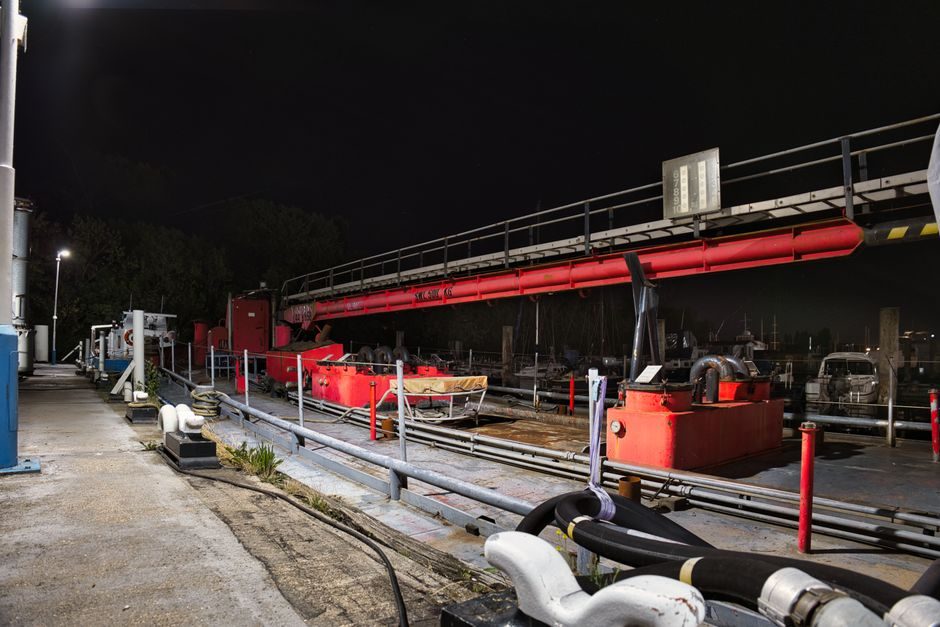
A hydraulic press is a fluid-power forming machine that multiplies a modest pump pressure into a very large linear ram force through a cross-sectional area differential — SICMI's PBM 100 M shop press, for example, delivers 100 tf (≈ 980 kN) of forming force from a 350 bar (5,076 psi) hydraulic circuit on a 1.5 kW pump [S1]. The category spans workshop hand-lever machines under 10 tons up to 5,000-ton rubber vulcanizing frames built by Shandong manufacturers [S3], so selecting the right architecture matters more than chasing the highest tonnage figure on a data sheet.
Operating principle is shared across the whole family: an electric or manual pump charges an oil-filled cylinder, the pressurized oil drives a piston and tooled ram, and a directional valve governs extend / retract / hold. The hydraulic pump feeding the actuator is sized for working speed, not just peak force — the PBM 100 M runs its forming stroke at 2 mm/s and its rapid approach at 25 mm/s from the same 1.5 kW motor [S1], which is a typical ratio of 10:1 to 15:1 between fast travel and forming travel for shop-class machines.
Frame Architectures: H-Frame, C-Frame, Four-Pillar and Sliding-Bench
Frame geometry dictates throat depth, workpiece access, and bias-load tolerance — three of the most common architectures are H-frame, C-frame, and four-pillar, with the sliding-bench bench press as a workshop specialty [S1][S3][S4]. Press Master, a New Jersey–based dealer with a 200,000 ft² inspection facility, stocks both H-frame and C-frame hydraulic presses alongside press brakes and shears, treating the two as separate product lines for different throat and loading requirements [S4].
The H-frame (also called "portal" or "gap-frame closed") puts the cylinder and table inside a closed throat, so the workpiece is surrounded on three sides — best for repeatable, centered forming such as blanking, punching, and deep drawing. The C-frame opens one side for wide or asymmetrical workpieces — typical in body shops, press shops, and repair lines where a long shaft or panel must slide in from the side. A four-column press, by contrast, mounts the moving bolster on four guide pillars, giving the best ram-to-table parallelism for compression molding and vulcanizing; Qingdao Eenor Trading offers four-pillar hydraulic presses from 20 tons to 1,200 tons in this configuration [S3]. The fifth architecture worth naming is the bench press with a transverse-sliding table — the PBM 100 M's 1,050 × 700 mm table slides along guides so a heavy motor or gearbox can be loaded by crane and then driven under the 500 mm-stroke cylinder without re-rigging the part [S1].
Tonnage Classes and Where Each Class Fits
Press tonnage is a function of ram area × system pressure, and the published market spread runs from sub-10-ton hand-lever shop machines to 5,000-ton rubber-belt curing presses [S3]. The PBM 100 M sits in the small-shop / repair class: 100 tf force, 700 mm daylight opening, 1.5 kW pump, 1,770 kg machine mass, hand-lever and push-button control [S1] — sized for straightening steel panels, pressing bearings, and light assembly work in a maintenance shop.
Mid-range machines (200–1,000 tons) handle stamping, deep drawing, and structural forming in metal-stamping plants. Heavy industrial presses (1,000–5,000 tons) are dominated by vulcanizing applications — Qingdao Eenor's catalog lists 20–5,000-ton plate vulcanizing presses for conveyor rubber belts, tire pre-cured strips, and frame-structure plates, with single-unit pricing from US$ 1,000 to US$ 200,000 depending on tonnage and options [S3]. A useful rule of thumb is to size tonnage at roughly 1.2–1.5× the calculated forming load to cover friction, material springback, and die wear — concrete numbers come from the die maker's draw calculation, not the press data sheet.
Comparison: H-Frame vs C-Frame vs Four-Pillar on Four Selection Criteria

Frame choice is a multi-criteria decision, and the four most useful axes are throat access, side-load tolerance, parallelism, and price per ton. H-frame presses win on parallelism and side-load tolerance because the closed throat reacts the forming force through the frame walls, not just the cylinder — but you pay for that in restricted side loading. Four-pillar presses give the best ram-to-bolster parallelism (typically within 0.05–0.10 mm/m) and the largest daylight for deep draws, which is why they dominate rubber vulcanizing and composite compression molding up to 5,000 tons [S3]. The sliding-bench bench press is a separate branch — the PBM 100 M is hand-lever, 1,770 kg, and fitted with a transversely movable cylinder that "allows you to position the piston exactly above the point on which you want to apply pressure, without having to move the piece to be worked on" [S1], trading raw tonnage for ergonomic loading.
Application Mapping by Industry
Hydraulic presses cluster into four application groups: metal forming, rubber and composite molding, assembly and straightening, and laboratory/R&D. Metal forming covers stamping, deep drawing, blanking, and forging — typical machine class is C-frame or H-frame, 50–2,000 tons, with controlled forming speed (the PBM 100 M's 2 mm/s working speed is representative for slow forming on steel and aluminum sheet [S1]). Rubber and composite molding is dominated by four-pillar heated-platen presses in the 100–5,000-ton range with steam or electric platen heating, which is exactly the niche that Shandong manufacturers serve [S3].
Assembly and straightening is the hand-lever shop press segment — the PBM 100 M targets sheet-metal straightening, bearing press-in, and light assembly of motors, gearboxes, and structural panels, with optional end-of-stroke sensors, support plates, stem anti-rotation devices, and hydraulically driven sliding benches as field-upgrade accessories [S1]. Laboratory and R&D presses are typically small-footprint, low-tonnage (1–50 ton) benchtop or floor-standing machines with digital pressure readout and closed-loop control for repeatable test coupons. Across all four groups, the selection logic is tonnage × daylight × stroke × frame access × duty cycle — in that order.
Limits, Failure Modes and Sourcing Constraints
Hydraulic presses have three inherent limits: fixed ram force (you cannot oversize the load), oil-temperature sensitivity (continuous duty above ~60 °C oil temperature derates seal life), and maintenance burden on seals, valves, and hoses. The first failure mode in workshop presses is seal blow-by on the cylinder, usually at the rod wiper; the second is hydraulic-valve sticking from contaminated oil; the third is frame fatigue at the throat corner, especially on C-frame presses loaded off-center. For a deeper dive on frame geometry and duty cycle as selection gates, the spec engineer's hydraulic press selection guide maps the same decision tree in tonnage terms, and the forging press selection guide covers the higher-energy hammer-and-press boundary where hydraulic ram speed becomes a constraint. Sourcing-side, lead times for >1,000-ton four-pillar presses out of Shandong typically run 60–120 days ex-works [S3], so engineering should lock tonnage and platen size early.
Standards, Safety and Specification Discipline
European and North American shop presses generally carry CE marking under the Machinery Directive and, for presses used in potentially explosive atmospheres (e.g. rubber-curing with solvent vapors), ATEX category per the applicable zone classification. PressMaster's H-frame and C-frame lines are CE-marked machines sold into the US and EU through a 200,000 ft² Harrison, NJ facility [S4]; Chinese vulcanizing presses in the 20–5,000-ton range typically ship with CE documentation and a one-year warranty, with optional overseas engineer service [S3]. Always verify the safety category — light guards, two-hand control, and pressure-relief valve calibration — against the actual workpiece and operator exposure, not against the press data sheet headline tonnage.
Three trackable signals close this map: (1) Chinese vulcanizing-press builders are pushing standard capacities above 5,000 tons for wind-turbine blade and conveyor-belt applications, with model-number ranges like 20–5,000 tons already advertised on Shandong factory lines [S3]; (2) European shop-press OEMs such as SICMI are adding end-of-stroke sensors, stem anti-rotation devices, and hydraulically driven sliding benches as factory options rather than custom modifications [S1]; (3) US dealers are consolidating around H-frame and C-frame stocking programs, with on-site inspection at 200,000 ft² facilities becoming a competitive differentiator [S4]. Each signal points to a maturing market where modular options, not raw tonnage, drive specification.