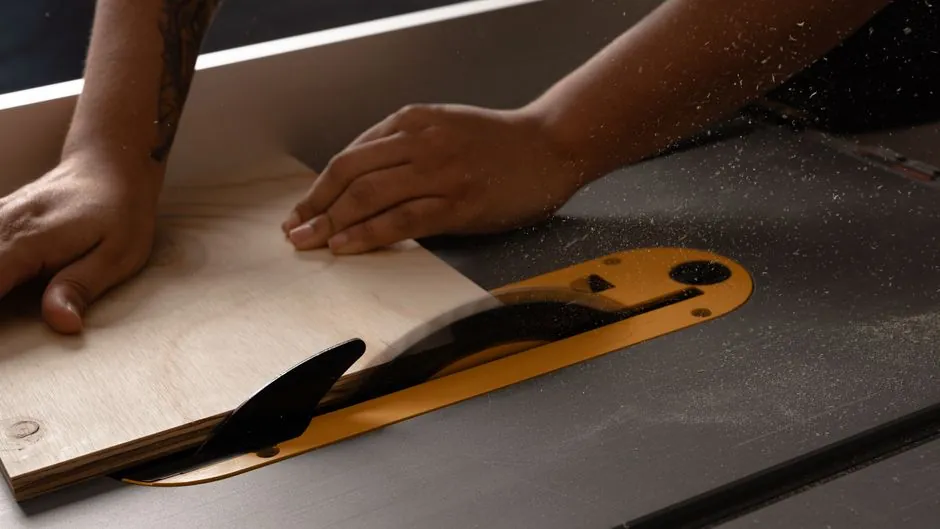
Hydraulic shearing does not automatically leave a rougher surface than saw cutting: cut quality depends on blade clearance, rake angle, hold-down pressure, material properties, and tool condition.
Sawing removes material with a toothed blade, while hydraulic shearing forces a moving upper blade against a stationary lower blade to separate the stock.
What Determines Sheared Surface Quality
A hydraulic shear can produce a clean, smooth edge with little or no chip waste, while a poorly adjusted shear produces excessive burrs, rough surfaces, and material distortion [S1][S4]. The cut is not defined by hydraulic power alone. It is the combined result of machine settings, material thickness and hardness, blade condition, and operator control [S4].
Blade clearance, rake angle, material thickness and hardness, and blade condition affect hydraulic-shear cut quality, while dull or misaligned blades can cause burrs and edge deformation [S4].
Other controlled variables include rake angle, hold-down pressure, and backstop position. A larger rake angle can reduce cutting force but permits greater material movement, while inadequate hold-down allows the stock to shift and produces inaccurate cuts [S4].
Saw Cutting Versus Hydraulic Shearing
The primary distinction is material-removal mechanism. A band saw removes small pieces through teeth around the blade, and its kerf is slightly wider than the blade itself. Hydraulic shearing uses two offset blades to deform and split the material, so the cut contains rolled, fractured, or burnished zones rather than a continuously toothed kerf [S1].
When Shearing Looks Rougher Than Sawing
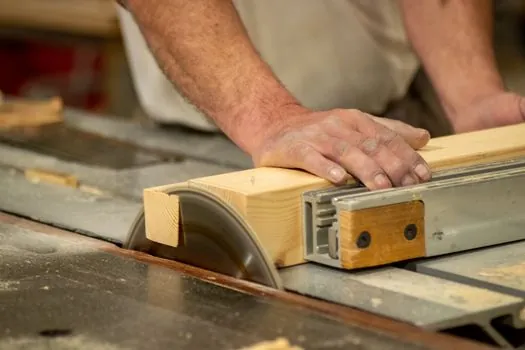
Sheared edges often look rougher because the blade plastically deforms the material before separation, creating a burnished zone, fracture zone, burr, and sometimes rollover [S1][S4]. Saw cuts can also retain marks from individual teeth, so “smooth” does not necessarily mean lower roughness in every measurement. The relevant acceptance criteria depend on whether the part needs a square blank, a weld fit-up, a thread blank, or a finished component [S3][S4].
Hydraulic shearing is particularly sensitive to thickness, hardness, and force demand. As stock becomes thicker, required tonnage rises and the material can stretch before it shears, creating tolerance loss and more finishing work [S1]. Material grade is therefore a sizing parameter, not merely a production note: carbon steel requires less force than high-tensile alloy, stainless, or heat-treated bar [S3].
Machine Setup That Prevents Poor Cut Quality
Correct alignment, clearance, and restraint convert shearing from a rough separation process into a controlled blanking operation.
Hold-down pressure must be high enough to stop movement but not so high that it marks soft material. Backstop position determines repeatability, while blade sharpness and alignment control burr formation and edge deformation [S4]. A shear does not remove this requirement through hydraulic force; added tonnage cannot compensate for incorrect clearance or worn tooling [S4].
Which Process Fits the Part
A hydraulic bar shear can produce thousands of blanks per shift for high-volume fastener blanking while improving throughput and eliminating recurring saw-blade costs, thereby feeding threading, chamfering, and heading operations [S3].
Choose sawing when the stock is thick, the section is complicated, the cut must follow a curve, or a cut edge must be prepared for welding or machining. Band saws maintain accurate cuts in plates, bars, pipes, and tubes, although flat stock can become unstable during the cut and sheet metal is less suitable [S1]. Sawing consumes saw blades and requires attention to coolant and swarf [S3].
Hydraulic shearing is not the automatic answer for every rough-looking edge. If the part requires a specific surface roughness, burr limit, or downstream fit, qualify the process using the actual material grade, thickness, tooling, and acceptance criteria. Measure burr height, edge straightness, dimensional accuracy, and finish rather than judging from appearance alone [S4].
Production Limits and Maintenance Risks
Poor shear quality creates more than a cosmetic defect. Excessive burrs and distortion can require secondary finishing, increase material waste, impair welding fit-up, create handling hazards from sharp edges, and reduce production efficiency [S4].
Blade wear is therefore a production variable rather than a maintenance-only issue. Dull or misaligned blades increase burrs and deformation, so inspection intervals should follow cutting volume, material hardness, and observed edge condition rather than a generic calendar schedule [S4].
The direct answer is conditional: hydraulic shearing can leave a rougher and more distorted edge than saw cutting, particularly with excessive clearance, poor hold-down, wrong rake geometry, dull blades, or stock near the machine’s force limit. With matched tooling and controlled settings, however, hydraulic shearing can deliver clean, smooth edges while cutting in seconds and eliminating chip waste [S1][S3][S4].
For procurement or production validation, run representative coupons in the actual alloy and thickness, then record cycle time, burr condition, dimensional repeatability, distortion, and downstream rework. Those five measurements provide a defensible comparison between shearing and sawing.