For a 60 m3/h ready-mix line, the HZS60 station pairs a JS1000 twin-shaft compulsory mixer (1 m3 batch, 130 kW total power, 4.1 m discharge height) with three aggregate bins and a 200 t/h inclined belt, which is the working envelope most general contractors target for residential and small commercial pours [S4].
Buyers in mid-2026 face a catalogue that runs from HZS25 mobile units (~25 m3/h, single-bin, no foundation) up to HZS270 modular plants (>240 m3/h continuous), and the design choice collapses to four axes: theoretical output, mixer model code, aggregate bin configuration, and discharge height against the truck-mixer fleet on site [S4].
Output Bands and Mixer Model Code
HZS-class stationary plants are stratified by their JS-series twin-shaft compulsory mixer, whose dry-charge volume directly sets the per-cycle batch size and therefore the rated m3/h [S4]. The current build band maps HZS25 to JS500 (0.5 m3), HZS50 to JS1000, HZS75 to JS1500 (0.75 m3, 165 kW, 4.1 m discharge), HZS120 to JS2000, HZS180 to JS3000 (3 m3 batch, 80 mm max aggregate), and HZS240/270 above JS4000 — a 1:2 mixer-to-throughput ratio that holds across Chinese OEM lines [S4]. Mid-range 50 m3/h HZS50 stations from FANGYUAN list at FOB US$63,000–77,000 per piece with a 1-piece minimum order, while HZS75 modules move into the US$96,000–123,000 band on the same export channel [S3].
Mobile batching plants (YHZS series) use the same JS mixers but skip the civil foundation; HAMAC’s 30-year export line sells them as containerised modules that can be live in 3–5 days versus 4–6 weeks for a stationary HZS of equivalent throughput [S2]. Output drops 10–20% on mobile versus stationary because the live bin is shorter and the in-spec aggregate window narrows under transport vibration, a real penalty that should be priced into any project schedule [S7].
Aggregate Bins, Discharge Height and Site Geometry
Aggregate bin count and discharge height are the two site-geometry levers that get specified late and forced early. The HZS60 uses three bin compartments and a 4.1 m discharge, suitable for standard 6×4 transit mixers; HZS75 allows 3–4 aggregate types to be batched without reconfiguration, which is the threshold for ready-mix yards that handle both crushed-stone and lightweight mixes [S4]. The HZS180 steps discharge height to 4.2 m to clear 8×4 truck-mixer drums and keeps the JS3000 batch cadence at 3 m3 per cycle, putting the plant at 150–180 m3/h sustained output on a 165–200 kW power budget [S4].
For a plant driving 6×4 transit mixers, a 4.1 m discharge is adequate; fleets using semi-trailer mixers or high-clearance agitors need 4.2–4.5 m, and below 3.8 m the truck-mixer chute geometry starts to spill on the down-stroke. CONMACH’s plant configurator treats bin count and discharge height as fixed at order — a retrofit on site usually means a new structural skid, so the choice should be made on the truck roster, not the budget [S7].
Stationary vs Mobile vs Compact Plant Trade-off
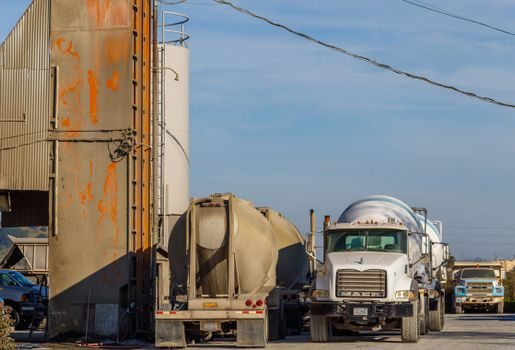
The HZS/YHZS/CBP split maps to project duration: stationary HZS for >24-month continuous operation on a fixed foundation; YHZS mobile for 6–24 month projects that move 2–4 times; compact CBP or skip-hoist stations for <6-month jobs or remote sites where trailer loading matters [S2][S4]. Walia International and Erie Strayer dealers in the US/Pakistan market segment stationary concrete batching solutions toward heavy civil and infrastructure, where plant permanence outweighs the freight cost of the 25–40 t structural skid [S1][S5].
Throughput penalty on mobile is the key spec to verify: HAMAC positions its mobile line at 10–20% below the equivalent HZS nameplate, and this is consistent with bin residence time and shorter inclined-belt lengths on the containerised frame [S2][S7]. For a contractor running 80 m3/h on a stationary HZS75, the mobile twin will deliver 64–72 m3/h — not 75 m3/h — and the pour schedule must absorb that delta or two plants are needed. For a related dump-truck / agitator spec comparison, see How to Choose a Concrete Mixer Truck: Capacity, Drive and Chassis Spec Bands — the truck-mixer fleet sets the discharge height spec in the plant selection loop, and that article covers the matching chassis and drum classes.
Power, Concrete and Mixer Output Per kW
Total connected power is the most falsified spec on Chinese-made plant data sheets. The HZS60 draws 130 kW, HZS75 draws 165 kW, and HZS180 climbs above 200 kW — these are nameplate connected loads, not running loads, and the real running load sits 25–35% below connected for a plant that is properly VFD-controlled on the inclined belt and skip hoist [S4]. Buyers should size the genset or grid feed at 1.3× connected load to absorb the inrush of two mixers cycling in overlap, and they should verify the per-mixer kW figure: JS1000 typically runs 2×18.5 kW flywheel motors, JS1500 2×30 kW, JS3000 2×55 kW — and the difference between 2×18.5 and 1×30 kW on a “JS1000” data sheet is the line between a real compulsory mixer and a planetary or drum mixer rebadged.
Cold-climate and high-altitude jobs should also confirm the plant can run a hot-water or steam-side admixture line without freezing the concrete admixture dosing pump, since most JS mixers are water-cooled at the bearing end and the dosing block can be the first thing to fail below −10 °C. For winter or hot-weather pours the concrete vibrator fleet on the placement side also has to be sized to the same pour cadence; a 60 m3/h plant that is placement-limited to 40 m3/h wastes 20 m3/h of nameplate. Aggregate handling upstream of the plant is covered in our Concrete Batching Plant sizing and selection guide reference page, which lists the full HZS/YHZS spec table and the per-bin load-out cadence.
Compliance, Permits and Site Footprint

Stationary concrete batching plants in the US and EU markets are usually subject to air-permit, stormwater and zoning controls, and dealers like Erie Strayer explicitly scope plant selection inside the permit envelope rather than letting the contractor pick first [S5]. CONMACH and HAMAC both export ISO 9001:2015-documented lines, and FANGYUAN additionally carries ISO 14001:2015 and ISO 45001:2018 management certifications — the three certificates appear together on the Made-in-China FANGYUAN factory page, dated 1999 establishment, 638 employees, Yantai, Shandong [S3].
For a US/EU buyer, the practical compliance check is dual: confirm the structural skid is CE-marked for the EU or IBC-compliant for US seismic/seismic zone, and that the dust collector on the cement silo is rated for PM10 below 20 mg/Nm3 — most permit denials are dust-collection and stormwater, not the mixer or the conveyor [S5][S7]. Walia’s duct-cleaning service line is a reminder that cement dust and admixture vapour management is a service industry in its own right, and that the original plant spec is only the starting point for the maintenance cycle [S1].
Selection Criteria: Who Needs Which Plant
Spec-driven selection of a concrete batching plant collapses to four filters, and any plant that fails one is the wrong plant: (1) theoretical output ≥ peak daily pour demand × 1.25 buffer; (2) mixer model code whose dry-charge volume matches the largest single truck-mixer pour (JS1000 for 1 m3 agitator fills, JS1500 for 1.5–2 m3 agitor drums); (3) aggregate bin count ≥ number of mix designs in the project (3 bins for single-design pours, 4 bins when crushed stone and lightweight share the same plant); (4) discharge height ≥ the tallest truck-mixer or agitator body on site, plus 0.2 m clearance [S4][S7].
A 25 m3/h YHZS25 mobile plant suits a remote dam or road subgrade that runs <20 m3/h sustained; an HZS50/60 suits residential developers running one mix design for slab and column pours; an HZS75 with 4-bin aggregate is the threshold for ready-mix yards serving mixed commercial work; an HZS120+ is for precast yards, high-rise central-mix plants and infrastructure pours >100 m3/h sustained.
The HZS75 at FOB US$96,000–123,000 with JS1500, 4-bin aggregate, 60–75 m3/h output, 80 mm max aggregate, 165 kW total power, and 4.1 m discharge height is the highest-volume sale in the mid-2026 export catalogue and the most defensible spec baseline for a first plant [S3][S4].
For a first concrete batching plant on a developing yard, the conservative spec is HZS75 with JS1500 mixer, 3–4-bin aggregate, 4.1 m discharge height, 165 kW total power, and ISO 9001:2015 documentation from an OEM with 20+ years of export, such as FANGYUAN (established 1999, ISO 9001:2015 / ISO 14001 / ISO 45001 certified) or HAMAC (approximately 30 years in the field).