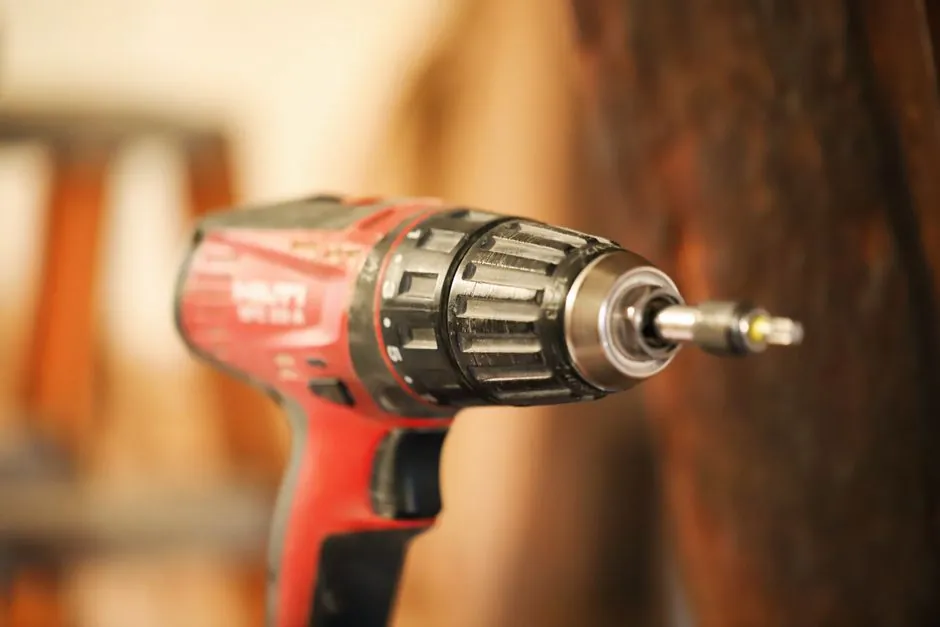
Impact drills remain one of the most common hand-held power tools on construction, MRO, and utility sites, and the published safety warnings in manufacturer manuals converge on a small set of hard rules: certified eye and hearing protection, an auxiliary handle for two-handed control, and a live-cable check before any wall, floor, or ceiling penetration [S2][S5][S8].
Concretely, the Parkside KH 3035 (PSBM 500) ships as a 230 V / 50 Hz, 500 W unit with a 13 mm chuck, max 3,000 rpm no-load speed, and a measured 97 dB(A) sound pressure level with K = 3 dB uncertainty, while impact-drilling in concrete produces a vibration emission of a_h,ID = 24.2 m/s² (K = 2.0 m/s²) per EN 60745 [S3]. The Datacol L220114 lands in a similar envelope at 230 V / 790 W with 0-1,000 rpm no-load speed, 13 mm steel capacity, 20 mm concrete capacity, 40 mm wood capacity, 8,000 bpm full-load impact rate, and 2.2 kg bare weight [S5]. These data points set the operating envelope inside which every safety rule below has to be applied.
Personal protective equipment and the standards behind it
Impact-drill manuals from DeWALT, Parkside, Datacol, Hikoki, and Hitachi repeat the same PPE list almost verbatim, and they map it to named standards: ANSI Z87.1 eye protection (or CAN/CSA Z94.3 in Canada), ANSI S12.6 (S3.19) hearing protection, plus NIOSH/OSHA/MSHA respiratory protection when dust is generated [S2][S5][S8].
The hazard drivers are explicit. Hammer action throws chips, and the DeWALT safety sheet for impact drivers and wrenches states that hammering operations cause chips to fly and that flying particles can cause permanent eye damage, with everyday eyeglasses not counting as safety glasses [S2]. Sound is the second driver: a Parkside KH 3035 running in concrete hits 97 dB(A) sound pressure and the working sound level can exceed 108 dB(A), which is why every manual in the research opens with wear ear protectors [S3][S5][S8][S10]. The third driver is dust, which is why a face or dust mask is added for masonry work, paired with impact-rated gloves for hot accessories and for vibration damping [S2].
Two-handed control, auxiliary handles, and torque-wrench mis-use
Loss of control is the dominant injury pathway for impact drills, and manufacturers counter it with three layered controls: an auxiliary side handle, a depth stop, and a two-handed grip rule [S5][S8][S9]. Datacol, Hikoki, and Hitachi manuals all carry the same sentence that "use auxiliary handles supplied with the tool, loss of control can cause personal injury," and the DeWALT safety sheet extends it to a hard "do not attempt to operate this tool without holding it with both hands" [S2][S5][S8][S9].
The second control is bit and material matching, since binding bits are the most common trigger for kick. Manuals instruct that cutting tools must be kept sharp and clean, because properly maintained cutting tools with sharp cutting edges are less likely to bind and are easier to control [S6][S7][S9]. Hitachi, Datacol, and Hikoki manuals also forbid using an impact drill as a torque wrench, on the basis that "impact wrenches are not torque wrenches" and that joint torque must be verified with a separate calibrated device, which is a separate failure mode from drilling safety [S2]. For broader context on torque-tool mis-use and pneumatic-tool control, the discussion in Pneumatic Silencer TCO: Material, Pressure, and Service-Life Drivers shows the same control-versus-load trade-off, and this guide on impact-wrench selection is the most direct cross-reference for the rotary-impact family.
Electrical hazards: live conductors, wet conditions, and insulation

Electrical risk is the one hazard that turns a drill into a fatal tool, and three controls dominate. First, the operator must hold the power tool by its insulated gripping surfaces whenever the cutting accessory may contact hidden wiring, because a "live" wire can make the exposed metal parts of the tool live and shock the operator [S2][S5][S6][S7].
Second, before drilling into walls, ceilings, or floors the operator must verify that no concealed power cables or conduits are buried inside, a warning repeated in the Hikoki VTP-16A, Hitachi DV 16V, DV 18V, and Datacol L220113/L220114 manuals [S5][S6][S7][S8][S9][S10]. Third, the tool must not be used under wet conditions or in the presence of flammable liquids or gases; the DeWALT sheet adds the cold/wet warning, while the impact-driver and impact-wrench list is more general [S1][S2]. For application context, impact drill sizing and selection covers the matching of chuck capacity, voltage class, and intended material, which is the upstream decision that drives the safe operating envelope below.
Vibration exposure under EN 60745 and HAVS control
Hand-arm vibration is the long-term injury pathway, and the test method is the standardised measurement procedure in EN 60745, the same standard the Parkside manual cites for its declared values [S3].
For the Parkside PSBM 500 the declared impact-drilling-in-concrete vibration is a_h,ID = 24.2 m/s² with K = 2.0 m/s², and drilling in metal is a_h,D = 4.7 m/s² with K = 1.5 m/s²; Parkside itself flags that different uses of the device give rise to different vibration levels and that these values can be exceeded in real work, and that idle or off periods must be factored into any daily exposure assessment [S3]. The DeWALT control set addresses this directly: "do not operate this tool for long periods of time," use gloves for extra cushion, and take frequent rest periods, because vibration caused by hammer action may be harmful to hands and arms [S2]. Operators should treat a_h,ID values above roughly 10 m/s² as a prompt to plan job-rotation, and use the EN 60745 declared triplet (a_h, K, standard) when comparing machines rather than reading marketing copy. For tool-side context, the air impact wrench reference page covers the impact-mechanism side of the same exposure family, while broader construction machinery and equipment gives the site-level framing.
Workpiece support, kick prevention, and PPE for flying debris
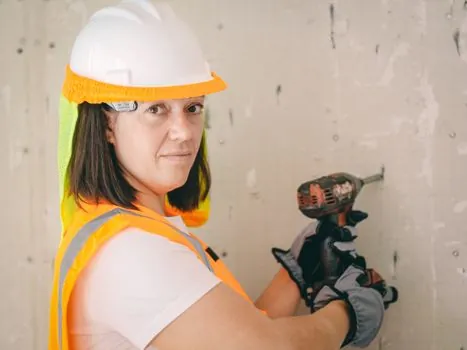
Unstable workpieces cause more impact-drill injuries than any single component, and the control is to clamp the workpiece to a stable platform rather than hold it freehand or against the body [S2]. Loose clothing, jewellery, and long hair are explicitly called out as entanglement risks because air vents often cover moving parts, and the operator is told to keep clear of those vents [S2].
For overhead or elevated work, the impact wrench safety guidance adds: never use an impact wrench in cold or wet conditions, and secure the tool against drop hazards when working at height, with the tool placed on its side on a stable surface when not in use to avoid a tripping or falling hazard [S1][S2]. On a hot accessory, the DeWALT sheet is unambiguous: accessories and tool may get hot during operation, so wear gloves when handling them for heat-producing applications such as hammer drilling and drilling metals [S2]. The same eye-protection logic carries into adjacent work, including the eyewear standards discussed in Optical glass for oil and gas: eyewear specs vs process sight glass, where ANSI Z87.1 is the same baseline used for impact-drill chips.
Comparison: EN 60745 test points versus common safe-use controls
Setting the test data and the operator controls side by side makes the trade-offs explicit. Impact-drilling in concrete is the worst case on both axes, with a_h,ID = 24.2 m/s² and a working sound level above 108 dB(A); metal drilling is roughly five times lower on vibration at a_h,D = 4.7 m/s² [S3]. The 13 mm chuck fits both, but the side handle and depth stop are mandatory for the concrete case and optional for light metal work, and the live-cable check is non-negotiable for any wall, ceiling, or floor penetration regardless of material [S3][S5][S8].
For selection the rule of thumb is: match the rated a_h,ID to the planned daily trigger time, match the chuck to the largest bit you will run (13 mm covers most masonry, 10 mm covers most metal), keep the side handle fitted for any bit above 6 mm, and require insulated grips plus a residual-current device for any work near concealed services. This is also the same control hierarchy that governs lamps and light fittings and lighting equipment and electric lamps on a construction site, where the live-conductor hazard is the common thread.
Operator qualification, manuals, and the "read the manual" baseline

Every manual in the research set, from PortaCo DI-05-76-O to Parkside KH 3035, treats operator qualification as part of the safety case rather than a separate HR step. PortaCo's manual limits the intended user circle to trained operators and maintenance personnel and insists that residual-risk knowledge plus general device knowledge is required for safe, accident-free work [S4].
The Parkside manual opens its general safety chapter with the instruction to "read all the safety advice and instructions," and the DeWALT sheet repeats that "failure to follow the specific product's manual instructions may result in electric shock, fire and/or serious injury," with a copyright line dated 04/2024 [S2][S3]. For site-level PPE discipline and supervisor sign-off, Fire safety is the natural cross-reference, since the same supervisor controls that govern hot-work permits also govern drill-permit sign-off in live plant areas.
The most useful safety signals to track in the next procurement cycle are: declared a_h,ID and K values per EN 60745 on the nameplate, the presence of an auxiliary side handle and depth stop in the standard-accessories list, the live-cable warning printed in the local language manual, and whether the manufacturer publishes a vibration-exposure calculator against the daily trigger time. Sites that pin these four data points to a tool registration record will catch most of the failure modes the manufacturer manuals are written to prevent.