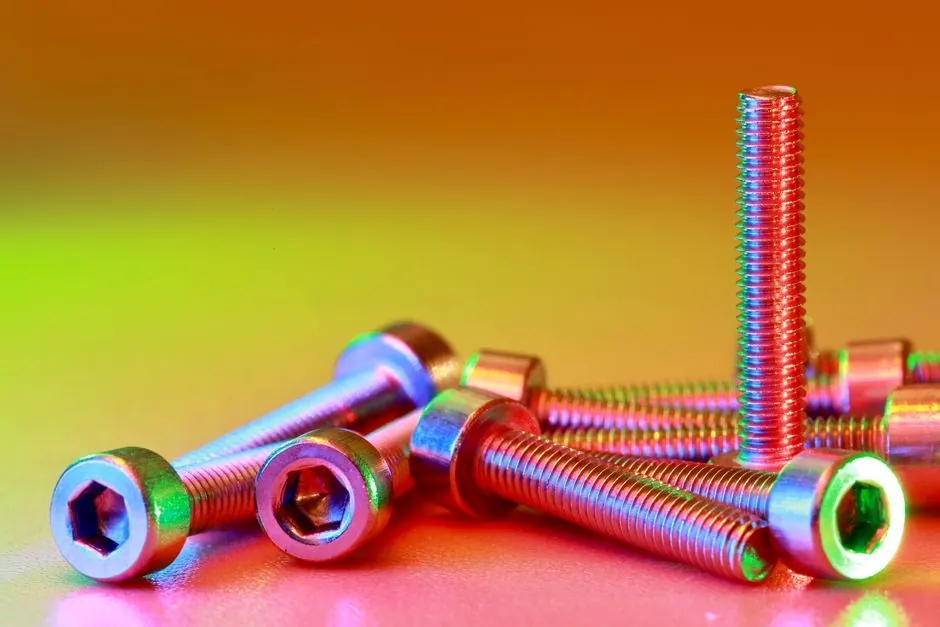
Industrial fastener demand is forecast to expand from USD 110.21 billion in 2026 to USD 156.11 billion by 2033, translating to a 5.1% compound annual growth rate over the 2026-2033 window, per a March 2026 market sizing [S3].
Freedonia's earlier study sized the 2022 global market at $95 billion and projected a 4.7% annual climb to $119 billion by 2027, with prices advancing 1.9% per year over that horizon [S1]. Together the two datasets bracket the 2026 base year between roughly $110B (Coherent) and a $119B-equivalent run rate (Freedonia's 2027 anchor), and both point to mid-single-digit real value growth through 2030 [S1][S3].
Demand Drivers: Autos, Construction, and Defense
Automotive is the single largest application, accounting for 31.1% of 2026 global fastener consumption, while infrastructure programs and EV battery-pack build-out are the dominant volume pullers [S3]. The U.S. Infrastructure Investment and Jobs Act injects $1.2 trillion in federal funding for highways, bridges, and utility projects, driving demand for anchor bolts, heavy-duty rivets, and corrosion-resistant structural fasteners [S3]. NATO defense spending, elevated since 2022, has tightened supply of high-strength aerospace and armor-grade fasteners, with lead times stretching for commercial buyers who share the same forging and heat-treat lines [S3]. The EV transition adds a parallel requirement set: battery pack enclosures use fasteners specified for thermal cycling, dielectric isolation, and vibration loads that differ from engine-bay legacy hardware, pushing suppliers to re-tool part numbers rather than reuse them [S3].
China's Belt and Road Initiative continues to seed demand for stainless and coated fasteners in port, rail, and energy projects across Asia and Africa, segments that price in long service life over lowest unit cost [S3]. Solar racking and wind turbine tower internals have opened a premium niche in stainless and composite fasteners, where margins sit materially above commodity bolt and nut averages [S3]. Material availability, however, is a binding constraint: sanctions on Russian steel and titanium exports have raised input costs and forced sourcing diversification for aerospace and defense spec lines [S3].
Product and Material Mix Through 2030
Metals are projected to hold 91.2% of 2026 raw-material share, leaving roughly 8.8% spread across plastics, composites, and specialty alloys, a ratio that the forecast assumes will persist across the 2026-2033 horizon [S3]. Externally threaded fasteners (bolts, screws, studs) lead the product type breakdown at 35.9% of 2026 value, ahead of nuts, washers, internally threaded parts, and non-threaded items such as rivets and retaining rings [S3]. The dominance of metal and external threading is a direct consequence of how the construction, automotive, and machinery OEM channels specify hardware: by ISO and ASME metric/inch thread standards, by property class (8.8, 10.9, 12.9 for steel), and by material grade rather than by application [S1][S3].
For a procurement engineer, the practical implication is that sourcing pressure will sit on three intersecting axes: steel and stainless base price, conformance documentation (EN 10204 3.1 mill certs, ISO 898-1 mechanical property testing), and the tightening of counterfeit lots, which Coherent flags as the principal growth restraint [S3]. Where the industrial coating spec shifts to zinc-flake, Geomet, or PTFE for corrosion class C4/C5, fastener suppliers typically bundle the coating as part of the part number, so a sourcing decision is as much a finish specification as a base-material call.
Regional and Trade Geography
North America is forecast to retain 39.2% of 2026 global fastener value, the largest single regional share, followed by Asia/Pacific, which Freedonia identifies as the dominant net-exporting region with a production share that continues to grow [S1][S3]. European production economics are under pressure from elevated electricity costs, which hit the energy-intensive forging and heat-treat steps hardest; Coherent flags this as a margin-compression risk that may push volume toward lower-cost regions [S3]. For a buyer in Western Europe or North America, that translates to longer and more variable lead times on parts that historically shipped from domestic mills, and a steady migration of OEM inquiries toward Asia/Pacific and Turkish sources for standard grades [S1][S3].
Freedonia's dataset breaks historical regional demand at five-year intervals (2012, 2017, 2022, 2027, 2032) and tracks net exports by region across the same windows, which gives a procurement team a clean way to align sourcing footprint decisions with the regional production shifts that the dataset already encodes [S1]. Net-export movement is the leading indicator here: when Asia/Pacific net exports rise as a share of global production, North American and European buyers should expect domestic mill lead times to lengthen, not shorten, in the next cycle [S1].
Forecast Comparison: Freedonia vs Coherent 2026-2030
Two independent forecasts frame the 2026-2030 planning window, and they agree on direction while diverging on base-year level and end-point. Freedonia's study (base 2022, $95B) projects 4.7% annual growth to $119B by 2027, implying roughly a $130-140B run rate by 2030 if the 4.7% trajectory extends [S1]. Coherent's study (base 2026, $110.21B) projects 5.1% CAGR to $156.11B by 2033, which yields approximately $127B by 2030 if interpolated [S3]. The 5.1% vs 4.7% CAGR gap is small but real, and the 2026 base-year gap of roughly $10-15B between the two studies reflects methodology differences in how aftermarket MRO, aerospace-grade, and construction segments are valued [S1][S3].
For a planning engineer, the practical forecast band for 2030 is therefore USD 127-140 billion in global value, with growth concentrated in automotive (31.1% of 2026 mix), construction tied to infrastructure bills, and defense pulling aerospace-grade volume [S1][S3]. A diesel forklift spec-driven selection guide, for example, will see higher-bolted chassis and mast assemblies on the heavier end of the duty range, where the fastener spec moves from grade 8.8 to 10.9 and the unit count per machine climbs, so the fastener line item tracks the heavy-duty share of the lift-truck fleet.
Risks and Constraints Through 2030
Counterfeit fasteners are flagged as the headline growth restraint, because undersized or sub-grade lots entering the MRO channel create downstream safety and warranty exposure that the OEM and EPC procurement teams have to filter out via traceability and mill-cert verification [S3]. Raw-material cost inflation on steel, stainless, and titanium is the second binding constraint, and the European energy-cost pressure on forging and heat-treat acts as a regional cost-side accelerator on top of raw-material moves [S3]. A third constraint is capacity: the defense and aerospace demand surge is pulling the same forging and heat-treat lines that serve commercial buyers, lengthening lead times for standard parts at exactly the time infrastructure demand is peaking [S3].
Where the fastener is paired with another load-bearing assembly, the spec call has to account for the joint: a disc coupling for a wind turbine drivetrain sits behind a high-strength stud set, and any drift in stud property class or torque procedure is amplified by the cyclic load the coupling transmits. Procurement specs that fix the property class, the coating, and the torque procedure together are the cleanest way to lock the joint, and they are what the industrial coating spec has to be written against.
Standards and Specification Anchors
Fastener specification is governed by a tight set of ISO, ASME, and ASTM standards, and the 2026-2030 forecast assumes the existing standards stack, not a new one. ISO 898-1 defines mechanical properties of carbon and alloy steel bolts and screws at property classes 8.8, 10.9, and 12.9. ISO 3506 covers corrosion-resistant stainless steel fasteners (A1-A5 for austenitic, C1-C4 for martensitic, F1 for ferritic grades). ASTM A193 and A194 cover alloy and stainless bolting for high-temperature or high-pressure service, which is the spec line that backs process-plant and energy applications. EN 14399 covers preloaded bolting for structural engineering, the spec line that backs bridge and high-rise construction. DIN 976 and ASME B18.31 cover threaded rod and continuous studs, which is where wind-tower internal fasteners live. [S3]
Traceability is specified by EN 10204, with 3.1 mill certificates the standard requirement for safety-critical and infrastructure-grade parts, and 3.2 required where the buyer needs independent validation. The relevant industrial ceramic fastening systems remain a niche, used where electrical isolation or thermal stability is required, but the volume base is the metal-91.2% segment, and the 2026-2030 forecast is anchored on the metal-and-externally-threaded product mix, not a fast-moving substitution story [S3].
Trackable signals for the next planning cycle: quarterly updates on the U.S. Infrastructure Investment and Jobs Act disbursement schedule, the European industrial electricity-price trajectory for the forging and heat-treat cost line, and any new sanctions package touching Russian or Chinese steel and titanium export quotas. Each of these three inputs moves the 2030 demand and price band by a measurable amount, and each is a public-data signal a procurement or planning team can monitor without a paid subscription.
Component reference pages worth checking: industrial adhesive.