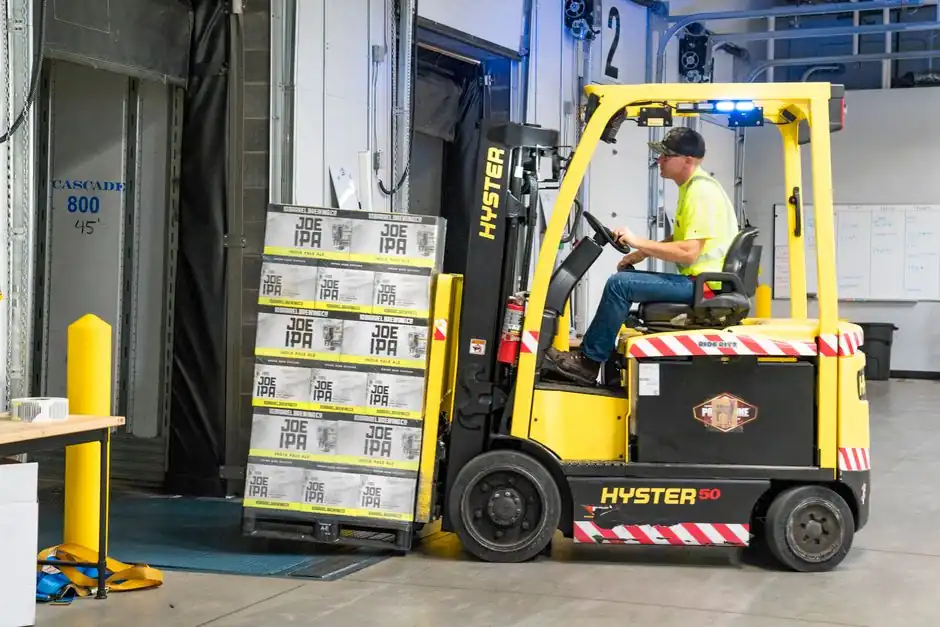
A diesel forklift is the default choice when a site demands outdoor, high-load, continuous-shift operation, with rated capacities commonly reaching 120,000 lb (54,000 kg) versus roughly 12,000 lb (5,400 kg) for a typical electric counterbalance, per dealer guidance [S1].
That capacity gap, plus fast refueling and the ability to run three shifts, is exactly why diesel still dominates ports, lumber yards, and construction logistics [S4][S5]. Buyers who anchor on tonnage first, then drive type, almost always end up specifying a diesel unit for those duty cycles.
Diesel vs electric vs LPG: the real decision matrix
Diesel forklifts lead on power density and continuous runtime: a typical diesel engine can carry around 120,000 lb while an electric motor in the same class caps near 12,000 lb, and modern diesel combustion efficiency sits between 40 and 45 percent versus over 90 percent for an electric motor at nominal power [S1][S4]. Electric units win on indoor air quality and noise, but their charging window of several hours makes them a poor match for 24/7 yards [S3]. LPG bridges indoor and outdoor, with emissions low enough for ventilated indoor use and quick cylinder swaps, but it delivers less power than diesel and demands strict cylinder storage under occupational safety rules [S4]. A simple way to read the matrix: outdoor + heavy + multi-shift points to diesel; indoor + clean air + light-to-medium duty points to electric; mixed indoor/outdoor with moderate loads points to LPG [S2][S4].
Load capacity, lift height, and load center
Spec sheets should always be read at the rated load center, typically 24 in (600 mm) from the fork face, because moving that center outward drops capacity non-linearly. Standard counterbalance forklifts cover lift heights from roughly 8 ft to 20 ft for everyday use, with specialty masts reaching well beyond that band, and lift height itself reshapes the load chart: the higher the mast, the lower the residual capacity at the top of the stroke [S2]. For diesel classes above 15,000 lb, mast options usually include two- and three-stage designs with freelift, and buyers should request the manufacturer load chart rather than relying on nameplate numbers alone. The reference forklift entry covers how load center and mast type interact on the capacity curve.
Engine, emissions, and where diesel legally cannot run
Diesel combustion produces CO, NOx, and particulate matter that rule out enclosed spaces unless site-specific ventilation meets occupational exposure limits, which is the single most common reason diesel units get rejected at food, pharma, and cold-storage facilities [S3][S4]. A modern diesel engine is also less efficient than an electric drivetrain, losing additional energy through the hydrostatic transmission common on these trucks, which caps throttle modulation and makes fine inching slower than on a peer electric [S4]. For sites near regulated urban air sheds, buyers should confirm the engine tier (US EPA Tier 4 Final, EU Stage V) and whether the unit carries a diesel particulate filter, because these retrofits change both maintenance intervals and refueling-area ventilation needs. Where diesel is locked out, the rough terrain forklift and articulated diesel-electric hybrids become the fallback options.
Terrain, tires, and drivetrain choices
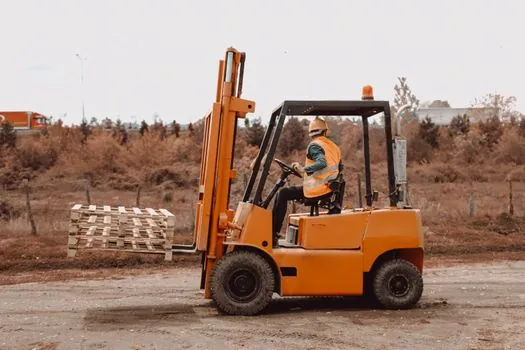
Tire selection is a direct function of ground condition: pneumatic (air-filled) tires for outdoor yards with debris, solid pneumatic for mixed surfaces where flats are a downtime risk, and cushion tires strictly for smooth indoor slabs [S2]. On rough construction or quarry yards, four-wheel drive and higher ground clearance push the spec toward a rough-terrain class, where the trade-off is a smaller mast lift envelope versus greater slope stability. A practical field test: if more than 20 percent of routes cross unpaved or graded terrain, plan on pneumatic tires and at minimum two-wheel drive assist; beyond 40 percent unpaved, spec a true rough-terrain chassis rather than a standard counterbalance on bigger tires.
Total cost of ownership, not just purchase price
Diesel trucks are typically cheaper to buy than equivalent electric units, but the long-term operating cost runs higher because diesel fuel costs more per energy unit than grid electricity, and the engine demands regular oil, filter, and fuel-system service that an electric drivetrain largely avoids [S3][S6]. A useful TCO lens compares per-hour fuel plus maintenance against an electric's battery depreciation and charger capex, then layers utilization: at one shift per day, electric often wins on TCO inside three to five years, while at two or three shifts the refueling speed of diesel (minutes, versus multi-hour charging) pulls the break-even point back toward diesel [S6]. Maintenance workload is a real differentiator: electric forklift care focuses on battery condition and replacement at end of life, while diesel service covers engine oil, filters, fuel system, and cooling, all on shorter intervals [S3].
Who should pick diesel, and who should not
Pick diesel when the application is outdoor, load classes regularly exceed 8,000 lb, duty cycles run two or three shifts, refueling infrastructure already exists on site, and noise plus exhaust are not regulated constraints [S2][S4][S5]. Skip diesel when the work is indoor or near food or pharmaceutical lines, when low noise is a permit or operator-comfort requirement, when loads stay under roughly 5,000 lb, or when the site has on-site renewable power and a charger budget but no fuel storage [S3][S4]. A shortlist logic: confirm outdoor ventilation and load class first, pick engine tier to local emissions rules, then size the mast to the tallest rack plus residual capacity, and only then evaluate TCO against electric and LPG. For heavier yard and pipeline logistics, the rough terrain forklift selection for mining piece walks through capacity and ground-clearance trade-offs that overlap with high-tonnage diesel specs. For construction sites, the rough terrain forklift specs for road construction sites guide covers the 4WD and tire choices that determine whether a standard diesel counterbalance or a dedicated rough-terrain chassis is the right call. Where the real question is compaction or earthmoving adjacent to forklift traffic, the dynamic compactor advantages, limits, and spec boundaries reference maps the equipment classes that share those yards.
Spec-level background on the components involved: pressure transmitter.