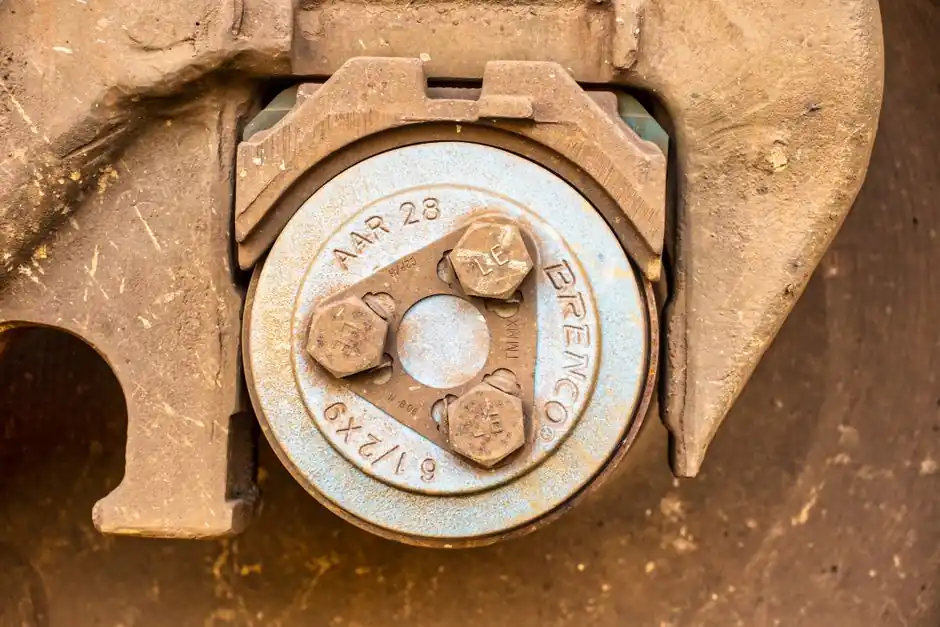
The global industrial fasteners market is sized at USD 92.13 billion in 2026 and projected to reach USD 113.33 billion by 2031, a 4.23% CAGR, with growth concentrated in aerospace, automotive electrification, and seismic-grade structural bolting rather than commodity carbon-steel screws [S1].
Three of the four major 2026 vintages of market sizing cluster within USD 108.95 to USD 114.37 billion, with Asia Pacific holding 38.64% of 2025 global revenue and North America contributing roughly 25% in the same period [S1][S3]. Demand is being pulled by offshore wind, EV battery packs, and high-rise seismic codes, each of which tightens the spec window and pushes buyers toward certified, traceable alloys.
Market Sizing: Where the 2026 Baseline Sits
Four independent 2026 forecasts bracket the global market between USD 92.13 billion and USD 114.37 billion, with the highest estimate (Coherent Market Insights) projecting USD 156.11 billion by 2033 at a 5.1% CAGR, and Precedence Research forecasting USD 176.32 billion by 2035 at a 4.32% CAGR [S1][S3][S4]. The variance reflects whether reporters count fasteners as a sub-line of hardware or include structural bolting, anchors, and aerospace specialty parts.
By raw material, metal fasteners held 49.23% of 2025 revenue and are the fastest-growing tracked material at 4.61% CAGR through 2031; plastic fasteners, by contrast, are forecast to expand at 5.73% CAGR between 2026 and 2035 in Precedence's lens, a different boundary that captures nylon and PEEK hardware used in electrical and lightweight assemblies [S1][S3]. By product type, externally threaded fasteners dominate at 47.34% to 49% of 2025 sales, and aerospace grades are forecast at a 5.07% CAGR to 2031 [S1][S3].
Driver Map: Electrification, Seismic Codes, Offshore Wind
Mordor's driver-impact model assigns the largest single lift to automotive electrification at +0.8% to the headline CAGR, with EV battery packs demanding torque-to-yield bolts that hold clamping force across a −40 °C to +85 °C cycle, a band that standard carbon-steel hardware cannot meet reliably [S1]. Seismic building codes in North America and Japan follow at +0.6%, mandating pretensioned bolts with ultimate strengths up to 200 ksi (roughly 1,380 MPa), which widens the spec gap versus A307-grade commodity fasteners [S1].
Offshore wind adds +0.5% to CAGR, with European North Sea and U.S. Atlantic Coast projects specifying large-diameter, corrosion-resistant bolts, often in super-duplex or 6Mo austenitic grades, to handle splash-zone exposure. Localization of aerospace fastener supply chains contributes +0.4%, precision micro-fasteners for industrial automation +0.5%, and emerging-economy infrastructure stimulus +0.7%, with India, Saudi Arabia, the UAE, and Southeast Asia the named hot spots [S1].
Selection Criteria and a Three-Option Comparison
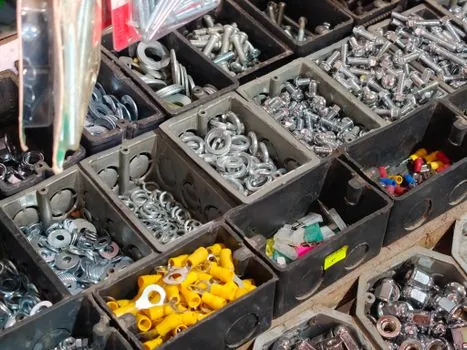
For an engineer sourcing fasteners in 2026, the decision pivots on three variables: required clamp-force retention across temperature, corrosion class (ISO 9223 C1 to C5), and traceability documentation (EN 10204 3.1/3.2). A useful three-way comparison frames the trade space: [S5]
Commodity carbon-steel bolts (ASTM A307, ISO 4014 grade 4.6 to 8.8) suit indoor, non-corrosive, static-loaded assemblies and remain the lowest-cost option, but lose clamp force in the EV battery-pack temperature window and have no high-cycle fatigue certification path [S1]. High-strength alloy structural bolts (ASTM F3125 grades A325/A490, ISO 4014 grade 10.9 with ultimate strengths to 200 ksi) address seismic and pre-tensioned structural joints and are the specified choice for high-rise and bridge work under U.S. and Japanese codes [S1].
Aerospace and corrosion-resistant specialty fasteners (Inconel, titanium grade 5/9, super-duplex stainless) carry the highest unit price but are the only option that simultaneously meets AS9100 traceability, NACE MR0175 sour-service compatibility, and offshore-wind ISO 12944 C5-M corrosion class. The 5.07% aerospace CAGR versus 4.23% headline confirms the premium tier is gaining mix [S1]. Nickel and molybdenum price volatility on stainless margins is the key cost-pressure variable in this segment, forcing producers to hedge or pass costs through.
Regional Read: Asia Pacific Leads, North America and Middle East Accelerate
Asia Pacific generated 38.64% of 2025 global fastener revenue, with Precedence sizing the region at USD 45.67 billion in 2025 and projecting USD 75.02 billion by 2035, a 5.09% regional CAGR, the highest of any geography in that dataset [S1][S3]. The Middle East follows with a 5.26% CAGR through 2031, driven by Saudi and UAE infrastructure pipelines [S1].
North America is sized at USD 20.70 billion in 2024 and projected to USD 24.29 billion by 2029, a slower growth rate but a higher-mix region: Mordor's data shows the U.S. capturing the bulk of seismic-bolt and aerospace-localization demand, both of which require certified U.S.-based suppliers under ITAR, DFARS, and Buy America provisions [S1][S2]. For European spec work, ATEX 2014/34/EU and EN 14399 high-strength structural bolting remain the governing framework for offshore and petrochemical assemblies, which is why nearshoring to qualified European mills is a recurring 2026 theme [S5].
Application Mix: Automotive, Industrial Machinery, Robotics
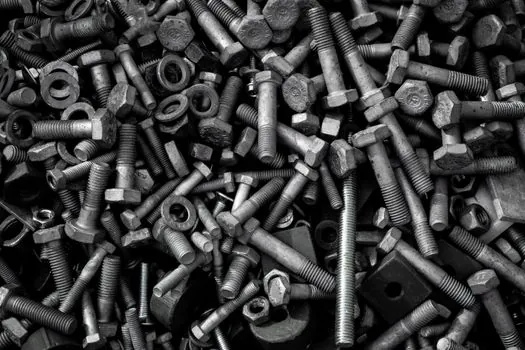
Automotive held 33.47% of 2025 fastener market sales globally, the single largest application line, while industrial machinery and robotics are the fastest-growing use case at 5.66% CAGR through 2031 [S1]. This split matters because EV battery packs reduce total fastener count per vehicle while raising per-fastener specification, a unit-volume decline masked by a unit-price increase, and robotics raises demand for precision micro-fasteners in sensor housings, harmonic drive assemblies and gripper bodies, where M2 to M4 titanium or stainless hardware is now standard.
Industrial buyers should track two verifiable indicators through the rest of 2026 and into 2027: the EV battery-pack fastener mix shift (A2-70 stainless versus coated carbon-steel share) and the offshore-wind monopile bolt order book from European fabricators. Both will move raw-material and lead-time signals inside the same quarter.
Risks: Counterfeits, Nickel Volatility, Substitution
Counterfeit fasteners remain the named market restraint in 2026, particularly in MRO and aftermarket channels, which is why EN 10204 3.1/3.2 mill certificates and IFI 138 or ASME B18.18 traceability are now spec-line items in most EPC packages [S4]. Nickel and molybdenum price volatility squeezes stainless-steel margins at the mill level, often 30 to 60 days before it surfaces in distributor price lists, so projects with fixed-price contracts should lock 304/316 and super-duplex tonnage early [S1].
Substitution risk is real in non-critical applications: plastic fasteners grow 5.73% CAGR, and engineered thermoplastics increasingly replace metal in electrical enclosures, consumer electronics, and lightweight interior trim [S3]. For a hands-on reference on which sub-segment a plant should actually standardize on, see the energy storage market 2026 capacity and battery-type splits, which carries related fastener-usage data points for utility-scale BESS containers. The closely linked top ball screw companies 2026 supplier map covers a complementary precision-motion fastening/linear-motion category that draws on the same titanium and high-grade stainless supply base.
Trackable Signals for the Next Two Quarters

Two indicators are worth watching through the end of 2026: the published 304/316 stainless surcharges from major European mills (visible monthly) and the 2026 IFE Phoenix show floor report on U.S. nearshoring capacity additions, scheduled October 7 to 9, 2026, which will be the first public read on whether the aerospace localization claim converts to booked orders [S2].
Component reference pages worth checking: industrial adhesive, and industrial borescope.