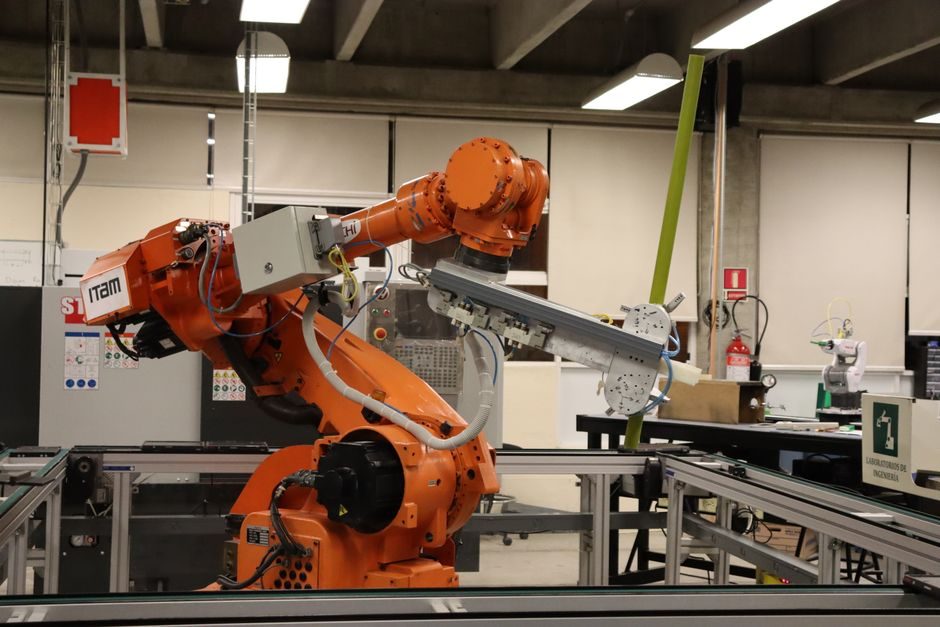
Global industrial robot production capacity is concentrated in five manufacturing economies — Japan, China, Germany, South Korea and the United States — which together account for the overwhelming majority of annual robot installations and OEM throughput worldwide, based on IFR national statistics [S4].
The market itself sits at roughly USD 23.71 Billion in 2024 and is projected to reach about USD 85.63 Billion by 2034, implying a 13.7% CAGR over 2025–2034 [S1]. On a unit basis, the picture is more uneven: Interact Analysis tracked 2024 as a year of mixed results, with global robot shipments projected to slip about 0.2% off a flat 2023, before reaccelerating in 2025 [S2]. For specifiers, the country-of-origin mix matters as much as the headline CAGR, because lead time, controller openness, and price floor all shift sharply between Japanese, European, Korean and Chinese supply.
Country Capacity Snapshot: Where the Robots Are Actually Built
IFR's standardised country tables track around 40 markets, with production, export and import data broken out for the major producers; the same report frames "robot density" — robots per 10,000 manufacturing employees — as the cross-country automation benchmark [S4]. Japan remains the historical OEM anchor: FANUC, Yaskawa (Motoman), Kawasaki Heavy Industries and Epson all run domestic final assembly plus overseas lines, and the country is the largest exporter of articulated-arm robots by value. South Korea is the second pillar on density, with a high robot-to-worker ratio driven by Samsung, LG and Hyundai's captive demand plus a strong export base from Doosan and Hyundai Robotics.
Germany holds the European seat: KUKA (now under Midea), KUKA Augsburg plus the legacy KUKA Swisslog palletising lines, and the Franka Emika / Neura Robotics mid-payload cluster, sit alongside Dürr and Stäubli integration. The United States remains a smaller-volume but high-value producer focused on defence, semiconductor, and collaborative arms, with companies such as Boston Dynamics (Stretch), Apptronik (Apollo), and the legacy American robot lines still running low-volume, high-mix builds. Mainland China is the fastest-scaling node, anchored by Estun (with its acquisition of the former German CLOOS welding line), Inovance, Siasun, Estun-Trojan, and a deep tier-2 supplier base in Suzhou, Shanghai and the Pearl River Delta; the country is now the largest single installer of industrial robots on an annual basis [S4].
Installed Base vs. Annual Output: The Two Numbers Specifiers Confuse
Installed base and annual production capacity are not the same metric, and confusing them is the most common sourcing mistake. IFR's reporting tracks both the cumulative operational stock in a country and the annual installations of new units; the country ranking differs depending on which figure you use [S4]. On installed base, China is now first, having crossed Japan around 2023–2024; on annual production output (OEM shipment origin), Japan still leads, with China second, Germany third, South Korea fourth, and the United States fifth — though the gap between China and Japan on the production side is closing fast as Chinese tier-1s ramp.
Global robot shipments were projected to dip about 0.2% in 2024 versus 2023, a flat-to-slightly-down year driven by destocking in automotive and weakness in electronics, before 2025 brought a renewed upward cycle on EV battery line capex and collaborative robot adoption in SMEs [S2]. The USD 23.71B → USD 85.63B trajectory at 13.7% CAGR is the demand-side envelope, not a single vendor's growth rate, and it is built on the assumption that automotive, electronics, metalworking, and logistics (with industrial camera machine-vision integration leading that last segment) all stay in expansion [S1][S4].
Decision-Criteria Comparison: Picking a Country of Origin for a Spec
For a process engineer writing a procurement spec, four criteria actually decide country of origin: controller openness, payload/precision tier, lead time, and price floor. On controller openness, Japanese OEMs (FANUC, Yaskawa, Kawasaki) still lock ROS/PC integration behind proprietary controllers, while most Chinese and many European vendors publish native EtherCAT / ROS 2 drivers; this matters far more for industrial coating cells and other vision-heavy lines than for a vanilla pick-and-place. On payload/precision tier, Japan and Germany still hold the high-precision (>0.02 mm repeatability) and heavy-payload (>300 kg) segments; China dominates the mid-payload (6–50 kg) collaborative and SCARA tier. [S1]
On lead time, Chinese tier-1s quote 4–8 weeks for standard articulated arms in 2026 versus 12–20 weeks from European and Japanese vendors, reflecting both the installed capacity growth covered in the industrial robot price trend 2026: where the floor sits and where the premium holds analysis and the broader capacity expansion tracked by IFR [S4]. The decision matrix is therefore: Japan/Germany for >100 kg or sub-0.02 mm precision; Korea for medium-payload automotive-tied lines; China for everything else where lead time and price dominate the RFQ.
Standards, Sourcing Signals and Failure Modes
Robots crossing into any major market are filtered by a small set of binding standards: ISO 10218-1/-2 (industrial robot safety), ISO/TS 15066 (cobot collaborative-operation limits), ISO 9283 (performance criteria), and the functional-safety pair ISO 13849-1 and IEC 62061; a typical open-source V&V framework will reference ISO 10218, 13849, 62061, 12100, 9283, 15066, 3691-4 and IEC 62443 in a single audit trail, which is what most Tier-1 audit checklists now expect [S3]. Open GitHub repositories tracked under the "industrial-robotics" topic explicitly list ISO 10218, ISO 13849, IEC 62061, ISO 12100, ISO 9283, ISO/TS 15066, ISO 3691-4 and IEC 62443 as the lifecycle anchors for both builder and reviewer roles [S3].
Two sourcing-side failure modes to flag: (1) controller firmware lockout — some Japanese OEMs will not allow third-party servo buses, which kills the economics of mixing a Chinese robot with European vision; (2) regional delivery pressure — a 2026 European auto-tier project is more likely to spec German or Japanese arms because the IFR density ranking shows the on-the-ground integration and service density is still concentrated there, even though the headline installed-base leader is now China [S4]. For higher-mix SME cells and any project sensitive to industrial adhesive dispensing repeatability, the spec almost always lands on a Chinese or Korean cobot with an open ROS 2 driver stack.
Trackable Signals for the Next 6–12 Months
Three signals are worth watching: IFR's next World Robotics release (annual cadence, typically Q3/Q4) will reconfirm or revise the 2025 unit-shipment number and the China-vs-Japan production split; any Chinese tier-1 disclosing a 200 kg+ heavy-payload arm at Hannover or CIIF would be a credible datapoint that the precision/payload gap is closing; and any new tariff or export-control action on Chinese-made industrial robots into the EU or US would shift the lead-time and price-floor split described above. [S2]