
Natural rubber (NR) and synthetic elastomers including NBR, EPDM, CR, FKM, and silicone span 30-80 Shore A hardness and 7-25 MPa tensile strength, which is why industrial rubber holds 60-70% of static-seal and 80%+ of vibration-mounting slots in chemical and heavy-machinery plants [S1].
Specifying the wrong family costs more than the part itself: a NBR seal in a hydrocarbon line swells and fails in weeks, while a FKM at -40°C cracks on first shift. This 2026 spec map covers what each elastomer family does well, where it fails, and how to read the data sheet line that actually decides service life.
Core Property Bands That Drive Every Selection
Hardness for commodity industrial rubber falls in the 30-80 Shore A range, with 60-70 Shore A covering roughly 70% of gaskets, O-rings, and mounts; below 50 Shore A the material flows under load, above 80 Shore A it loses the elastic recovery that defines an elastomer [S1]. Tensile strength for unfilled NR sits at 20-25 MPa, dropping to 7-15 MPa for most filled general-purpose compounds and rising above 25 MPa for carbon-black-reinforced NBR and EPDM grades.
Elongation at break typically lands between 300-700% for NR and EPDM, falling to 150-300% for FKM and silicone; this matters because higher elongation tolerates flange mismatch and thermal expansion without splitting.
Operating-temperature windows differ by family: silicone spans -60 to 230°C, EPDM -50 to 150°C, NBR -40 to 110°C, CR -40 to 120°C, FKM -26 to 205°C, and NR -50 to 80°C, which sets the first hard cut when a datasheet is opened. Specific gravity runs 0.91-0.94 for NR, 0.97-1.00 for silicone, 1.00-1.30 for NBR/EPDM/CR, and 1.80-1.90 for FKM — the density band is a quick sanity check that the right polymer, not a cheap extender, is on the certificate.
Advantages: Why Engineers Keep Specifying Rubber
Elastic recovery above 80% after 100% strain lets rubber absorb vibration and shock that would fatigue a rigid polymer, which is why industrial rubber dominates conveyor idler covers, pump mount pads, and pipe-rubber expansion joints. Chemical resistance is family-specific but well-documented: EPDM tolerates steam, hot water, ketones, and brake fluids, while NBR resists petroleum oils, diesel, and greases at room temperature and is the default for hydraulic and fuel-line sealing.
Cost per kilogram stays low: NR, SBR, and CR compounds land at $2-5/kg, EPDM at $3-6/kg, NBR at $3-7/kg, while FKM and FFKM climb to $30-80/kg, which is the chief reason FKM is reserved for hot oil, acid, or aerospace duty. Rubber bonds to metal and fabric during vulcanization, which is why steel-cord conveyor belts, rubber-lined steel pipes, and vibration-isolating rubber-to-metal mounts are single assemblies rather than glued stacks.
Dielectric strength of 10-30 kV/mm for silicone and EPDM makes rubber a default insulator for cable jackets, transformer boots, and HV switchgear shrouds. Low thermal conductivity around 0.13-0.30 W/m·K is a weakness for heat transfer but a feature for thermal insulation on steam lines and exhaust hangers.
Disadvantages and Failure Modes Engineers Hit in Service
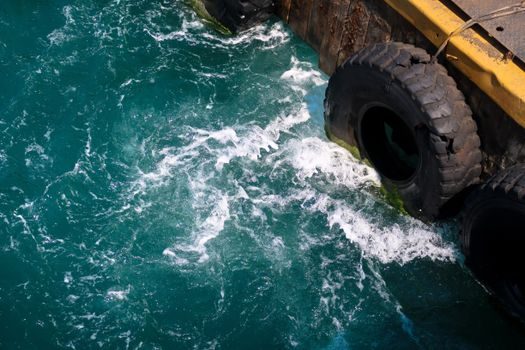
Compression-set creep is the number-one replacement driver: any elastomer held under 15-25% deflection will gradually take a permanent set, lose preload on a flange, and start to leak — the typical hydraulic O-ring overhaul window is 18-36 months in continuous duty [S1]. UV, ozone, and weathering crack NR, SBR, and NBR unless antiozonants are added, which is why outdoor-exposed parts default to EPDM, CR, or silicone and why black compounds with 1.5-3 phr carbon black outlive light-coloured equivalents outdoors.
Chemical attack is highly family-specific and catastrophic when misapplied: NBR swells 15-40% in ketones and aromatics, NR dissolves in turpentine and gasoline, EPDM fails in petroleum oil, and silicone swells in many solvents. Continuous upper-temperature exposure is the silent killer — NBR held 10°C above its 110°C ceiling hardens and loses 50% elongation in 1,000 h, while FKM keeps 90% properties at 200°C for the same period.
Other hard limits: rubber is not a structural material (modulus 1-25 MPa versus 200 GPa for steel), burns readily without flame-retardant additives, and tolerates only modest pressure in dynamic seals — a typical NBR O-ring at 70 Shore A is rated to 10-20 MPa static and 5-7 MPa dynamic. Recyclability is poor: vulcanized thermoset rubber cannot be remelted, and ground crumb rubber is mostly downcycled into lower-grade mats and asphalt.
Family Comparison: NBR vs EPDM vs CR vs FKM vs Silicone
On temperature window, EPDM (-50 to 150°C) and silicone (-60 to 230°C) cover the broadest spans, while NBR (-40 to 110°C) and CR (-40 to 120°C) sit in the mid-band and FKM (-26 to 205°C) owns hot oil and chemical duty [S1]. On hydrocarbon resistance NBR and FKM pass, EPDM and silicone fail; on steam, hot water, and brake-fluid resistance EPDM and silicone pass while NBR and CR fail — this single cross-cut rules most hydraulic and chemical-plant seal picks.
On cost the ranking is NR/SBR/CR < EPDM ≈ NBR < silicone < FKM << FFKM, with the 5-15x price jump from NBR to FKM forcing plant engineers to limit FKM to hot or chemically aggressive zones. On aging and ozone resistance EPDM, CR, and silicone last 10-20 years outdoors; NR and SBR need covers or confinement. On dynamic-seal life at 80-100°C, FKM runs 3-5x the cycles of NBR in synthetic hydraulic oil — the premium pays for itself when disassembly costs dominate.
For an at-a-glance call: water, steam, brake fluid → EPDM; petroleum oil, diesel, general hydraulic → NBR; outdoor weather, moderate chemicals, adhesives → CR; hot oil, acid, aerospace, semiconductor → FKM; food-grade, medical, extreme cold or high heat → silicone; heavy abrasion, high tensile, no oil → NR. The same selection logic is applied to plant-wide equipment like vertical lift module advantages and disadvantages: 2026 spec engineer's view, where elastomer rollers and seals are picked against duty cycle and chemistry.
Typical Industrial Use Cases by Service
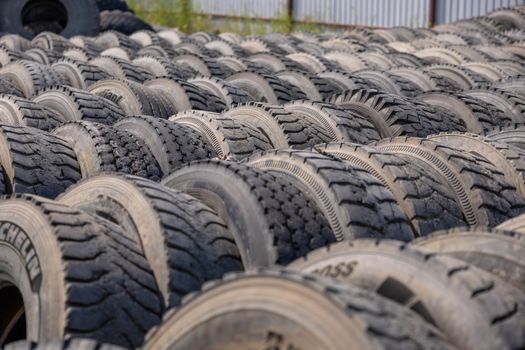
Conveyor belting uses NR/SBR covers rated 60-80 Shore A with 15-25 MPa tensile for aggregate and 10-18 MPa for chemical lines, with hot-material belts switching to EPDM covers up to 150°C [S1]. Rubber-lined steel pipe and tanks take 6-12 mm of NR, BR, or EPDM lining bonded to ASTM A36 or A516 steel, extending service in abrasive slurry from 1-2 years (unlined) to 8-15 years. Anti-vibration mounts pair 40-60 Shore A NR or CR with metal hardware and target natural frequencies of 5-15 Hz to decouple rotating equipment.
Hydraulic and pneumatic seals lean on NBR 70-90 Shore A for mineral oil and EPDM 70-80 Shore A for water-glycol and brake fluid, with back-up rings in PTFE or POM handling extrusion gaps above 0.5 mm. Rubber rolls for paper, printing, and textile lines use 20-40 Shore A EPDM or silicone for soft nip, and 70-90 Shore A NBR or polyurethane for hard press rolls, with the related belt tensioner sizing and selection: spec-level guide for serpentine and conveyor drives covering the matching drive-side spec chain.
Who Should Specify Rubber — and Who Should Not
Specifiers in chemical processing, water treatment, oil & gas, food and beverage, mining, and rail benefit most from elastomer sealing, lining, and damping. A rubber-lined pipe in a slurry duty often outlasts stainless steel by 3-5x at a fraction of the installed cost, which is hard for a metallurgist to dismiss once the field data lands. [S1]
A common 2026 pitfall is choosing EPDM because it is "the outdoor rubber" without checking that the system is also exposed to petroleum — the seal then swells and the warranty claim is filed. Another is selecting NR for an ozone-rich switchyard, where the same EPDM would have run twice as long. The point is not to avoid rubber but to honour the family boundaries the data sheet sets out.
Sourcing Signals, Standards, and Spec Discipline
Hard specs should reference ASTM D2000 line call-outs (e.g. "AA 710 A26 B36"), ISO 3601 for O-ring dimensions, and EN 681-1 for elastomer sealing gaskets in water and drainage; for potable water NSF/ANSI 61, for food contact FDA 21 CFR 177.2600, and for oilfield sour service NACE MR0175 / ISO 15156 are the governing references [S1]. A complete datasheet should list hardness ±5 Shore A, tensile strength, elongation at break, compression set at the rated temperature, specific gravity, and a fluid ageing row (ASTM D471) showing hardness change ± points, tensile change %, and volume change % after 70 h in the target fluid.
Trackable 2026 signals: the global industrial rubber market sits above $40 billion with steady 4-5% CAGR, Chinese and Southeast-Asian capacity additions in EPDM and silicone continue to compress lead times from 12-16 weeks to 4-8 weeks for commodity grades, while FKM and FFKM supply remains tight at 16-24 weeks. Two watch items — (1) the EU PFAS restriction proposal covering FKM and FFKM, and (2) ASTM D2000 revision work to add bio-based EPDM grades — are the next decisions that will shift which row a process engineer checks first on the spec sheet.
Component reference pages worth checking: industrial adhesive, and industrial borescope.