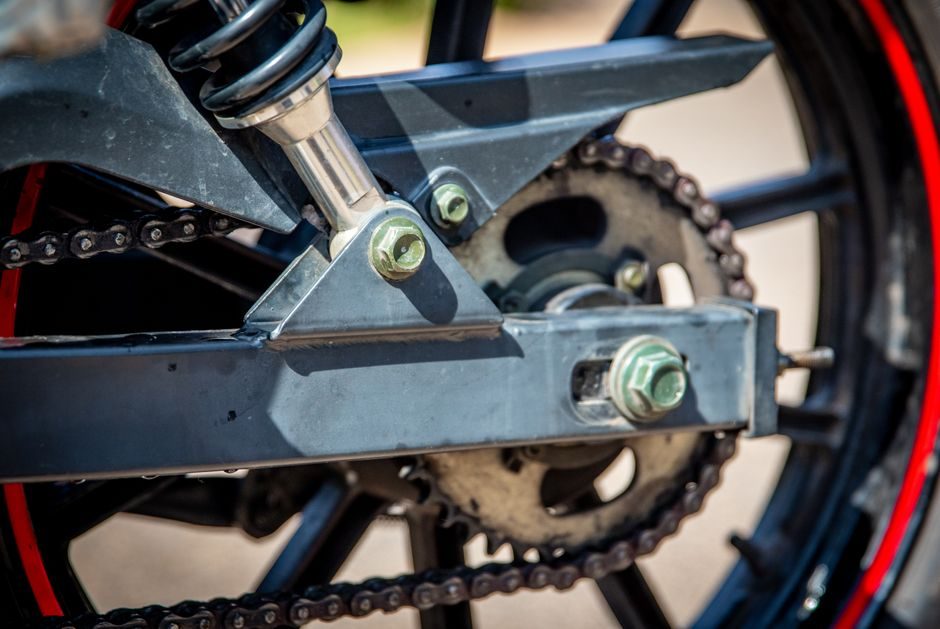
For 2026 procurement, the industrial shock absorber market splits cleanly into two spec universes: small hydraulic dampers (M8-M14 thread, 2-20 Nm/cycle, US$2-5 FOB Zhejiang on bulk orders) and automotive OE dampers sized by vehicle mass and OE part number (KYB 349134 rear-axle unit for AUDI A6 4G/FORD platforms, bottom-eye/top-pin mount pattern) [S1][S3].
Treat "shock absorber" as an umbrella term: engineers building automation cells care about energy absorption per cycle and lifetime cycles to lockout, while automotive buyers match OE reference numbers, mounting geometry and damping curve to a chassis platform [S1]. A buy written against the wrong spec class wastes weeks — industrial pneumatic and hydraulic units cannot be swapped for an automotive damper even if both share thread pitch [S1].
Spec Gate 1: Energy Per Stroke vs Cycle Life
Industrial self-compensating hydraulic dampers in the M8-M14 size band are typically rated 2-20 Nm per cycle, with cycle life quoted at 0.5-2 million strokes depending on piston seal stack, oil viscosity and rod speed [S3]. A buyer who only reads "max energy" without the matching cycle count ends up with a unit that locks up at 200,000 strokes on a high-cam pick-and-place line [S3].
For sizing basics and how a linear guide pairs with end-of-stroke damping, the mechanism overlap is identical to machine-tool axis arrest.
Spec Gate 2: Mounting, Thread and Environment
Thread pitch, body length-to-stroke ratio and mount style (bottom eye, top pin, clevis, flange) lock the damper to a fixture before any energy number matters [S1]. The KYB 349134 pattern — bottom-eye plus top-pin, rear-axle fitment for AUDI 4G5513035 platforms — shows how a part number encodes both geometry and damping curve, and why cross-OE substitution without a damping-curve match gives a wallowing car [S1].
For industrial cells the parallel is stainless rod vs chromed rod, NBR vs FKM seals, and operating-temperature window (standard NBR: roughly -10 to +80 °C; FKM: roughly -15 to +200 °C). On washdown or food lines, insist on FDA-grade seal oil and a 304/316 stainless body; on a welding cell, FKM seals and a chrome-plated rod are baseline [S3].
Spec Gate 3: Adjustment vs Fixed Orifice
Fixed-orifice (self-compensating) dampers are cheaper and more repeatable, which is why they dominate the US$2-5 FOB tier out of Zhejiang [S3]. Adjustable units add a needle valve on the rod end, letting a technician tune the deceleration curve on-site — useful for prototype lines where payload and speed drift, but they introduce a set-and-forget risk: a knocked adjuster silently changes the curve in production [S3].
A useful rule: fixed-orifice for high-volume OEM machines (cost-driven, repeatable), adjustable for low-volume special machinery (engineering-driven, tunable). Pneumatic versions add a reservoir and a metered air bleed — slower response, but immune to oil-foam at low temperature [S3].
Comparison: Fixed Hydraulic vs Adjustable Hydraulic vs Pneumatic
Lining the three common types against four decision criteria, using ranges grounded in the Made-in-China supplier data and standard damper catalogues [S3]:
Fixed hydraulic small-bore: energy 2-20 Nm/cycle, cycle life 0.5-2 M strokes, price band US$2-5 FOB per piece at 1-piece MOQ, environment indoor automation only, no on-site tuning. Adjustable hydraulic small-bore: energy 3-30 Nm/cycle, cycle life 0.3-1 M strokes, price band typically 30-80% above fixed for the same bore, environment indoor automation, on-site tuning via needle valve. Pneumatic (large-bore, reservoir-style): energy 50-500 Nm/cycle, cycle life 0.1-0.5 M strokes, price band tens to low-hundreds USD, environment outdoor/heavy industry, oil-immune but slower response [S3].
For a moving-mass arrest at the end of a linear guide axis, the first two are the right answer; for a 200 kg press-door arrest, only the third class has the energy budget.
Who This Is For, and Who It Is Not For

This guide is for automation engineers, machine builders, automotive aftermarket buyers and maintenance leads specifying dampers in 2026 — people who have a force budget, a cycle count and a fixture drawing in hand. It is not for buyers sourcing consumer sportswear, where the term "shock absorber" denotes a sports-bra brand (Shock Absorber®, Hanesbrands Inc.) at retail £36-£52 in the UK [S2][S4][S5].
If the spec sheet you are reading mentions bra sizing, fabric, or running-activity rating, you are in the wrong catalogue [S2][S5]. The two markets do not overlap on price, units, or supplier list — and a buyer who confuses them wastes RFQ cycles.
Real Use Cases and a Sourcing Map
Pick-and-place end-of-arm arrest, cylinder rod-end cushioning, conveyor diverter dampers and rotary indexing-table stops are the four highest-volume industrial applications; all four land in the fixed hydraulic small-bore class and the US$2-5 FOB Zhejiang price band is realistic at 1-piece MOQ on Made-in-China [S3]. Automotive OE rear-axle fitments (KYB 349134 / AUDI 4G5513035 reference) sit in a different procurement lane — OE part number, vehicle platform, mounting geometry [S1].
For cost planning on a multi-axis machine line, the parallel read on motion controller cost structures is useful: axis count and bus type decide the bill in motion control the way bore and cycle count decide it in damping. For heavy-load arrest above 500 Nm/cycle, escalate to a pneumatic or oil-hydro reservoir unit, not a larger-bore hydraulic small unit — the seal stack cannot keep up [S3].
Limitations, Failure Modes and Standards
Hydraulic small-bore dampers fail in three predictable ways: rod-seal blow-by (oil-wet rod, gradual force loss), nitrogen pre-charge loss on adjustable types (inconsistent curves), and rod bending from side-load on a misaligned mount [S3]. Heat-soak above roughly +80 °C on NBR-seal units is the silent killer; the rod looks fine, the oil thins, the curve drifts, and the line trips a quality alarm weeks later [S3].
Standards to anchor a spec on: ISO 5598 (pneumatic-hydraulic vocabulary) and the OEM-specific vibration/damping test methods (e.g. automotive: manufacturer-internal damped-oscillation test for OE dampers like the KYB 349134 class) [S1]. On food/pharma washdown lines, insist on 304/316 stainless wetted parts and FDA-grade seal oil; on offshore, FKM seals and a salt-spray-rated rod finish [S3].
RFQ Checklist and 2026 Watch-Items
Send the supplier four numbers and one drawing: effective mass (kg), impact speed (m/s), impacts per minute, and desired cycles-to-failure, plus the fixture drawing with thread and mount style [S1][S3]. Get back a matched energy-per-cycle, cycle life, oil type, seal material and operating-temperature window, and reject any quote that returns only max energy without cycle life [S3].
Trackable signals to watch in the second half of 2026: Zhejiang small-bore FOB pricing around the US$2-5 per-piece band as the cycle-life benchmark [S3], and OE automotive damper price moves on AUDI/FORD rear-axle references such as KYB 349134 / AUDI 4G5513035 [S1]. If FOB pricing on the industrial band drops below US$2, audit seal material and rod plating before accepting the order [S3].
For component-level specifications, see crossed roller guide.