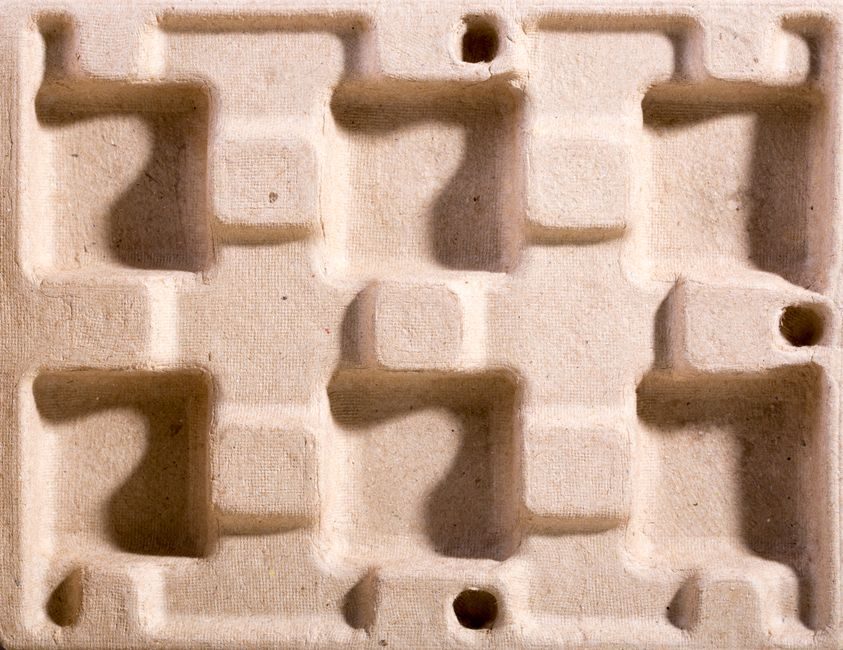
Specifying an injection molded part correctly requires resolving three independent variables — resin family, mold class, and part-geometry draft/rib rules — before quoting any tonnage or cycle time [S1][S2].
PCBWay positions injection molding as a process suited to medical inserts, automotive brackets, and aerospace/defense components, where repeatability and unit-cost-at-scale dominate the selection logic [S1]. JA Future-Mould reports a throughput of 300–400 molds per year at 99.98% on-time delivery, illustrating the production cadence tier a sourcing team should benchmark against rapid-prototype shops [S3].
Resin Family and Direction-Dependent Behaviour
Glass-reinforced engineering thermoplastics — fiberglass-filled PPS, for example — exhibit direction-dependent coefficients of thermal expansion (CTE) above and below the glass transition temperature, which directly affects shaft and housing tolerances measured by TMA [S4].
For non-reinforced commodity resins (PP, PE, ABS), CTE is roughly isotropic, but for glass-filled grades an axial vs radial CTE delta of 20–50% is common; specifiers working with a shaft or bearing housing must measure both axes, not a single datasheet number [S4]. Selecting unfilled resin when isotropy is required — and glass-filled resin only when creep resistance and stiffness justify the directional drift — is the first hard trade-off.
Tooling Class: Rapid Aluminum vs Production Hardened Steel
Rapid tooling with aluminum or soft-steel cavities is built in days and suited to runs of a few hundred to a few thousand parts, while production tooling in hardened P20 or H13 steel supports runs above ~100,000 shots with tighter dimensional control [S1].
Unit-price crossover typically sits in the 5,000–10,000 part window: below that, rapid aluminum wins on amortized cost; above it, hardened-steel tooling lowers per-part cost and supports tighter tolerances. Molders reporting 300–400 mold builds per year generally use multi-cavity hardened-steel tooling for production runs, not single-cavity rapid tools [S3]. Aluminum rapid tools also limit achievable surface finish and shut off at polymer temperatures above ~260 °C, which excludes PEEK and most glass-filled PPS grades.
Draft, Ribs and Wall-Thickness Rules

Support ribs joining tapered screw bosses to drafted sidewalls cannot use the basic Rib command in Autodesk Inventor without rework; designers must hand-craft the blend surface to maintain continuous draft across the junction, otherwise the part will drag or flash on ejection [S2]. Wall thickness uniformity — typically held within ±25% across a part — is the single biggest predictor of sink, warp, and cycle-time stability.
Comparison: Commodity vs Engineering vs Glass-Filled Resin
Commodity resins (PP, PE, ABS) deliver the lowest unit cost and isotropic behaviour but cap continuous service temperature around 80–100 °C and offer modest tensile strength in the 30–50 MPa range. Engineering resins (PA66, PC, POM) raise service temperature to 120–150 °C and tensile strength to 50–80 MPa with a 2–4× cost premium. Glass-filled engineering resins (PPS-GF, PA66-GF30) push continuous service above 200 °C and tensile strength above 150 MPa, but introduce direction-dependent CTE that must be measured part-by-part [S4]. For specifiers working in industrial valves or flow meters housings, glass-filled grades are the default where chemical resistance and dimensional stability under thermal cycling dominate; for embedded parts in low-stress assemblies, commodity grades usually win on cost.
Selection Criteria, Use Cases and Limits
Injection molding fits when annual volume exceeds roughly 1,000 parts, the part has uniform wall section, and the resin choice is a known production-grade — not a prototype-only grade that will be discontinued in 18 months [S1][S3].
It does not fit for sub-100-part runs (where SLA or vacuum casting is cheaper), for parts with wall-thickness ratios above 4:1 (sink and warp become uncontrollable), or for parts that require post-mold metal inserts press-fitted into a flexible substrate. The standard rule of thumb mirrored in the Autodesk community: a draft angle per side of at least 1° for a depth of 25 mm, and never an internal corner sharper than the material's minimum draft allows, is the gating geometry test before any DFM review.
Standards, Sourcing Signals and Common Failures
For cross-process comparison, see the industrial spring cost guide and the wire form cost guide — both use the same amortized-tooling-vs-unit-cost logic.
Trackable signals: any quoted mold with >2 cavities, hardened-steel tooling, and a documented DFM revision cycle is the right tier for production; aluminum single-cavity quotes above 5,000 parts/year usually signal an under-specified sourcing decision and should be challenged on cycle time, draft, and resin flow before PO release.