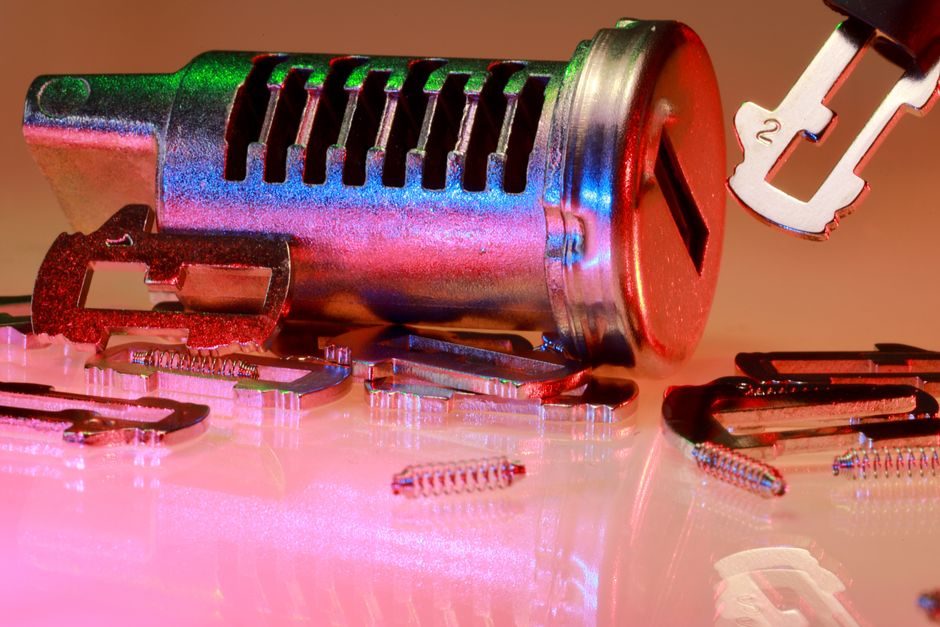
Wire form part cost in 2026 is best understood as a stack: raw wire-rod material, tooling/setup amortisation, secondary operations, and supplier overhead, with ISO 9001-registered custom shops commonly setting a USD $2,000 minimum order value for made-to-order runs [S2].
This guide breaks down how those four cost layers actually move the unit price, and where buyers can defensibly negotiate versus where the supplier's hand is forced by raw-material markets tracked through the U.S. Bureau of Labor Statistics Producer Price Index (PPI) program [S1].
Raw Wire-Rod Material: The Largest Single Cost Driver
Wire-rod grade, diameter and temper account for the single largest line item on a wire form RFQ, typically 35-55% of unit cost on simple geometries [S2]. Carbon-steel music wire (ASTM A228), hard-drawn (ASTM A227), stainless 302/304 and 316, and oil-tempered chrome-silicon (ASTM A229) carry materially different price points per pound, and each has its own diameter window where formability and cost are balanced.
The PPI series for steel wire and cold-finished bars is the reference index used inside long-term supply contracts to pass raw-material inflation through to the buyer, and BLS publishes over 2 million series annually covering producer, consumer, export and import price indexes [S1]. For a buyer's hedging discussion, that index family is the legitimate anchor; it is also the same dataset that custom spring manufacturers reference when re-pricing annual contracts.
Tooling, Setup and the Per-Part Setup Tax
Setup cost on a multi-slide CNC wire former is amortised across the production lot, so per-part setup cost falls sharply as lot size rises — a structural effect buyers should plan around when issuing blanket POs [S2]. For prototypes, setup frequently represents more than 60% of the unit price; for runs above 10,000 pieces, setup drops below 5% of unit cost on most standard geometries.
Material grade also drives setup cost indirectly: 17-7 PH and 316 stainless work-harden faster than 304, which feeds back into feed-rate limits, tool-wear allowances and therefore machine time per part. This is why a stainless 316 J-hook quote is rarely directly comparable to a 304 quote even at identical wire diameter and bend count.
Geometry and Secondary Operations: What Adds Real Cost

Each additional bend, pierce, thread, weld or plating operation layers onto the per-part cost in a near-discrete way, and the four-axis multi-slide forming limit (typically up to 4 bends or punches in one setup) defines the boundary between single-hit and progressive-tool pricing [S2].
Common secondary operations that materially shift a quote include: zinc plating (commercial vs. ASTM B633 Class 1 vs. Class 3), black oxide, powder coating, passivation for stainless (ASTM A967), heat treatment, stress relief, and assembly with purchased components such as threaded inserts. Each of these is a separate line on the supplier's cost sheet and is the area where precision linear guides in the forming machine are part of the reason tolerance consistency is achievable — a tangent, but a real one when justifying price differentials across shops.
Quantity Breaks and MOQ Economics
Master Spring, a Midwest U.S. ISO 9001-registered custom wire form and coil spring manufacturer, publishes a USD $2,000 minimum purchase order for made-to-order wire forms and coil springs, an explicit acknowledgement that setup economics below that threshold simply do not amortise [S2]. That figure is a useful benchmark when comparing quotes from peer shops, though some producers will accept smaller prototype orders at higher per-piece pricing.
Volume discount curves typically show three steps: prototype (1-100 pieces, highest per-piece), pilot (100-2,500), and production (2,500+).
Material Selection Trade-Offs: Cost vs. Corrosion vs. Formability
Comparing the four most commonly specified wire-rod families against four practical decision criteria gives buyers a defensible selection matrix. (1) Cost per pound — hard-drawn carbon steel is the cheapest, 316 stainless is the most expensive, often 4-6x the carbon-steel baseline. (2) Corrosion resistance — carbon steels need plating; 304 stainless is adequate for most indoor and mild outdoor service; 316 is required for marine, chloride-rich and medical-grade exposure. (3) Formability / bend complexity — 304 stainless and hard-drawn carbon steel form cleanly in 4-axis multi-slide machines; 17-7 PH and 316 work-harden and push cycle times up. (4) Temperature / fatigue service — chrome-silicon oil-tempered (ASTM A229) and music wire (ASTM A228) win for cyclic-load springs, with music wire the top performer for high-cycle extension and torsion springs at moderate temperatures [S2].
For buyers who need to understand the upstream stock, wire rod is the hot-rolled coiled feedstock that custom formers draw down to their specified final diameter, and the per-pound delta between hot-rolled rod and finished bright wire is itself a line item suppliers pass through.
Standards, Inspection and the Hidden Cost of Quality
Most automotive, appliance and industrial buyers specify PPAP or First Article Inspection (AS9102 or AIAG PPAP 4th edition) on critical wire forms, and that documentation cost is real and per-part-number, not per-piece. ISO 9001 registration is the floor; Tier-1 automotive and medical buyers typically also require IATF 16949 or ISO 13485 respectively, and that scope of certification is reflected in the supplier overhead component of the quote [S2].
Buyers should expect to see gauge calibration, spring-rate testing, salt-spray testing per ASTM B117 (typically 24-96 hours for zinc-plated carbon-steel forms), and RoHS/REACH compliance documentation as separate line items, and these are legitimate costs rather than supplier padding when sourced from a registered shop.
Where the Negotiation Room Actually Lives

Beyond material, the next two levers are lot size commitment (signing a 12-month blanket releases setup amortisation across the year) and standardising bend radii and tolerances (loosening a ±0.005 in. tolerance to ±0.010 in. often halves the scrap-rate allowance suppliers build in).
For buyers with adjacent engineered-component spend, similar dynamics apply across crossed roller guides and other motion-control hardware, where raw-material indexation, setup amortisation and certification overhead stack the same way as on a wire form RFQ. The framework is transferable: identify the material line, the setup line, the secondary-operation line, and the overhead line, then negotiate them independently.
Trackable signals for the next 90 days: PPI steel-wire series movements from the BLS release schedule [S1], and ISO 9001 / IATF 16949 audit-cycle pricing adjustments at peer custom formers [S2]. Buyers who lock material spec and volume forecasts now will be best positioned when the next raw-material index pass-through lands.
For related coverage, see Machine Vision System Manufacturing: Process Map, Component Stack and 2026 Sourcing.