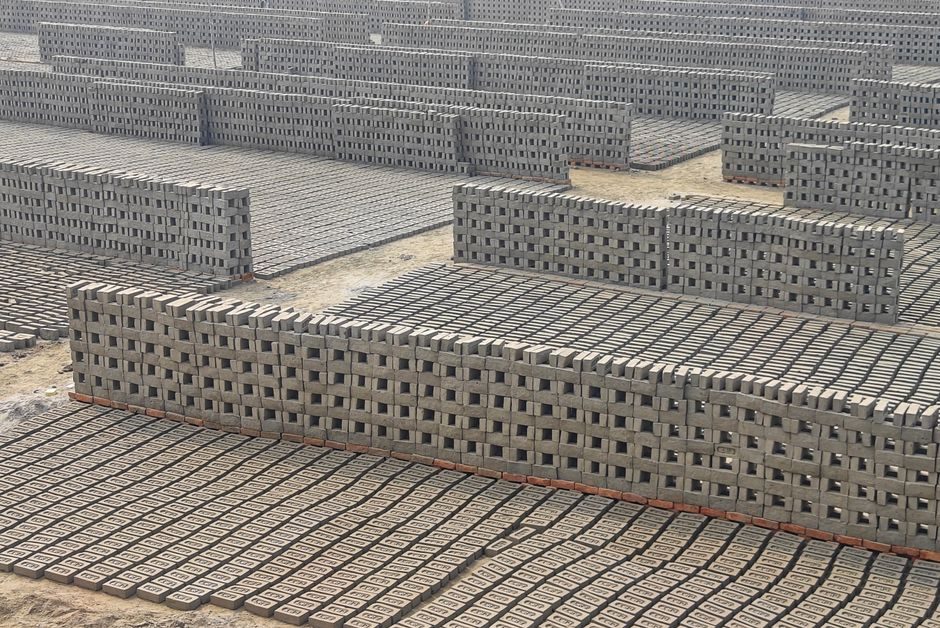
For furnace, kiln and firebox lining decisions the choice between a board-format <b>insulation board</b> polyurethane-insulation family and a <b>fired clay brick</b> fired-brick is driven by hot-face temperature, λ-target, and structural load — not by marketing claims of "energy saving".
Fired clay bricks span JM23 (≈ 0.55 W/m·K, 1300 °C) through JM30 (≈ 0.65 W/m·K, 1650 °C) per CNBM's published B-series index [S5], while rigid foam and mineral boards (EPS, XPS, PU, rock wool) run λ = 0.024–0.040 W/m·K but cap below 250 °C without a facing layer [S1]. Cross-referenced <b>EPS</b> and <b>XPS</b> grades are catalogued separately in the eps-board reference, and high-density <b>insulation board</b> families in the insulation-board entry.
Temperature Class and Refractoriness Window
Fired clay bricks are graded by Al₂O₃ content and use temperature: 65 % Al₂O₃ minimum high-alumina brick is rated to 1600 °C, with a manufacturer-published use temperature band of 1300–1700 °C depending on grade [S6]. CMAX-series firebricks are classified between 1300 °C and 1700 °C and are described as dense shaped refractory material with high refractoriness and good thermal shock resistance [S4]. The JK series insulation fireclay brick line covers the same hot-face band, marketed as an "ideal thermal insulation material for industrial furnaces and heating pipe" applications [S9].
Rigid foam and most fibrous <b>insulation board</b> products sit well below that band. Expanded polystyrene (EPS) and extruded polystyrene (XPS) boards soften past 70–100 °C, polyurethane (PU/PIR) boards cap around 110–120 °C, and rock wool or ceramic fiber board extends the range to roughly 600–1200 °C depending on density and binder [S1]. Where a furnace hot face runs >250 °C, a non-ceramic <b>insulation board</b> must be paired with an inner refractory skin — board alone is not a substitute.
Density, Thermal Conductivity and the λ-Trade
The defining trade-off is λ vs density. Lightweight clay firebrick is sold at US$230–390 per ton FOB China (MOQ 5 t) with refractoriness reported in the 1300–1700 °C window [S3], and JK-series insulation fireclay bricks list FOB ≈ US$1.89 per piece with delivery in 15 days from China [S9]. High-alumina lightweight bricks are explicitly built on organic-matter burnout to raise porosity, which simultaneously lowers volume density and thermal conductivity while keeping mechanical strength adequate for furnace lining [S2][S6].
Foam and fiber boards win the λ contest by an order of magnitude: closed-cell PU boards run 0.022–0.028 W/m·K, XPS 0.029–0.035 W/m·K, and EPS 0.032–0.040 W/m·K at 25 °C mean. At 200 kg/m³ bulk density a typical rock wool board is ≈ 0.035 W/m·K, and 128 kg/m³ ceramic fiber board is ≈ 0.040 W/m·K at 200 °C mean. The penalty is temperature ceiling: a <b>block-brick</b> block-brick refractory cannot be replaced by a foam board behind a steel jacket, and an EPS <b>insulation board</b> cannot sit on the hot face of a 1200 °C kiln.
Where Insulation Board Wins, Where Fired Brick Wins
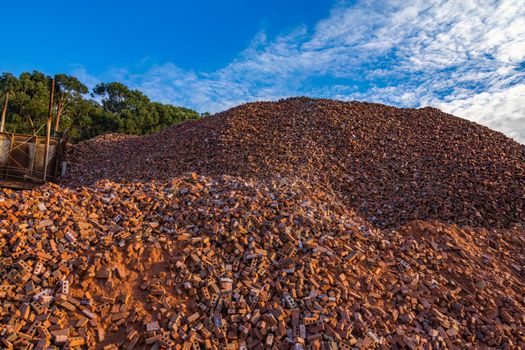
Use a foam or fiber <b>insulation board</b> on cold-face and building-envelope work: external walls, cold-storage sandwich panels, pipe and duct lagging below 250 °C, and the cold-side backup of a multi-layer refractory lining. Use a fired clay brick — JM23, JM26, JM28 or JM30 grade — for hot-face lining of converters, AC and DC arc furnaces, ladle slag lines, and reheat furnaces where the working lining sees >1000 °C [S5].
The B-series lightweight thermal fireclay insulation brick line is targeted at furnace and firebox lining where bulk density below 1000 kg/m³ is acceptable and a low-λ backing is needed behind a denser hot-face brick [S7]. A 1000 t/month supply capability from Shanghai-based exporters is typical for this category [S7][S8], so lead time on a multi-container order is dominated by sea freight, not by mill queue.
Mechanical Load, Thermal Shock and Service Life
Fired clay bricks are specified where the lining carries mechanical load — refractory brick is "a block of refractory ceramic material used in lining furnaces, kilns, fireboxes, and fireplaces" [S7][S8], and phosphate-bonded high-alumina bricks list high strength and low thermal conductivity as parallel advantages [S4]. High-alumina lightweight brick uses organic burnout to engineer porosity for insulation while preserving mechanical intensity for lining life [S2].
Foam and fiber <b>insulation board</b> products generally are not structural. PU and PIR boards take compression loads of 100–250 kPa at 10 % deflection depending on grade, rock wool boards are weaker, and EPS/XPS sit in a similar 60–200 kPa band. In a furnace, board is a backup, not a working lining. Thermal cycling is the failure mode to watch: a ceramic-fiber <b>insulation board</b> can take rapid heat-up better than a brick, but is far more vulnerable to mechanical erosion and to alkali attack from process dust.
Standards Conformance and Sourcing
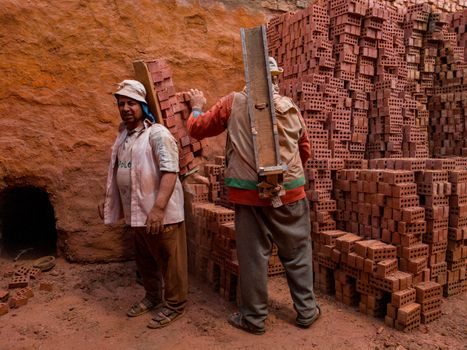
CNBM publishes conformity to ISO 9000 for the insulating fire brick range, with thermal insulation fire clay bricks meeting ASTM and JIS requirements and MSDS available on request [S5]. ASTM C155 covers insulating fire brick classification, ISO 2245 covers shaped insulating refractory products, and JIS R2301 series governs Japanese fireclay brick grades — these are the reference documents buyers should request, not generic ISO 9000 only. Manufacturer-published use temperatures (1300 °C for the JM23 grade, 1650 °C for JM30 in the CNBM index) [S5] are the starting numbers for spec sheets, with actual hot-face rating confirmed by independent test report.
For shipping, both categories move as containerized bulk. JK insulation fireclay bricks are quoted at US$1.89 per piece, MOQ negotiable, 15-day delivery in wooden case [S9]; lightweight clay firebrick is sold at US$230–390 per ton, MOQ 5 t, FOB Qingdao with a 10 000 t/year production line [S3]; the B-series line lists a 1 t MOQ and 1000 t/month capacity from Shanghai [S7]. Comparable context for foam and fiber <b>insulation board</b> is given in the insulation board buying guide 2026 which walks the same variables — material, density, service temperature, MOQ — for the cold-face side of the same envelope.
Decision Comparison at a Glance
Where the call is genuinely two-way, a composite lining is the engineering answer: dense fireclay brick on the hot face, lightweight insulating firebrick (JM23/JM26) as the intermediate cold-face backup, and a fiber or foam <b>insulation board</b> at the shell. This is the configuration CNBM's data sheet and ASTM C155-class design both expect, and the configuration the insulation board buying guide 2026 walks through from the cold side.
Track on the next spec cycle: manufacturer-published λ-vs-temperature curves for the new 65 % Al₂O₃ lightweight brick grade [S6] in real furnace cycling, and the 2026 GB/T 10325 and ASTM C155 updates to the 1300 °C and 1600 °C use-temperature bands. Also worth monitoring: any Shanghai exporter's published price revision on the B-series 1-tonne MOQ line [S7] — a clean read on whether refractory logistics costs have stabilised post-2025.