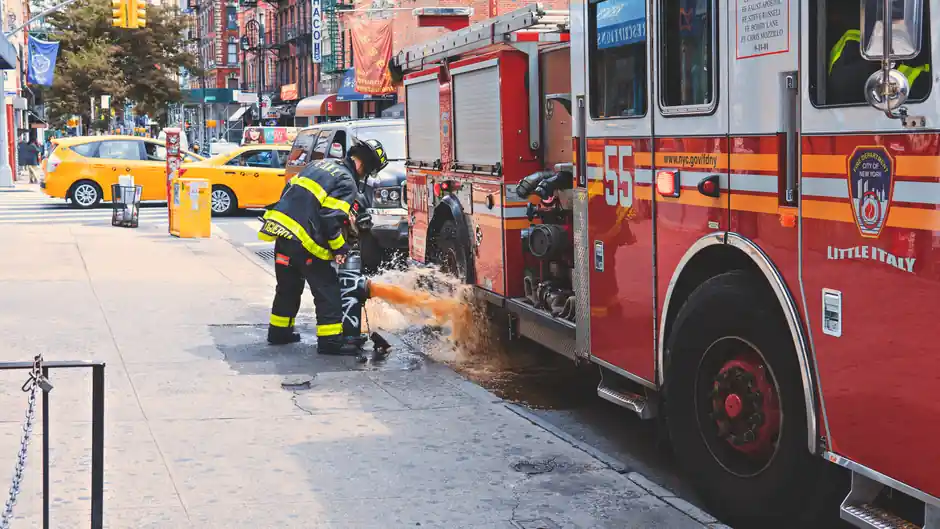
Specifying a fire hydrant for a laboratory campus is not the same as picking one for a residential street: chemical plume risk, isolation distance, and potable-water cross-contamination rules reshape the AWWA C502/C503 decision [S2][S4].
The dominant criteria for 2026 lab projects remain dry-barrel construction to AWWA C502, ductile-iron barrel per AWWA C550 epoxy interior coating, and a 5-inch Storz pumper plus two 2.5-inch NST hose nozzles, the same nozzle stack the City of Friendswood mandates for its municipal hydrants [S2].
Dry-barrel vs wet-barrel: which fits a lab site
AWWA C502 dry-barrel hydrants are required wherever frost penetrates the bury line or where the main can be drained between the valve and the hydrant; the barrel stays empty until the main valve opens, so a lab yard hydrant that sits idle for months will not trap a stagnant column against the seat [S2].
AWWA C503 wet-barrel hydrants hold water in the barrel at all times and are restricted to warm, non-freezing climates such as Southern California and South Texas; specifying a wet-barrel unit on a freeze-exposed lab campus typically triggers rejection at the submittal stage because the seat is continuously wetted [S2].
For a chemistry or biotech lab, dry-barrel also reduces the risk that residual water in the barrel leaches metals or picks up solvent fumes, a concern that pushes many EHS teams to bury the hydrant at least 100 feet from any acid storage pad and to fence it inside a vehicular access lane.
Flow and pressure sizing for lab fire-water demand
A single 4.5-inch main valve hydrant delivers roughly 1,500 GPM at 20 psi residual, the baseline that NFPA 1 and NFPA 24 expect from a Class AA hydrant, and this is the figure most lab sprinkler calculations use as the design flow for the yard loop connection [S4].
For a small teaching or analytical lab under 5,000 sq ft, two hydrants at 1,500 GPM each is usually enough to feed the standpipe riser plus a monitor nozzle, but a pilot plant or a BSL-3/4 facility often asks for a third hydrant on a separate lead to keep one leg available during a chemical release [S2][S4].
WSSC Water's published 3-inch hydrant-meter flow of 250 GPM (15,000 gal/hr) and 3/4-inch meter flow of 25 GPM (1,500 gal/hr) are useful sanity checks when sizing temporary construction water, but the permanent lab hydrant must be sized off the AWWA Manual M17 flow-test result, not off a meter rental [S1].
Materials, coatings, and chemical compatibility
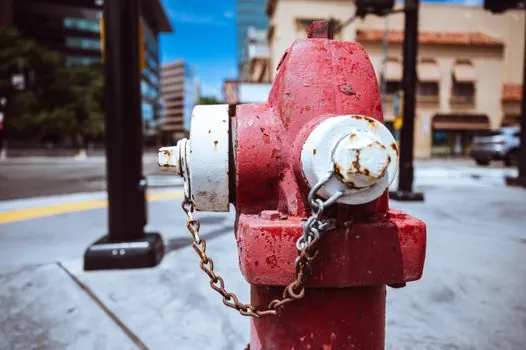
Ductile iron is now the default barrel material; the Friendswood spec requires a single-piece ductile lower barrel with a 360-degree rotating upper coupling, eliminating the cast-iron two-bolt joint that historically caused failures below the traffic flange [S2].
AWWA C550 internal epoxy coating is the minimum for any hydrant tied to a domestic loop, and most lab owners layer a NSF/ANSI 61 certified lining on top so that leachates during stagnation do not contaminate the eye-wash or safety shower feed [S2].
Above the traffic flange, the spec language reads alkyd enamel per Federal Standard A-A-2962A, but lab projects in coastal or HF-exposure zones usually upgrade to a two-part epoxy or polyurethane topcoat to resist acid drift, then keep the bonnet color-coded to NFPA 291: green for 1,000-1,499 GPM, orange for 500-999 GPM, red below 500 GPM [S2].
Submittal, auditing, and field-testing workflow
Owners increasingly reserve the right to randomly pull a furnished hydrant for lab disassembly at the contractor's expense, a clause the City of Friendswood writes verbatim in Section 02435 and that most lab capex projects copy into their front-end documents [S2].
Field acceptance follows AWWA Manual M17: cycle the hydrant, replace gaskets, lubricate the stem per the OEM bulletin, then run a flow test at the rated static pressure to confirm the 1,500 GPM pumper curve, with results filed against the valve and lead GIS record [S2].
For a lab owner, the practical takeaway is to require the same submittal package on every order: manufacturer name, bonnet paint system, engineering control drawing number, and the AWWA C502 or C503 mark, then tie payment for the assembly to a passing M17 flow test on the as-built lead [S2].
Isolation distance, access, and lab-specific siting
NFPA 24 and most institutional EHS standards require a clear 3-foot radial clearance around the hydrant and a 15-foot clear path for a fire-engine connection, which in a lab courtyard often means losing one or two parking spaces to keep the pumper nozzle reachable [S4].
Sodium hypochlorite and solvent drum storage should sit at least 50 feet downwind, and many pharma and university EHS teams extend that to 100 feet for Class I flammable liquid rooms, with the hydrant placed on the access-road side rather than inside the fenced chemical pad [S4].
Where the lab is inside a larger industrial park, coordination with the yard hydrant loop matters: shared private hydrants must be listed in the fire safety plan with a flow-test record dated within the last 12 months, and the supply curve re-verified whenever a new building ties in.
Standards anchor and procurement checklist
The four standards that govern every lab hydrant submittal are AWWA C502 (dry-barrel), AWWA C503 (wet-barrel), AWWA C550 (epoxy interior), and AWWA Manual M17 (installation, field testing, maintenance); each is named in Section 02435 of the Friendswood spec and is the same set a lab owner's engineer should reference in the front-end [S2].
Procurement checklist for a 2026 lab project: confirm AWWA C502 dry-barrel rating, ductile-iron lower barrel, 360-degree rotating upper coupling, 5-inch Storz pumper with tethered cap, two 2.5-inch NST hose nozzles, AWWA C550 internal epoxy plus NSF/ANSI 61 lining, alkyd or polyurethane topcoat in the NFPA 291 flow-class color, and an M17 flow-test report filed with the fire hydrant asset record before substantial completion [S2].
Where the lab also has a standpipe and hose system, the fire-rated door and fire door penetrations feeding the stairwell must be coordinated with the hydrant lead so the FDC piping does not compromise the fire-resistance rating of the enclosure.
Next signals to track: the City of Denton's FY 2026/2027 facility fee update of $8.23 (effective October 2026) for the Reuse Fill Station, which will shift temporary construction-water economics on Texas lab sites [S3]; and any 2026 AWWA C502 ballot items on Storz cap retention, since the Friendswood spec already calls for a factory-installed, louver-free, cable-tethered Storz cap that several OEMs are still updating [S2]. For broader fire-water integration, see the fire safety reference and the fire extinguisher placement map when sizing portable suppression around the same chemical rooms.
Related analysis: Automatic Level Selection for Masonry: 2026 Spec Map.