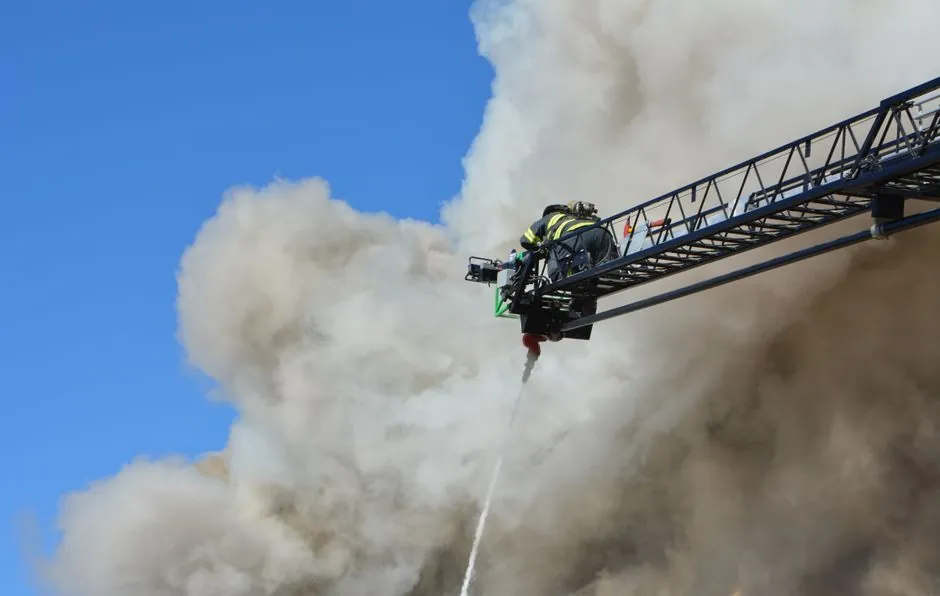
Work-at-height zones (ceiling heights above 7.5 m, atrium voids, scissor-lift platforms, cherry-picker baskets) cannot be served by standard point-type smoke detectors used at 2.4-3.5 m residential head heights, because thermal layering and smoke stratification delay particle arrival at the sensor [S3].
A ceiling above 6 m drops point-type coverage to 60 m² at 7.5 m intervals, and beyond roughly 10.5 m, point-type detectors are no longer reliable without engineered ventilation compensation, pushing the spec toward aspirating systems, projected beam, or flame/heat hybrids for elevated work platforms [S1][S3].
Why standard point-types fail above 7.5 m ceilings
Point-type photoelectric and ionization smoke detectors rely on smoke buoyancy transport to the sensing chamber; in still air above 7.5 m, a smoldering fire may take 30-90 seconds longer to reach the unit than in a 3 m room, and stratified smoke layers frequently pass beneath the sensor with no alarm [S3]. The published 50-100 m² coverage band collapses to roughly 60 m² at 6-7.5 m head height and falls outside the certifiable range of most point units beyond 10.5 m without formal fire-engineering justification [S3]. On a sloped or peaked ceiling, BS 5839-1 requires the unit to sit within 600 mm of the apex, and at least 300 mm clear of any wall, light fitting, or structural obstruction, a hard constraint on ladders or boom platforms used for installation [S5].
Detectors specified for work at height are usually installed from MEWPs (mobile elevating work platforms) rather than fixed scaffold; installers need a unit that can be commissioned single-handed, with a remote test interface, because the working envelope of a scissor-lift or boom is often too tight to reach the test button by hand. See related guidance on work platform constraints for adjacent lifting contexts. Flame and smoke detector performance maps for industrial sites show that combustion products from hydrocarbon fires radiate strongly in UV/IR bands, and a multi-criteria detector combining smoke, heat, and CO sensing can cut nuisance alarms in high-ceiling warehouses by a measurable margin compared to ionization-only units [S1][S2].
Detection technology options, side by side
Four families cover most elevated-zone specs. (1) Aspirating smoke detection (ASD) draws air through sampling pipes down to IP-rated capillaries, with sensitivity expressed as % obscuration/m (typical 0.1-0.5%), and works up to 30 m ceiling heights where point-types lose certification [S2]. (2) Projected-beam smoke detection uses an IR transmitter and receiver across 8-100 m spans, ideal for atriums and cable tunnels, but needs rigid mounting because alignment drift > 1° causes false alarms [S2]. (3) Multi-criteria / multi-sensor detectors combine photoelectric with heat (fixed 57-90 °C) and/or CO, and are typically EN 54-5/7 approved for ceiling heights up to 10.5 m without ventilation engineering [S2]. (4) Flame detectors (UV, IR, UV/IR, MSIR) respond in seconds to hydrocarbon or hydrogen flames, with the trade-off of cost and a narrow field of view, generally 60-90° horizontal cone and detection ranges of 15-30 m for a 0.1 m² n-heptane reference fire [S1].
Selection criteria, by the numbers: ceiling height, false-alarm tolerance, response time, and certification envelope. Below 7.5 m: point-type photoelectric, 100 m², BS 5839-1 Grade A. 7.5-10.5 m: multi-criteria or beam, 60-80 m², EN 54-5/7 plus EN 54-12 for beam. 10.5-30 m: ASD (EN 54-20 classes A/B/C) or flame (FM/ATEX/IECEx). Industrial hazardous-area specifiers add ATEX 2014/34/EU or IECEx for Zone 1/21, and SIL 2 per IEC 61508 for SIL-rated shutdown paths [S1][S2].
Where work-at-height specs actually trigger
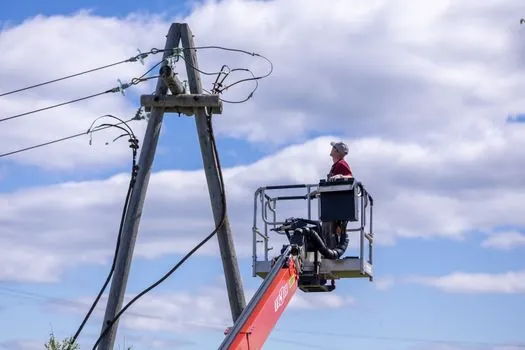
Construction sites using MEWPs and boom lifts, warehouse racking aisles, aircraft hangars, and maintenance gantries are the four highest-frequency elevated cases. In a 12 m warehouse racking aisle, point-types are excluded by BS 5839-1 spacings; beam detectors mounted on the racking uprights cover the 8-25 m span with a single pair, and survive the mechanical vibration of forklift traffic when mounted on anti-vibration brackets [S2]. Hangar ceilings above 15 m typically require dual ASD pipe networks, one per fire zone, with sample holes spaced to BS EN 54-20 Class B (high sensitivity). Construction-phase temporary detection on scissor-lift platforms almost always uses wireless, battery-powered photoelectric units with a 10-year sealed cell, because pulling fixed cable to height is uneconomic for short-duration works [S4].
Compare against the warehouse and welding selection maps: Smoke Detector Selection for Warehouses: 2026 Spec Map covers racking-aisle beam density, while Smoke Detector Selection for Welding Operations: 2026 Spec Map addresses hot-work permits where nuisance alarms from welding fume are the dominant design driver. The work-at-height envelope sits between the two: warehouse-scale ceilings, but with construction-grade mobility.
Mounting, commissioning, and access constraints
For installations above 4 m, BS 5839-1 allows the detector to be mounted on a fixed bracket or a permanent access platform, and explicitly permits the use of a MEWP during commissioning and quarterly inspection, with the unit's remote test input wired back to the fire panel at 1.5 m head height [S5]. Optical air-flow compensation (an integral thermistor + pressure reference) is the only practical answer to stratification in ceilings 7.5-10.5 m; without it, point-type false-alarm rates climb sharply in spaces with HVAC supply diffusers, which is the common case in commercial atria [S3].
Installer rule of thumb: every detector on an elevated work platform needs a documented test-and-maintain route that an aerial work platform or scissor-lift can reach, because annual BS 5839-1 functional tests cannot be performed from a ladder above 4 m. That means the detector loop, the remote LED indicator, and the sounder base all have to be wired back to 1.5-1.8 m, with the sounder not less than 0.7 m above floor level at the head of the work area. For boom-lift crews, the detector housing itself should be IP23D or better, since overspray, dust, and weather exposure are routine on construction and exterior sites.
Standards, certifications, and common spec pitfalls

Three standards dominate. BS 5839-1:2017 sets commercial spacing, grades, and commissioning. EN 54-5 (heat), EN 54-7 (smoke point-type), EN 54-12 (beam), and EN 54-20 (aspirating) are the relevant product standards, with EN 54-20 Class A being the highest sensitivity band (0.05% obs/m). For hazardous-area plant, ATEX 2014/34/EU (Group II, Category 2G/D) or IECEx Scheme certification is non-negotiable, and flame detectors for hydrocarbon service carry FM 3260 or equivalent third-party performance listings [S1].
Pitfalls seen in 2025-2026 audit reports: specifying point-type ionization units above 6 m without airflow engineering; installing beam detectors on racking without anti-vibration brackets and suffering repeat false alarms from forklift impact; using residential 10-year sealed lithium units (X-Sense SC01, First Alert SA320, etc.) on construction sites where the spec actually called for EN 54-7 commercial grade [S3][S6]. The fix in all three cases is to re-spec before procurement: pick EN 54 ASD for >10 m ceilings, beam for racking aisles with rigid mountings, and always commercial-grade photoelectric or multi-criteria for any installation on a boom lift or MEWP at height.
Limitations and failure modes to engineer around
Every elevated-zone detector has a documented blind spot. ASD pipes freeze below roughly -10 °C unless trace-heated, so external cold-store canopies need a heated enclosure. Beam detectors fail in dense steam, fog, or welding fume; spec them in dry atmospheres only, and never share a fire zone with a hot-work permit. Multi-criteria units depend on the CO sensor staying calibrated, and most CO cells have a 5-7 year life, so spares planning starts at the install date. Flame detectors have a narrow FoV and are pointed line-of-sight, so multiple units are required for full cone coverage of a generator set or transformer bay [S1][S2].
Stratification delays are the deepest gotcha. In a 12 m atrium, a slow-smolder fire can stratify at 4-6 m and never trigger a ceiling-mounted point-type at all; an ASD with sample pipes on two vertical levels, or a beam at 6-8 m, is the only certifiable solution. For work-at-height crews operating on a MEWP, the take-away is that a single ceiling point-type above 7.5 m is not a life-safety solution, regardless of brand, and procurement should be reworked to match the actual ceiling height of the zone.
Two trackable signals: (1) when a project draws on construction-phase temporary detection, push for a wireless photoelectric with 10-year lithium cell and EN 14604 / 50291 dual marking, so the same unit can be left in service after handover. (2) For permanent install above 10.5 m, write the spec to EN 54-20 Class B ASD plus a gas detector channel on the same loop, giving a single-panel solution for both smoke and refrigerant or battery-off-gas stratification in tall voids.