
Laboratory head protection is governed by the same ANSI/ISEA Z89.1 / EN 397 framework used on construction sites, but the typical lab hazard profile (chemical splash, flying particles, biological aerosols, low-velocity lateral bumps from fume hoods and bench equipment) demands a different material and accessory stack than a fall-hazard construction site [S5][S4].
OSHA 29 CFR 1910.135 mandates that head protection in any work environment with falling objects, struck-by incidents, or overhead electrical hazards comply with ANSI/ISEA Z89.1 [S5]. In the 2021-2022 US reporting window the International Safety Equipment Association logged 195,720 head injuries with 684 fatalities, and the National Safety Council pegged the average head-injury claim cost at $91,844, including medical expenses and wage losses [S5]. A lab supervisor who treats head protection as a line item rather than a hazard-mapped spec absorbs that risk directly.
Lab Hazard Categories That Drive Helmet Choice
Four hazard families dominate laboratory head-injury exposure: chemical splash and vapour exposure to the shell material, ballistic and shard impact from broken glassware, lateral impact from under-bench cabinets and overhead service straps, and thermal exposure from autoclaves, Bunsen burners, or cryogenic vials [S1][S4]. Falling objects remain the single most common cause of head injury across all sites, so even a wet chem-lab operator is not exempt from a Type II-rated shell if a reagent bottle is stored above head height on an open shelf [S4].
Slip, trip, and fall incidents produce head strikes against bench edges and floor-mounted service panels, which is why the Virginia Tech STAR evaluation programme tested 38 construction helmets using 12 oblique impacts per sample (3 locations x 2 speeds x 2 trials) at 5.5 m/s and 6.8 m/s onto a 25-degree steel anvil coated with 80-grit sandpaper [S2]. Their finding, that Type II helmets outperform Type I on linear and rotational head acceleration, applies directly to lab benches where the impact direction is rarely straight down [S2]. A lab procurement spec that defaults to Type I purely on cost is making a measurable trade against lateral protection.
Standards and Certification Map for Lab Helmets
ANSI/ISEA Z89.1 is the controlling US standard for industrial head protection and breaks products into Type I (top impact), Type II (top, front, back, and lateral impact), and electrical Classes G (2,200 V), E (20,000 V phase-to-ground), and C (no electrical rating) [S5]. For European and most global lab procurements, EN 397 governs industrial safety helmets, EN 14052 covers high-performance side-impact helmets, EN 12492 is the mountaineering/work-at-height above 2.5 m spec carried on some lab climbing and maintenance helmets, and EN 812 bump caps are explicitly excluded from falling-object protection [S4][S2].
A non-conforming shell is a non-shell: if a hard hat does not carry Z89.1 conformance marking, the buyer has no assurance of either impact class or electrical class, regardless of vendor marketing claims [S5]. The STAR programme also documents that even compliant helmets vary widely; the MILWAUKEE BOLT 200 (Type 2, Class E, 540 g, no vents, EN 12492 + EN 397 marked) scored a STAR value of 40.74 against a maximum possible 200, while other Type 1 helmets in the same 38-sample pool scored multiples of that figure [S2]. Translated to a lab RFQ, this means the spec writer should require both the standard designation and the impact-class letter, not just the word "industrial".
Material Selection: Polycarbonate vs Polypropylene vs ABS

Lab-grade helmets in the typical Dräger and 3M product lines are offered in three shell materials with meaningfully different behaviour: polycarbonate (high impact strength, good chemical resistance to dilute acids and alcohols, but vulnerable to strong solvents like acetone and certain ketones), polypropylene (lighter, better chemical resistance to a broader solvent family including many alcohols and bases, but lower impact performance at low temperature), and ABS (acrylonitrile butadiene styrene, a cost-optimized middle ground with moderate chemical resistance and acceptable impact at room temperature) [S1]. The MedSolut lab-helmet portfolio lists polypropylene and polycarbonate as the two reusable shell options it carries [S1].
Spec language should require the shell material to be declared in writing and matched to the chemicals on the lab's Safety Data Sheet inventory, not selected on aesthetics. For a PC shell, validate against the chemical resistance chart published by the manufacturer; for a PP shell, verify low-temperature impact rating if the lab has a -20 degrees C freezer room. The Dräger X-plore visor accessory, sold for attachment to standard lab helmets, is a useful spec pointer because its published use cases include dust and particulate protection in lab-adjacent work, confirming the system-level approach vendors take to chemical and biological hazards [S1].
Type and Class Comparison for Lab Specifiers
For a typical analytical chemistry or biology lab, the conservative pick is a Type II / Class G or Class E shell with vented comfort harness, integrated or attachable chemical-resistant visor, and slots for ear plugs or muffs. The comparison below lines up the main shell options against the criteria that matter in a lab RFQ. [S1]
Type I / Class C: lightest and cheapest, no electrical rating, top-impact only. Use only in dry, non-electrical, low-lateral-hazard labs such as a microscopy suite. Type I / Class G: adds 2,200 V protection for benches with low-voltage instrumentation; still top-impact only. Type II / Class E: 20,000 V phase-to-ground protection, full lateral impact coverage, the default for a mixed chemical/electrical lab. Type II / Class E plus chinstrap and EN 12492 marking: required where the same worker accesses mezzanines, service platforms, or catwalks above 2.5 m, since EN 397 alone does not certify a helmet for fall-arrest scenarios [S4][S5]. The lab PPE selection guide for adjacent eye protection, covered in a separate ANSI Z87 hazard-class walkthrough, follows the same type-and-class matrix logic and stacks cleanly under a lab helmet spec.
Comfort, Fit, and PPE Stacking Requirements
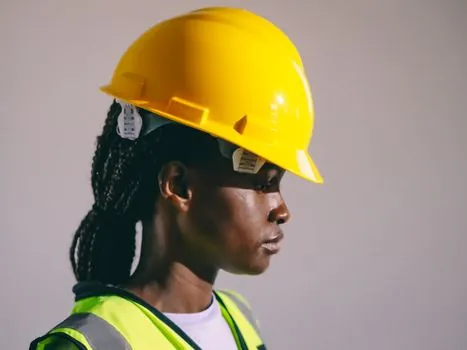
Helmet comfort is not a soft variable; a worker who removes a helmet in a contaminated corridor has removed their protection. Spec language should require a 6-point or 8-point textile suspension harness, adjustable ratchet or wheel sizing in 1 mm increments, a chinstrap with a load-rated buckle (typically 50 N release or breakaway), and a sweatband rated for the lab's washdown chemical set [S1][S4]. Hellberg's selection guide is explicit that combined PPE (helmet plus hearing protection, plus visor, plus respirator) must be certified as a system by the manufacturer, not assembled from independently certified parts [S4].
Weight matters for shift-long wear. The MILWAUKEE BOLT 200 reference shell at 540 g is a reasonable upper bound for an unvented Type II Class E helmet; vented Type II shells in the same class typically land in the 380-450 g range, which is the practical target for an 8-hour lab shift [S2]. For a chemical splash plus particulate environment, the X-plore style attachable visor approach lets the lab reuse a comfortable Type II shell across multiple hazard zones by swapping the visor cartridge [S1]. Pairing the helmet spec with a safety-shoe spec built on EN S-classes and ASTM F2413 closes the head-to-toe PPE loop on a single RFQ.
Cleaning, Decontamination, and Service Life
Lab shells are typically wiped down with 70 percent isopropanol, 10 percent bleach solution, or peracetic acid blends, depending on the biosafety level of the work [S1]. The spec should require that the shell material, harness webbing, and sweatband are all rated by the manufacturer for the lab's decontamination chemical set, and that replacement sweatbands and harnesses are listed as orderable spare parts, not proprietary assemblies.
Most manufacturers cap service life at 5 years for the plastic shell (UV and chemical exposure degrade the polymer even without impact) and 1-2 years for the textile suspension, regardless of visible condition. A spec that omits the service-life clause invites out-of-date shells into the fleet; combined with the safety-certification reference workflow, a written replacement-interval policy is the simplest way to keep the program auditable.
What a Lab Helmet Is Not For

Industrial construction helmets (EN 397 / Z89.1 Type I, Class C) are not appropriate for chemical splash zones, biological safety cabinets, or any environment where lateral impact is plausible; bump caps (EN 812) provide no falling-object protection and must not be substituted for a Z89.1 helmet anywhere overhead storage exists [S4]. Firefighter helmets (NFPA 1971) and arc-flash helmets (ASTM F2178) are over-specified for a routine lab and create heat-stress and weight penalties that drive non-compliance.
For any lab where the same employee moves between a bench, a chemical storage room, and a rooftop service area, the spec needs to address the rooftop segment with EN 12492-marked chinstraps and fall-arrest compatibility, not by handing the worker a second helmet at the access ladder. Signage around the access point should follow the OSHA 1910.145 / ANSI Z535.2 selection logic so the helmet requirement is visible before the worker commits to the climb.
Acceptance Test and Audit Trail
Every lab helmet delivered against a Z89.1 or EN 397 spec must arrive with a date code, lot number, shell material declaration, and the full standard marking printed or moulded into the shell [S5]. Receiving inspection should reject any shell missing the Z89.1 Type and Class characters, the EN 397 mark, or the manufacturer date code, and should log the lot number against the lab's PPE inventory so a future recall or field corrective action can be traced.
For independent performance verification on a contested procurement, the Southwest Research Institute Helmet Testing Laboratory runs monorail impact, penetration, retention, and environmental conditioning tests against DOT FMVSS 218, ANSI Z90.1, NILECJ standards, and NFPA fire-helmet criteria, and accepts custom test protocols for new helmet designs [S3]. A lab that commissions a single-lot impact test on a candidate shell gets a paper trail that survives an OSHA inspection, which for a $91,844-average-claim exposure is cheap insurance [S5][S3]. Track two signals over the next procurement cycle: whether the helmet vendor publishes a Z89.1 Type II Class E vented shell under 450 g with a published chemical compatibility list, and whether the lab's PPE inventory system starts logging lot numbers and date codes at receiving rather than at issue.
For component-level specifications, see safety helmet, and fire safety.