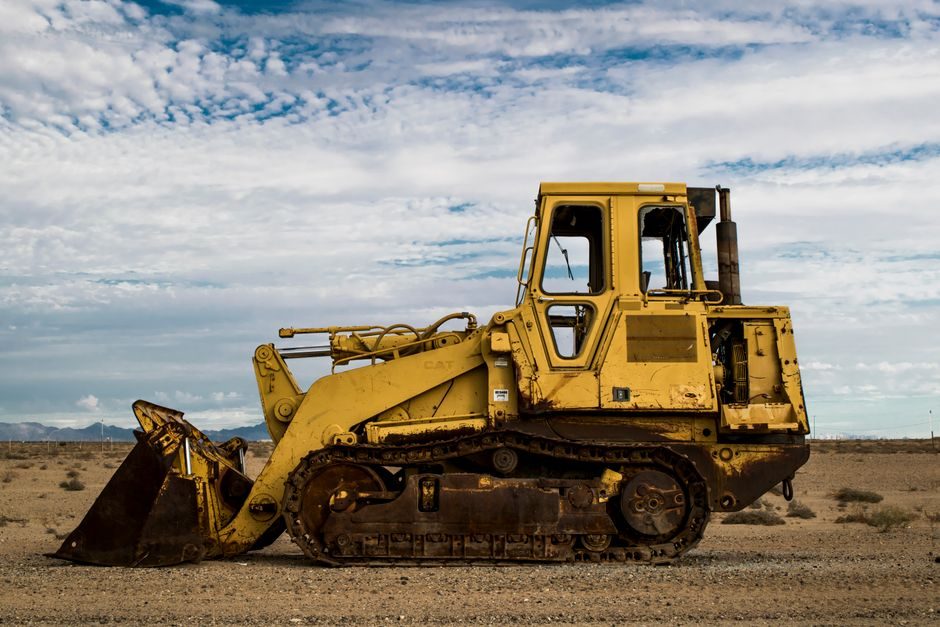
For sanitary landfill work the baseline machine class is the D7 / TD-18 mid-size crawler, with daily cover, refuse compaction, and haul-road grading as the three core duties, per the Maui County class specification 8A.070 [S2].
Municipal procurement scopes for refuse-disposal bulldozers also typically bundle a guaranteed maintenance and buyback programme, so the spec is written as a 10-15 year total-cost-of-ownership decision rather than a single-machine purchase [S1].
Where a landfill dozer sits in the equipment fleet
On sites receiving up to 50 t/day of municipal solid waste, a single 50-60 kW crawler dozer is the only prime-mover required, with no support plant called for in the EU/EuropAid landfill operations manual sizing table [S4].
From 50-100 t/day, the same table pairs a 60-70 kW dozer with a 50-70 kW trash-compaction wheel (ties) and a water-spraying tanker, and allows an excavator to substitute for the compaction wheel or for tipper unloading vehicles [S4].
At 100-300 t/day the configuration scales to a 90-120 kW dozer plus 2-3 compaction wheels and 1-2 water sprayers; the 300-1000 t/day band keeps the same power class but extends the compactor and sprayer counts further, which is why [S2] explicitly allows a Landfill Bulldozer Operator I to be cross-trained on tank trucks, track loaders and motor graders rather than locked to one chassis.
Duty cycle the spec has to cover
Inside the working face the dozer is used to push, spread and compact refuse, then to place 150-300 mm of daily cover soil and shape the cell for drainage — three distinct load cases that punish both the undercarriage and the blade [S2].
Roadway construction and maintenance in and out of the active cell is a separate duty, so the same machine needs scarifier capability to segregate boulders from cover material, plus a tilting or semi-U blade to grade terraces that resist slope slides [S2].
Fuel, oil and water servicing, plus minor field repairs, are written into the operator class as primary duties, which in practice forces procurement to specify easy ground-level access to filters, drains and wear plates rather than dealer-only service intervals [S2].
Mandatory guarding and refuse-specific options
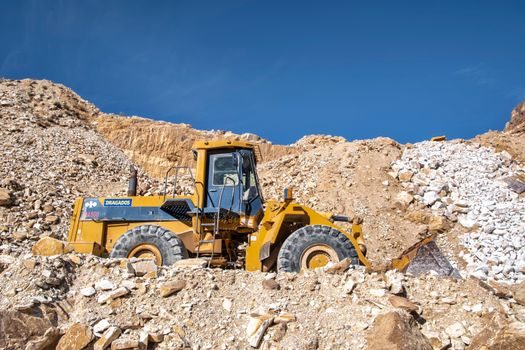
A landfill-spec dozer must be ordered with the protective devices common to refuse work — bottom guards, fuel-tank shielding, sealed electrical connectors, ventilation suitable for dusty and corrosive atmospheres — and those items are explicitly the difference between a "general-purpose" dozer and one "equipped for landfill use" [S1].
Buyers typically extend the package with a heat-resistant exhaust, elevated air intake, sealed cab with positive-pressure filtered ventilation, and a striker box on the front of the blade to protect the radiator from impacts with hidden debris [S1][S2].
Optional equipment that has become standard in EU municipal scopes: rear-view camera, fire-suppression system (mandatory on many sites), a ROPS/FOPS cab rated for impact and rollover, and high-idle cooling for sustained low-speed pushing without thermal cutback [S1].
Selection criteria: weight class, power, blade, undercarriage
The four hard criteria for landfill procurement are: (1) operating weight in the 18-25 t band for the D7/TD-18 class, (2) flywheel power 130-160 kW so the engine does not bog at full blade load in compacted refuse, (3) full-length track frames and sealed-and-lubricated chains because of abrasive grit, and (4) a semi-U or full-U blade with a capacity around 4.0-5.5 m³ matched to the cell width [S1][S2].
A direct comparison of the three realistic platforms shows the trade-off: a D6-class (~13-15 t, ~100-120 kW) suits 50-100 t/day sites with thin lifts; a D7/TD-18 (~18-25 t, ~130-160 kW) is the default 100-300 t/day platform; a D8 (~30-40 t, ~190-230 kW) is the minimum for 300-1000 t/day cells where refuse depth exceeds 3 m [S2][S4].
For operators accustomed to demolition work, the priority list differs — see the Bulldozer Selection for Demolition: A Working Spec Map sister guide, where the weight class is pushed higher and the cab is up-armoured, whereas landfill work demands sealing and corrosion resistance more than ballistic protection.
Who this spec is — and is not — for
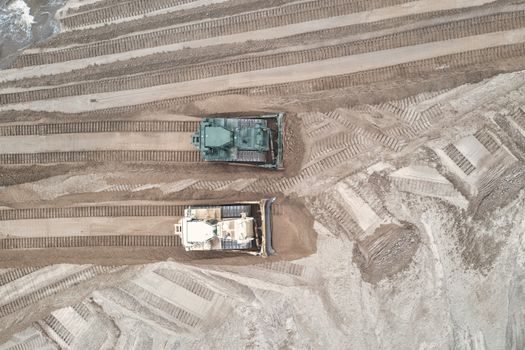
The D7/TD-18 specification fits a municipal or contractor run sanitary landfill receiving 100-300 t/day of mixed MSW, with a single working face, a daily cover programme, and an operator pool licensed to run a Class A or B CDV [S2].
It is not the right pick for construction-and-demolition (C&D) sites, where material density and metal contamination demand a heavier, narrower-tracked platform with a rake rather than a U-blade, nor for hazardous-waste cells that need a remote-control or tele-operated dozer with no operator on the seat during placement.
Sub-50 t/day rural transfer stations usually run a single used D5-D6 with operator-only daily cover and one compaction wheel, and the spec in [S1] will over-spec them; the [S4] sizing table gives a more realistic minimum-fleet baseline for those sites.
Operator certification and health baseline
Municipal minimum qualification typically pairs a high-school education with at least one year of operating heavy equipment, or a formal trainer certification, plus a current Class A or B Commercial Driver's Licence with the state medical examiner's certificate [S2].
The work is in the "Heavy" physical effort group: handling weights, sustained noise above 85 dBA, dust, and exposure to landfill gas — which is why monitoring atmospheres with a multi-gas detector (or, more accurately, a portable LEL/H2S/CO/O2 four-gas unit) is built into the site safety plan, and the same class spec is tied to "obnoxious and hazardous conditions" as a baseline [S2].
Failure modes and limits of the spec
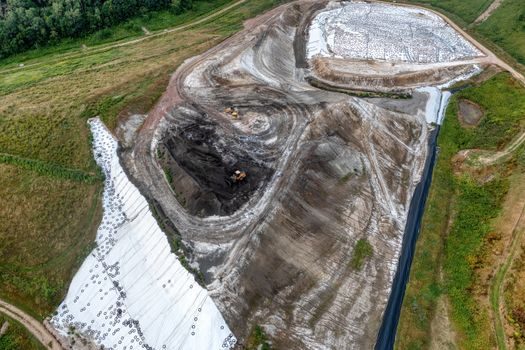
The three predictable failure modes on a landfill dozer are undercarriage wear from abrasive cover material, radiator and air-intree clogging from litter and dust, and fire risk from accumulated refuse around hot surfaces — each has a guarding or maintenance answer in the spec, not a re-design answer [S1][S2].
Spec writers should resist the temptation to spec a tracked loader "because it is cheaper": a dozer is required because the duty cycle is push-and-spread heavy refuse under the blade, where a wheeled loader's tyres are destroyed by hidden debris and the lift-arm geometry does not give a controlled cell slope [S2][S4].
Track tension must be checked daily because grit packing forces premature bushing wear, and the machine's hours-meter-based PM intervals are usually shortened by 25% versus the general construction baseline, with both items called out in the buyback-programme maintenance schedule [S1].
Sourcing, standards and what to ask the dealer
For EU sites the relevant baseline is the EU Landfill Directive (1999/31/EC) as operationalised in the EU/EuropAid landfill operations manual sizing tables cited above [S4], and for US municipal buyers the baseline is the state-DOT procurement spec, often a Cat or Komatsu OEM build sheet overlaid with a city-specific options list [S1].
Use a published, comparable tender (Savannah Event 5173, scope in [S1]) as the line-by-line reference for a 100-300 t/day machine: machine class, refuse-package guarding, fire suppression, ROPS/FOPS cab, training, and a 10-year guaranteed-maintenance buyback envelope. Buyers who skip the buyback line item typically pay 18-25% more over the machine's life in unplanned downtime, which is the figure to anchor the negotiation against [S1].
Trackable signals to watch: a 2026 municipal RFP listing the same machine class and refuse-package options, the OEM's published landfill-duty PM schedule revision, and any state procurement office publishing an updated minimum specification for refuse-disposal bulldozers.
Detailed specification references: bulldozer, and pressure transmitter.