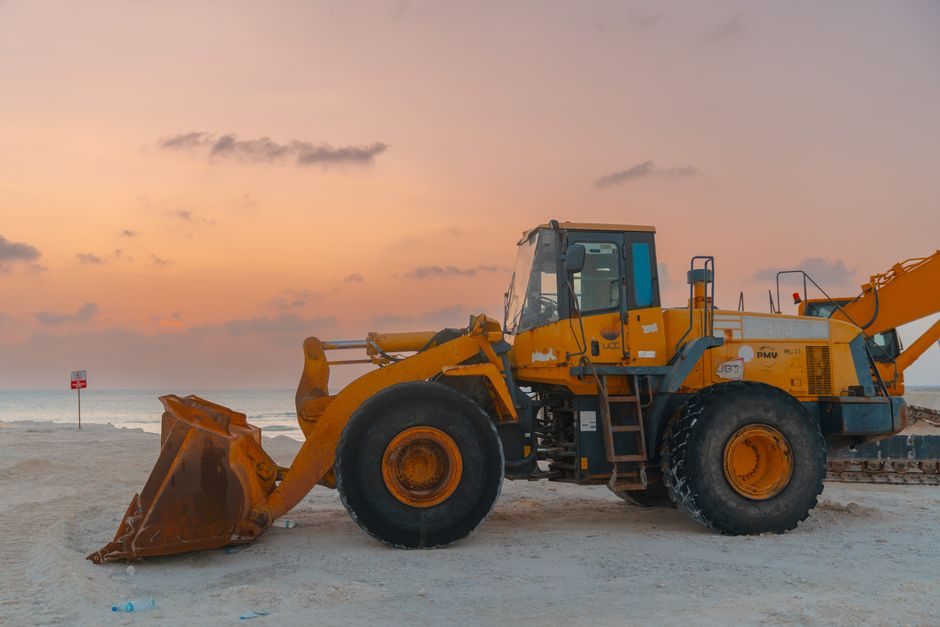
On structural demolition, crawler bulldozers in the 30–50 tonne operating-weight band are the workhorses — large enough to push over single-storey masonry and break reinforced slabs, small enough to load on standard lowboys and still meet 8–12 psi ground pressure limits on prepared sub-base [S2][S3].
Selection for demolition is governed by four hard constraints: structure type and height, debris density, site access width, and emissions or ventilation class — and each of those maps directly to operating weight, horsepower, blade geometry, and engine tier [S4][S7].
Class Boundaries and What Each Band Actually Does
Bulldozers segment into four functional classes by operating weight, and each maps cleanly to a demolition scope [S3][S6]. Compact dozers below ~9 tonnes (e.g. CASE 650M at 16,839 lb / ~7.6 t) are landscaping and light site-prep machines — too light to topple a structural wall, fine for clearing brush and backfilling trenches [S6]. Medium dozers in the 14–36 t / ~150–310 hp band are the demolition core: they push single-storey CMU walls, shear light steel framing, and break 4–8 in. slab with the ripper [S3]. Large dozers rated 310 hp and above are built for mining and highway work; they are over-spec for most building teardowns and bring ground-pressure and transport headaches that swallow any time saving [S3].
For 90% of urban and industrial demolition, a 20–35 t crawler in the 200–300 hp window is the correct pick — enough mass to commit a wall, enough track length (2.4–3.0 m) to keep ground pressure under 11 psi on crushed-stone sub-base, and small enough to fit a 3.6 m site gate [S4][S6].
Crawler vs Wheel vs Swamp — Configuration Trade-Off
Track configuration is decided by ground, not by preference [S2][S7]. Crawler (track) dozers are the default for demolition because their lower ground pressure lets them work on rubble-strewn sub-base without bogging, and their steel tracks tolerate rebar and broken concrete that would shred rubber tyres [S2]. Wheel dozers are faster on hardstand and finished asphalt, but their tyres are vulnerable to sharp rebar stubble and plate glass — a non-starter on active structural demo [S2][S7]. Swamp / low-ground-pressure dozers with extended track frames (ground pressure in the 3–5 psi range) are reserved for wetland pipe-line corridors and reservoir cleanouts, not building demolition [S2].
Track geometry also matters: low-track dozers sit lower for transport and tight turning, high-track dozers raise the final drives clear of rock and rebar mat — the high-track layout is the right call on a slab-and-footing demo where the undercarriage will see constant impact loading [S7].
Power, Drivetrain, and the Hydrostatic Question
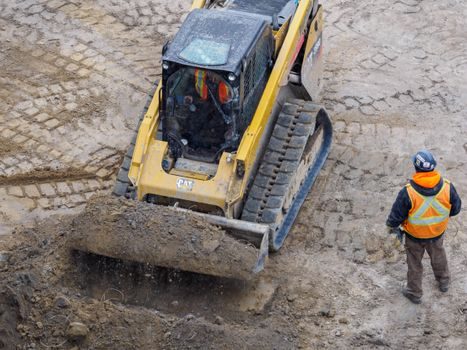
Modern demolition-spec crawlers in the 20–40 t band are dominated by hydrostatic drive — one or two variable-displacement pumps feed independent left/right track motors, which gives counter-rotation for pivot turns and infinitely variable ground speed under load [S4]. The older torque-converter + powershift layout still ships from some manufacturers and is mechanically simpler to field-repair, but loses 8–12% of engine power to driveline loss and forces the operator to clutch-brake steer, which fatigues operators and chews up the steering clutches on repetitive push cycles [S4].
For demolition, hydrostatic wins on two specific counts: (1) the machine can push a wall at idle throttle, then snap to full rpm only at the moment of commit, reducing fuel burn and heat soak; (2) counter-rotation lets a single operator slot the machine into a 4 m wide bay without a second banksman. Working hydraulic flow for the blade lift and tilt cylinders typically lands in the 60–80 gpm range on mid-size dozers, which is also what drives a rear-mounted hydraulic breaker or ripper if you spec that option [S4].
Blade and Rear Implement — What Actually Touches the Work
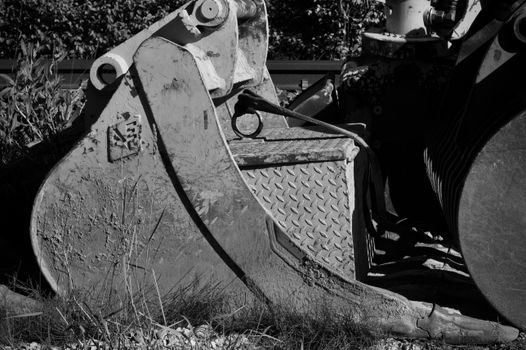
Three blade geometries cover almost all demolition work, and the choice is set by material, not machine size [S3][S6]. Straight (S-blade) is the narrowest, pushes the densest piles, and is the right pick for slot dozing rubble into a truck-hopper or windrow. Universal (U-blade) has larger wings and higher capacity — useful for spreading clean fill but it loses material sideways when you try to push a wall fragment. Semi-U (SU) is the demolition compromise: a curved wingset that still contains the load, fitted to most mid-size dozers as OEM standard [S3].
The rear ripper is the second deciding factor. Single-shank rippers on large dozers break hardpan and frozen ground; on demolition-class mid-size dozers, a multi-shank parallelogram ripper is what actually cracks a 150–200 mm reinforced slab so the blade can peel it [S3]. If your scope is slab-and-foundation demo, spec the ripper — without it you are using the blade as a poor man's breaker and you will burn the cutting edges in a week.
Engine Tier, Ventilation, and Indoor Work
Demolition increasingly means working inside a partially-collapsed structure, in a basement, or inside a building with cross-ventilation cut off. Tier 4 Final / Stage V diesel dozers with diesel particulate filter (DPF) and diesel exhaust fluid (DEF) aftertreatment are non-negotiable for indoor or semi-enclosed work in North America and the EU — most job-site safety plans will not let a non-tiered machine below grade [S4]. For Tier 4 platforms, expect a 5–8% fuel penalty versus the equivalent Tier 3 machine and a DPF regen cycle that forces idle every 8–12 hours, which the operator must plan for in the shift rota.
For confined-space demolition — basement slabs, interior strip-out, tunnel approaches — battery-electric and diesel-electric prototype dozers are entering the market, but as of 2026 production volume is still in the low hundreds of units globally and lead times run 12–18 months [S4]. For 2026 project planning, treat electric dozers as a future option and stick with Tier 4 Final diesel for any near-term bid.
Sizing Math: Wall Height, Debris Density, and Ground Pressure
Three numbers settle the size question without a site visit: wall height, debris density, and allowable ground pressure [S3][S6]. For a single-storey CMU or light-steel wall up to 4 m, a 20 t dozer with SU-blade and ripper commits the wall in one push on level ground. For a 6–10 m reinforced-concrete wall, step to 30–40 t with a single-shank ripper pre-fracturing the base. For a structural-steel frame building, mass alone is not enough — the dozer pulls the steel sideways to buckle a column, which is a 30 t+ job and typically pairs with an excavator with a shear attachment [S2].
Ground pressure is the constraint most specs miss. A 30 t crawler with 600 mm track shoes on 2.6 m track length sits at roughly 9–10 psi — fine on crushed-stone sub-base, marginal on undisturbed clay, fatal on a 150 mm asphalt cap over a parking deck [S6][S7]. When in doubt, add 100 mm track shoes and recheck; the wider shoe drops ground pressure by 15–20% with no other change to the machine.
Selection Criteria Comparison: Three Demo Scenarios
Lining the three common demolition profiles against four decision criteria — operating weight, drivetrain, rear implement, and emissions class — gives a quick decision matrix [S3][S4][S6]:
Scenario A — Urban low-rise (1–3 storey masonry, ≤4 m walls, 150 mm slab): 20–25 t crawler, hydrostatic drive, parallelogram multi-shank ripper, Tier 4 Final / Stage V diesel. Operating weight 20–25 t, ground pressure 8–10 psi, transport width under 3 m.
Scenario B — Industrial shed (8–12 m steel frame, 200 mm reinforced slab): 30–40 t crawler, hydrostatic drive, single-shank ripper for slab pre-fracture plus SU-blade, Tier 4 Final diesel. Operating weight 30–40 t, ground pressure 9–11 psi, transport width 3.0–3.4 m.
Scenario C — Confined or indoor strip-out (basement, interior partition removal, ≤3 m walls): 7–14 t compact crawler, hydrostatic drive, no ripper (use blade only), Tier 4 Final with active DPF regen. Operating weight 7–14 t, ground pressure 5–7 psi, fits through 2.4 m door.
For comparison, a bulldozer picked without checking ground pressure or emissions class is the single most common cause of a demolition-spec machine being grounded on day one of the job.
Operator Skill, Safety, and the Hidden Constraint
Large dozers — 310 hp and above — are explicitly flagged in OEM guidance as requiring advanced operator certification and on-site supervisor sign-off, because their mass and momentum make wall commitment decisions irreversible [S3]. Mid-size demolition dozers in the 20–40 t band are within reach of a competent operator with 2+ years on a similar platform, but they still need a pre-shift walk-around on undercarriage, ripper pin retention, and blade cutting-edge wear — a worn edge turns a SU-blade into a U-blade and changes the machine's behaviour at the wall [S3][S4].
Adjacent process equipment shows up in similar mid-size selection work — a demolition hammer sized to the same 20–30 t excavator that supports the dozer is a typical pairing for vertical structure work where the dozer alone cannot reach.
Procurement Signals Worth Tracking
Two trackable signals for 2026 demolition-spec buying: lead times on Tier 4 Final / Stage V mid-size crawlers from major OEMs are running 6–9 months for new factory order, with rental fleet availability tight in the EU and North America through 2026-Q3; used-machine inventories of 20–30 t hydrostatic crawlers from 2018–2022 model years remain the most cost-effective entry point for contractors scaling a demolition fleet without committing to a 12-month factory slot. Spec the ripper, the wide-track shoes, and the Tier 4 aftertreatment package up front — retrofit lead times on those three items run longer than the dozer itself. For broader context on heavy-equipment specification across adjacent trades, the 2026 selection map for stainless steel for medical devices applies similar Tier 4 emissions and traceability logic to a different equipment class. [S2]
Spec-level background on the components involved: pressure transmitter.