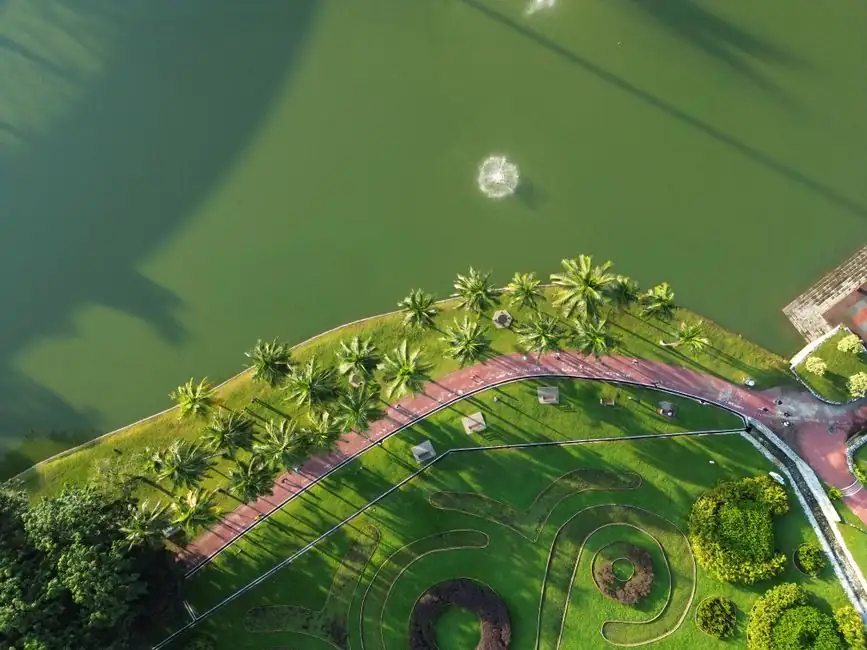
Landscaping pours such as plazas, garden terraces, pedestrian decks, driveway aprons, and amenity slabs demand flatter tolerances than general paving, and a laser-guided screed with a rotating transmitter and hydraulic head control delivers ±3 mm elevation repeatability over working widths of 2.0–7.5 m [S1].
Selection pivots on slab size, slope drainage, finish class, and crew skill, because landscaping work rarely justifies a ride-on boom machine but frequently needs tighter levelness than a hand-pulled vibrating screed can deliver [S3].
Definition and Scope: What Counts as a Landscaping Screed
A landscaping laser screed in 2026 is typically a walk-behind two-wheel or four-wheel unit with a 2.0–4.5 m screed head, a self-levelling rotating laser transmitter, and a hydraulic lift cylinder driven by a small diesel or electric power pack, and the same hardware class is described generically in the laser screed reference page [S1].
Walk-behind formats dominate because ride-on machines need 3.5–4.0 m clear access, which most garden, plaza, and streetscape sites cannot provide, and contractors confirm that two-wheel designs are the most manoeuvrable in tight or curved layouts [S2].
Selection Criteria: Working Width, Slope Handling, and Finish
Working width is the first gate: 2.0–2.5 m heads suit paths and narrow terraces, 3.0–3.5 m heads cover residential driveways and plaza strips, and 4.0–4.5 m heads handle commercial courtyards in 4–6 passes per bay, all figures drawn from the buying guide on two-wheel machines [S2].
Finish class drives head choice: pan floats for broom finishes, auger/plow heads for exposed aggregate, and truss screeds with vibration for polished or honed tops, and buyers should match the head to the specified F-number (typically F<sub>F</sub> ≥ 35 / F<sub>L</sub> ≥ 25 for pedestrian areas) rather than assume one head covers all finishes [S1][S3].
Who a Two-Wheel Walk-Behind Is For (and Who It Is Not)

Walk-behind two-wheel screeds are built for landscaping contractors, small civil works, and decorative-concrete specialists placing 200–1,500 m² per day on sites with limited truck access, single-side formwork, and at least one unobstructed laser line of sight [S2].
They are not the right tool for distribution-centre floor slabs, airport aprons, or container terminals above roughly 5,000 m² per pour, where ride-on boom screeds with 6.0–7.5 m heads and 3D control are the only realistic option for hitting F<sub>F</sub> ≥ 50 over a single shift [S1].
For HVAC plant rooms and mechanical-pump bases, a separate selection logic applies and is mapped in the Laser Screed Selection for HVAC Plant Slabs reference, which prioritises vibration isolation pads and oil-resistant sealers over landscape finish criteria.
Main Options Compared: Two-Wheel vs Four-Wheel Walk-Behind vs Ride-On
Two-wheel walk-behind units weigh 280–450 kg, run a 2.0–3.5 m head at 0.8–1.5 km/h, and need 1 operator plus 1–2 finishers, while four-wheel walk-behind units add 30–40% traction for soft sub-base and raked slopes at the cost of 200–300 kg extra shipping mass [S2].
Ride-on boom screeds cover 4.0–7.5 m per pass at 1.5–2.5 km/h with on-board 3D profiling, but require 3.5–4.0 m access, a 380–420 V three-phase generator on remote sites, and a higher operator skill floor, so they rarely pencil out below 5,000 m² per shift [S1].
Landscaping buyers should weigh four decision criteria side by side: (1) daily output in m², (2) minimum site access width, (3) maximum single-grade slope capability, and (4) wear-part cost per m², and on all four a two-wheel walk-behind usually wins for sub-1,500 m²/day landscape work [S1][S2].
Use Cases: Plazas, Driveways, Park Decks, and Garden Pours

Plaza and public-realm pours benefit from a 3.0 m truss head paired with a pan float, hitting F<sub>F</sub> 35–45 across a single 600–1,200 m² bay per day, and the rotating laser reference allows the crew to maintain a constant 1.5% cross-fall for drainage without re-stringing form lines [S3].
Driveway and apron pours on residential or estate work typically use a 2.5 m head with light vibration, 80–100 mm slab depth, and fibre reinforcement, where the laser-controlled head removes the rippling that hand screeding leaves on broom finishes [S1].
Park decks, podium slabs, and rooftop amenity spaces often impose a 1.0–1.5 t/m² live load and a capped total slab weight, so a lighter walk-behind at 280–350 kg protects the waterproofing membrane and reduces point loads during placement [S2].
Limitations and Failure Modes
Laser accuracy on a two-wheel walk-behind screed is typically ±3 mm over the head width when the transmitter is calibrated and unobstructed, but a single knocked tripod, dirty receiver window, or a strong sun glare line can add 5–10 mm of error within minutes [S1][S3].
Concrete consistency gates the result: slumps above 150 mm cause the head to hydroplane, and slumps below 80 mm force the auger to bulldoze, both of which override the laser level reference and produce waves that no amount of downstream floating can hide [S3].
Setup errors account for most landscape-screed rework, including a transmitter set on a vibrating scaffold, a benchmark not tied to a permanent datum, and receivers mounted off the centreline, all of which produce a systematic slope error across the bay rather than random waviness [S3].
Sourcing, Standards, and Service Considerations
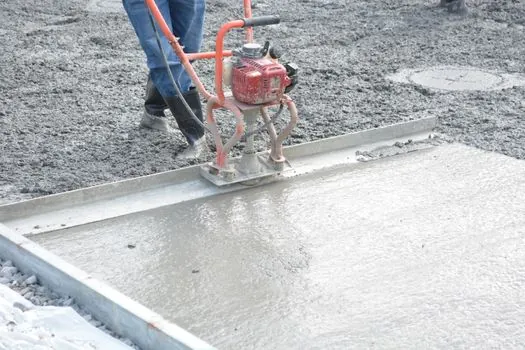
Suppliers active in landscaping-class walk-behind machines include Shandong Vanse Machinery, HIKING, and Allen Engineering, alongside OEM-branded units exported through Qingdao, Ningbo, and Shanghai with CE marking and optional local-voltage configuration for EU, GCC, and ASEAN sites [S1].
Buyers should verify at minimum: documented laser accuracy (e.g. ±1.5 mm at 30 m for the transmitter), hydraulic service intervals, wear-part lists with part numbers, and a service contact inside the destination region, because 25% of construction projects exceed their initial budgets on equipment downtime [S2].
Two practical tracking signals for the next buying cycle: (1) 3D total-station interfaces dropping below USD 8,000 retrofit price on walk-behind chassis, and (2) more Chinese OEM brands publishing F<sub>F</sub>/F<sub>L</sub> test certificates on request rather than only marketing flatness claims.
Spec-level background on the components involved: laser marker.