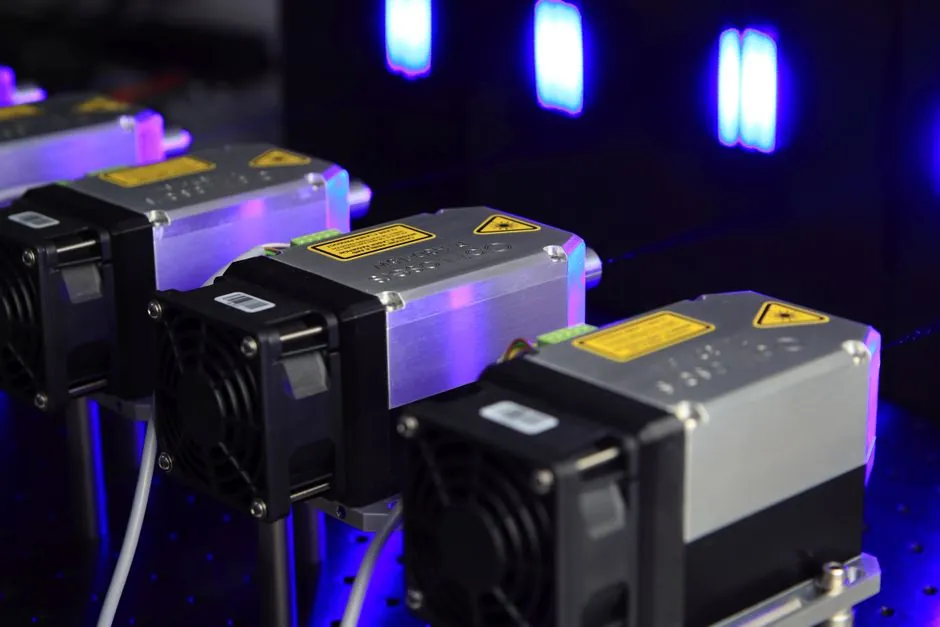
Industrial 1D laser triangulation sensors on the 2026 market list from roughly $200 for short-range diffuse-reflective heads (30–100 mm reference) to over $5,000 for sub-micron high-speed units with linearity of 0.02% to 0.04% FSO, with the gap explained by spec, not brand markup [S1][S2][S3].
Four spec buckets set the price: measuring range, linearity class, sampling rate, and housing/ingress protection, and each one moves the quote by a meaningful step, so buyers should match the spec to the application before negotiating on the vendor name [S1][S2][S3].
Price bands by performance class
Short-range diffuse-reflective laser triangulation heads with a 30–100 mm reference distance, 1 µm resolution, and IP67 housing, such as the Autonics BD series, sit at the entry-level band and are the typical pick for cost-sensitive inline inspection, with amplifier units interconnectable up to 8 channels to share cost across a station [S2].
Mid-band units like the RIFTEK RF602 cover 10–500 mm with linearity of 0.05% to 0.1% FSO, 9.4 kHz sampling, 9–36 V supply, and 1.5–2 W draw, and the published availability of both red and blue laser diodes in the same housing is a useful spec-first differentiator, because blue laser reduces error on hot or dark surfaces [S1].
High-end CCD-based units like the Keyence LK-G3000 series and the Micro-Epsilon optoNCDT 5500 push linearity down to 0.02% to 0.04% FSO with measuring rates from 0.3 kHz up to 150 kHz across 10–200 mm ranges, which is where per-unit prices cross the $3,000 to $5,000 threshold and where quotation, not list, is the only honest answer [S3][S5].
What actually moves the quote
Measuring range is the first cost driver: a 25–50 mm head costs less than a 300–1,000 mm head, because the latter needs a longer baseline, larger optics, and tighter alignment tolerances, and WayCon's LAS series covers 10–1,000 mm at a 1 kHz rate in this category [S3].
Linearity class is the second: jumping from ±0.1% FSO to ±0.05% FSO typically adds a tier of price, and going to ±0.02% to ±0.04% FSO (the optoNCDT 5500 bracket) is a step change, not a slope, because the detector and ASIC change [S3].
Sampling rate is the third: 660 Hz heads (WayCon LAR, 10–400 mm) cost less than 5 kHz heads (Keyence LAH-G1, 4–300 mm), and going past 49 kHz (the upper optoNCDT 5500 limit at 150 kHz max) puts the unit firmly in process-control pricing, not OEM machine-builder pricing [S3].
Housing and laser color are the fourth: IP67 is now table stakes for industrial heads, and the choice between a red and a blue diode on the RF602 line is typically a no-cost option at quote time, but it changes accuracy on red-hot or transparent targets, which is a hidden TCO line item if missed [S1][S3].
Options compared on decision criteria

Buyers comparing triangulation, confocal, and time-of-flight (ToF) laser displacement sensors should weight four criteria: sub-micron accuracy on shiny or transparent parts, standoff distance, target material independence, and unit cost; on this matrix, triangulation wins on cost and resolution, confocal wins on material independence, and ToF wins on long range but loses on resolution [S3].
A focused laser displacement sensor selection should also reference the broader displacement sensor category, because contact and non-contact types are often chosen in pairs on the same machine, and a confocal displacement sensor becomes the right answer when the target is mirrored, transparent, or multilayer, which is where triangulation drifts.
Total cost of ownership, not sticker price
Installation cost is the silent 30% to 60% adder on a single-point sensor: bracket, cable, amplifier unit, and IP-rated connector add up, and detachable head/amplifier designs like the Autonics BD series cut mean-time-to-replace because the head can be swapped without re-routing the cable [S2].
Maintenance is the second TCO line: laser diodes in triangulation sensors are rated for years in clean plants, but lens contamination from coolant, oil mist, or weld spatter turns a 5-year service life into 18 months, which is why IP67 plus a purge-air collar is the cheaper long-term answer in dirty cells [S1][S2].
Calibration and drift is the third: high-linearity sensors (0.02% to 0.04% FSO) need yearly recertification against a gauge block or laser interferometer, and that recurring cost should be priced into a multi-year procurement, not buried in year-one CAPEX [S3].
For plants that already run photoelectric or fiber-optic chains, the cross-reference to lighting equipment and electric lamps is relevant only for stable-illumination inspection stations; for motion stages, a linear guide or crossed roller guide spec controls the runout that a displacement sensor is trying to measure, and pairing the two is where procurement gets the system accuracy it is actually paying for.
Who laser triangulation is for, and who it is not
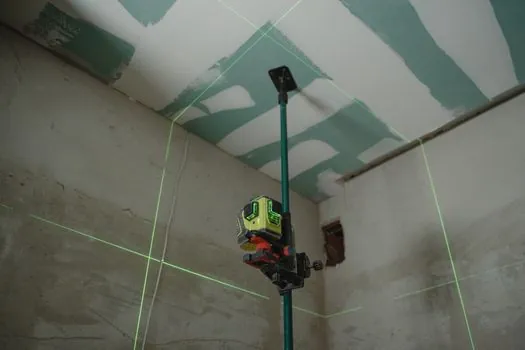
Triangulation is the right pick for short-to-mid standoff (10–500 mm) dimensional checks, thickness, vibration, runout, and surface profiling on opaque targets, and it is the workhorse of EV battery tab measurement, semiconductor wafer mapping, and steel coil thickness [S1][S2].
It is the wrong pick for transparent film, mirrored glass, or multilayer coatings, where the laser spot walks through the surface and gives a phantom reading; confocal displacement sensors are the correct substitution in those cases, and a quick target-material audit before RFQ prevents the classic mis-spec [S3].
It is also the wrong pick for long-range (1 m+) or harsh-dust tank level, where time-of-flight or 2D/3D LiDAR is the right tool; buyers who try to push a 1,000 mm triangulation head into a 5 m silo are paying for a sensor that will fail within a quarter, not saving money [S3][S4].
Procurement signals worth tracking
RFQ volume on the Tianjin G-TEK LF25 line and on Chinese OEM triangulation lines at 20+ year sensor vendors is a leading indicator that 2026 H2 pricing on mid-range heads (100–300 mm, 0.1% FSO) is under downward pressure [S4].
DirectIndustry listings refreshed between 2026-05-22 and 2026-08-03 show the LK-G3000 series datasheet is still actively maintained, which signals Keyence is shipping current-generation hardware rather than running on a legacy catalog, a useful pre-RFQ check [S3][S5].
Industrial purchasing teams cross-referencing displacement sensors against test and measurement tenders, like the open Electronic Components and Associated Products, Services Kits, Tools, Fixings, Test and Measurement Equipment and Batteries signal, will see laser displacement heads called out under dimensional metrology lots, and pairing that with the level switch selection guide for 2026 helps engineers place laser sensors in the right instrument family at spec time.