Tank geometry, not brand preference, drives the primary instrument choice: vertical atmospheric tanks of 2-15 m height are the natural fit for a magnetic level gauge with an external chamber, while compact sumps, drip pans, and small chemical feed vessels are the natural fit for a level switch actuated by a single float or tuning fork.
Across the Chinese supplier base the two product families are sold side by side: Hebei Xukang Meter lists 10 main product lines including magnetic level gauge, sight glass, level meter and level switch under one factory roof [S2], and Made-in-China.com indexes 2026 product listings for both families under the "Level Gauge For Tanks" category, with palm-oil, water, and remote-transmitter variants [S4].
Operating envelope and tank-geometry fit
The JC-56L magnetic level gauge family is offered in side-mounted, top-mounted, top-loading, and side-loading configurations, with PTFE/PFA, PP, PVDF, and uPVC lining options, and is rated for measurement of the liquid surface in open or closed pressure vessels with stainless steel 304, 316L, PTFE, or PP wetted parts [S3]. The unlimited-length column and 360° rotatable flag display make it practical for vertical tanks from roughly 1 m up to 15 m, but horizontal cylinders below ~1 m diameter lose the visual resolution advantage of the magnetic flag.
For magnetic float switches, the Trimod'Besta P 01 04 series is published at PN 25 per DIN, 1-250°C operating, 1-80°C ambient, minimum liquid density 0.7 kg/dm³, 12 mm fixed switching differential, and CrNiMo stainless wetted parts with a seawater-resistant aluminium housing [S5]. That 12 mm differential and 0.7 kg/dm³ density floor are the two numbers that quietly disqualify a float switch for steam-jacketed, low-density hydrocarbon service on a vertical tank.
Comparison: magnetic level gauge vs level switch on five decision criteria
Indication type is the first differentiator: a magnetic level gauge gives continuous visual readout across the full liquid column, with optional 4-20 mA transmitter and reed switch outputs added to the same chamber [S3], whereas a float or magnetic level switch gives only a discrete on/off state at the float elevation.
Process interface and safety is the second: a magnetic level gauge is "completely sealed for safety, no leakage to atmosphere" and is "particularly suitable for dangerous or toxic fluids" [S3], while a top-mounted float switch typically relies on a single gasket at the tank nozzle. For toxic or flammable services this is usually enough to push the spec toward a sealed chamber plus reed or magnetic sensor strip.
Material and corrosion envelope is the third: magnetic level gauges are quoted in 304, 316L, PTFE, PP, and PVDF [S3], giving wide chemical compatibility; float switches on the published P 01 04 data use CrNiMo stainless with no lining, which is acceptable for many hydrocarbons but not for hot concentrated acid service.
Switching accuracy and trip count is the fourth: the P 01 04 float switch has a fixed 12 mm differential at a single point [S5], so trip point accuracy is bounded by float hysteresis and reed tolerance, typically a few millimetres. A magnetic level gauge outfitted with one or two external switch modules, such as the ABB LMS100 SPDT unit designed to mount on a KM26 magnetic liquid level indicator or LS series cage level switch [S1], can be ordered at the same trip points the user draws on the scale.
Cost and footprint is the fifth: a bare float switch on a 1/2" or 1" nozzle is the cheapest possible level device, while a magnetic level gauge adds the external chamber, process isolation valves, and usually a scale. For one trip point on a small tank the switch wins on price; for two or more trip points, the magnetic chamber with snap-on switches frequently pulls ahead once piping, valves, and the second nozzle are costed.
Best-fit tank geometries for each technology
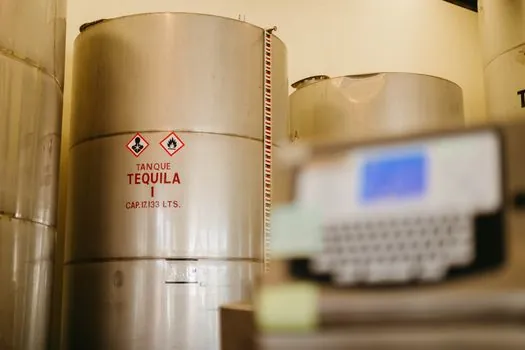
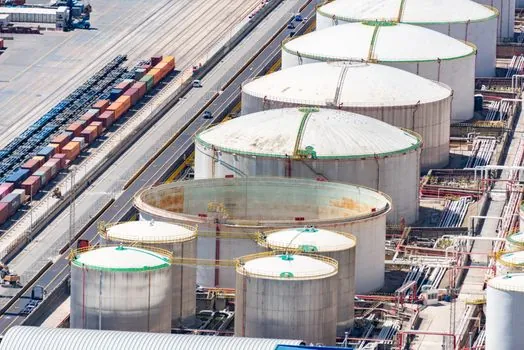
Vertical atmospheric storage tanks from 2 m to 15 m are the textbook magnetic level gauge application, with the chamber bypass mounted on the side and an optional 4-20 mA transmitter added for the DCS [S3]. Spherical and bullet LPG vessels are also common chamber-gauge applications when a sight glass would be a cold spot and a single float switch cannot represent multiple levels.
Compact sumps, condensate drip pans, pump-skid day tanks, and small chemical feed tanks below roughly 1 m height are the textbook level switch application. The P 01 04's 1/8" BSPP control port and 12 mm fixed differential [S5] suit a single high-level or low-level cut-out where the only requirement is a clean dry-contact output to a pump contactor.
Agitated reactors and jacketed vessels with dense internal hardware are an edge case: a magnetic chamber installed on the side is usually the only option, with the float chosen for low-density fluids and a high-temperature float specified for steam-jacketed reactors. The JC-56L line explicitly calls out a "high temperature, high pressure and low density special float design" for these services [S3], which is a useful cue that the standard float data is not adequate.
Hybrid configurations for difficult geometry
The cleanest engineering answer on a difficult vessel is a magnetic level gauge as the primary continuous instrument, with a magnetic level gauge switch snapped on the chamber for the alarm or trip set points. The ABB LMS100 is documented as a magnetically actuated single pole double throw switch that mounts on a KM26 magnetic liquid level indicator, an LS series cage level switch, or an external chamber [S1], so the same chamber can carry one, two, or three independent SPDT contacts without extra tank penetrations.
For rf admittance level switch service in tanks with foam, vapour, or coating build-up, the published P 01 04 pneumatic float switch is the wrong technology, and an RF admittance probe on a stilling well is the more typical choice. The reference set here covers the magnetic and float families specifically, so RF admittance is only relevant where the user is replacing a failed float switch in a foaming or coating service and is willing to retune the probe.
Standards, certifications, and sourcing checkpoints
For hazardous-area service the published ABB product page does not state an ATEX or IECEx certificate number in the captured text [S1], so the specifier must pull the certificate PDF directly from the manufacturer and verify the marked Ex rating, ambient range, and process temperature limits before accepting the LMS100 on a classified vessel. The same applies to any magnetic level gauge: the captured JC-56L feature list is descriptive only, with no certificate number shown [S3].
Material traceability is a separate checkpoint: 304 vs 316L stainless selection for chloride-bearing or marine service, and PTFE/PFA vs PP vs PVDF lining for acidic or hot caustic service, must be confirmed on the vendor's data sheet, not assumed from the family name. For LPG, ammonia, or other low-density fluids, the published 0.7 kg/dm³ density floor on the P 01 04 [S5] rules out the standard float, and a low-density float or a different technology must be substituted.
Supply-chain data points worth tracking: Hebei Xukang Meter was established 2017-03-17 with 42 employees and reports a 5.0/5 supplier rating with an average response time of ≤2.79 h on Made-in-China.com [S2], which is a useful supplier-vetting signal but is not a product certification. For more on selection frameworks used across other instrument families, the load cell selection guide on force, capacity, geometry, and class uses the same geometry-driven reasoning that applies here, and the thermocouple selection for hazardous-area temperature points article covers the same hazardous-area certificate verification path needed for any Ex-rated level device.
Track two signals before placing the next order: the published hazardous-area certificate number and revision on the LMS100 or its successor on the ABB product page [S1], and the per-vendor 2026 datasheet revision for chamber material and lining combinations, since the JC-56L product description does not carry a revision code in the captured text [S3]. If both are clean and the tank geometry sits inside the 2-15 m vertical range, specify a chamber gauge with snap-on switches; if the vessel is small, horizontal, or only needs a single trip, a float or magnetic level switch on a single nozzle is the lower-cost answer.