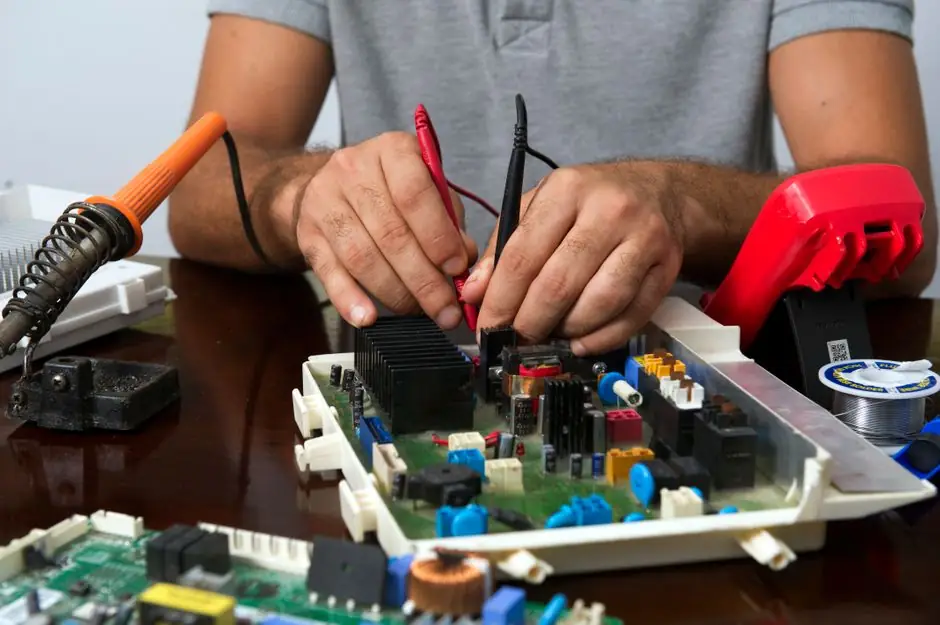
A digital multimeter on a generator set, switchgear bay, or turbine panel must satisfy three non-negotiable specs: true-RMS AC, a safety category of CAT IV 600 V or CAT III 1000 V, and a 10 A current input protected by a high-energy (HRC) fuse [S2]. The Fluke 87V, listed at the top of professional review tables at roughly $400, combines a 6000-count dual-display, a selectable low-pass filter for variable-frequency drives, and a 1000 V AC/DC input rating that meets the CAT III 1000 V / CAT IV 600 V envelope used on 480 V to 600 V generator feeders [S2][S3].
Selection is not about the brand badge on the holster; it is about which measurement functions survive the harmonics, common-mode noise, and 4 kV+ transient rings of a 1 MW genset bus. Mid-tier meters at the $50 to $100 band, such as the Extech EX330 (CAT III 600 V, 10 A AC/DC, 4000 counts) cover residential and small commercial backup generators but lack the transient immunity of a CAT III 1000 V unit [S2]. On utility-scale, hydro, or wind plant switchboards, a CAT III 1000 V instrument with 100 kHz bandwidth, 0.025% basic DC accuracy, and a 1 ms peak capture is the minimum viable spec [S2].
What "Power-Generation Grade" Actually Means in Specs
A DMM qualified for power-plant work must publish four numbers: a measurement category (CAT III 1000 V or CAT IV 600 V), a stated basic DC accuracy (0.05% to 0.1% on the Fluke 87V class), a maximum continuous input of 1000 V AC/DC, and a transient withstand aligned to the installation environment [S2]. The Lowe's top-rated ranking (2026-09) puts the KAIWEETS 600 A true-RMS clamp and the Fluke 117 in the consumer best-seller slots, but neither carries CAT IV 600 V at 1000 V DC, which is the lower bound for any work past a 480 V breaker [S3].
For generator-side troubleshooting, also verify: temperature via Type-K thermocouple input (-200 to 1090 °C on the 87V), capacitance to 10 000 µF for capacitor-bank checking, and a continuity beeper that latches on <25 Ω for cable-to-busbar verification [S2]. A digital panel meter installed at the switchgear gives the continuous readout, while the handheld DMM handles the diagnostic sweep.
True-RMS, Bandwidth, and VFD Filtering on Inverter-Fed Sets
True-RMS acquisition to 100 kHz bandwidth, as implemented on the Fluke 87V, Fluke 289, and Agilent U1253B, keeps voltage and current readings inside the spec sheet's accuracy envelope across the full PWM spectrum [S2].
The Fluke 87V's selectable AC low-pass filter blocks 3rd-order harmonics and switching noise above 800 Hz, which is the reason it remains the default on motor and drive commissioning crews [S2]. For solar inverter strings, where DC bus voltages hit 1000 V to 1500 V, the Fluke 283 (1000 V DC, CAT III 1000 V) or the 289 are safer picks than a 600 V DMM, because a single 1500 V open-circuit string would smoke a 600 V input stage [S2].
Current Measurement: Clamp, Shunt, or Direct 10 A?

Direct 10 A input remains the cleanest path for low-current loops (4 mA to 20 mA signals, AVR excitation at 2 A to 5 A), but a generator stator running at 600 A to 4000 A cannot be measured with test leads [S2]. A power meter with CT inputs handles continuous logging, while a CAT IV 600 V clamp meter (Fluke 376 FC, 1000 A AC/DC) covers the spot checks on busbar and feeder conductors [S1][S2].
Three current options compared on the criteria that matter to a generation site:
1. 10 A fused input on the DMM: best for signal-loop and AVR diagnostics; limited to 10 A continuous (20 A for 30 s on the 87V); requires breaking the circuit to insert in series.<br>2. Flexible AC clamp (iFlex 2500 A on Fluke 376 FC): non-invasive on cables up to 2500 A, true-RMS, logs to phone over Bluetooth; adds cost above $300.<br>3. Hall-effect DC clamp (Fluke 381, 1000 A AC/DC): needed for battery string and DC bus on solar hybrid plants, since current transformers pass AC only.<br>For 3-phase generator paralleling, a clamp-on power quality logger (Fluke 1738 or 435-II) captures voltage, current, THD, and unbalance simultaneously, exporting the data that the DMM cannot [S1][S2].
Safety Category, Fuses, and the Real Cost of a Cheap Meter
CAT ratings are not marketing: a CAT III 1000 V meter has been type-tested to survive a 6000 V transient with 2 Ω source impedance, the worst case at a switchgear bus; a CAT II 600 V meter has been tested only to 4000 V at 1 Ω, which fails the same arc-flash incident [S2]. The Home Depot best-rated list is dominated by 600 V CAT III units, such as the Klein Tools 600 V Digital Multi-Meter, fine for branch-circuit work but not for a 480 V genset output breaker [S4].
High-energy fuses are the second safety layer: the Fluke 87V uses a 11 A, 1000 V, 20 kA interrupt-rated HRC fuse on the current input, which contains a prospective short-circuit current of 20 kA without venting the case. A sub-$30 meter typically ships with a 250 V glass fuse, which ruptures violently at 1000 V and is the documented cause of arc-flash injury on generator bays [S2]. Budget below $50 is a real threshold: a meter in that band is appropriate for 12 V automotive, not for live switchgear.
Brand Tiers, Pricing, and Where Each One Fits

The Test Meter Pro tiering (2025) groups the market into budget (under $50), midrange ($50 to $100), high ($100 to $300), and premium (over $400), and the right DMM tier for a power-gen application depends on where in the plant it is used [S2]. The INNOVA 3320 at roughly $20 covers 12 V battery checks and small standby gensets, with a 600 V AC/DC ceiling but only 200 mA on AC current, which is too low for any work beyond a 1 kW portable [S2]. The Klein MM1000 and Amprobe AM-510 sit in the $50 to $100 band with 1000 V DC inputs, suitable for small commercial 208 V backup systems [S2].
At the $100 to $300 band, the Fluke 115 and 116, the Greenlee DM-820A, and the EEVBlog BM235 are popular general-purpose meters, but the Fluke 115 lacks the 87V's temperature input and 1000 V AC rating, which restricts it on 480 V generator terminals [S2]. The premium band holds the Fluke 87V (around $400), the Fluke 177, the Fluke 279 FC with built-in thermal imaging, and the Agilent U1253B data-logging DMM, the last of which logs 1000 points to internal memory for trending AVR response over a 24 h period [S2]. For utility-scale hydro or thermal plants, a related discussion of rotating-equipment hydraulics in hydraulic pump selection for power generation runs alongside the electrical spec sheet, and the same engineering rigour applies.
Calibration, Field Checks, and Common Failure Modes
Annual calibration of a CAT III 1000 V DMM is typically required for ISO 9001 / ISO 17025-controlled power plants, with traceable certificates from a national lab (NIST, NPL, or PTB); a $400 Fluke 87V carries a 3-year warranty and 1-year calibration cycle, while a sub-$50 meter has none [S1][S2]. Field verification on the generator bay is a five-step routine: continuity on a known-good cable (expect <0.5 Ω on a 10 ft run), insulation resistance at 500 V (use a megohmmeter, not a DMM, because DMMs cannot source the 500 V test), phase rotation on the 480 V output (Fluke 9040 phase rotation tester is the standard tool), voltage between phases and to ground, and frequency at 50 Hz or 60 Hz [S2].
The most common DMM failure mode in power-gen service is not the meter itself but the lead: a worn test probe with 5 kΩ contact resistance can mask a 30 V drop on a 480 V bus, leading to a misread of system health. Inspect leads for cracked insulation, replace any probe with a broken finger guard (CAT-rated probes have a fixed guard that exposes only 4 mm of tip), and verify that the current-input fuse is intact by measuring continuity across the A-jack before each shift [S2]. Where the DMM is paired with a permanent power distribution panel, the installed power cable insulation integrity and a clamp-on power mixer for load sharing round out the measurement kit.
Trackable next signals for specifiers: whether the Fluke 87V replacement (rumored in 2025 trade press to target 2027) retains the 1000 V AC envelope, and whether the 1000 V DC / 1500 V DC CAT III solar-inverter DMM class becomes the new default for hybrid plant commissioning. For utilities and EPCs, the procurement spec should lock CAT III 1000 V / CAT IV 600 V, true-RMS, 100 kHz bandwidth, and 0.05% basic DC accuracy on the evaluation checklist, then disqualify any candidate that cannot publish all four numbers in the datasheet.