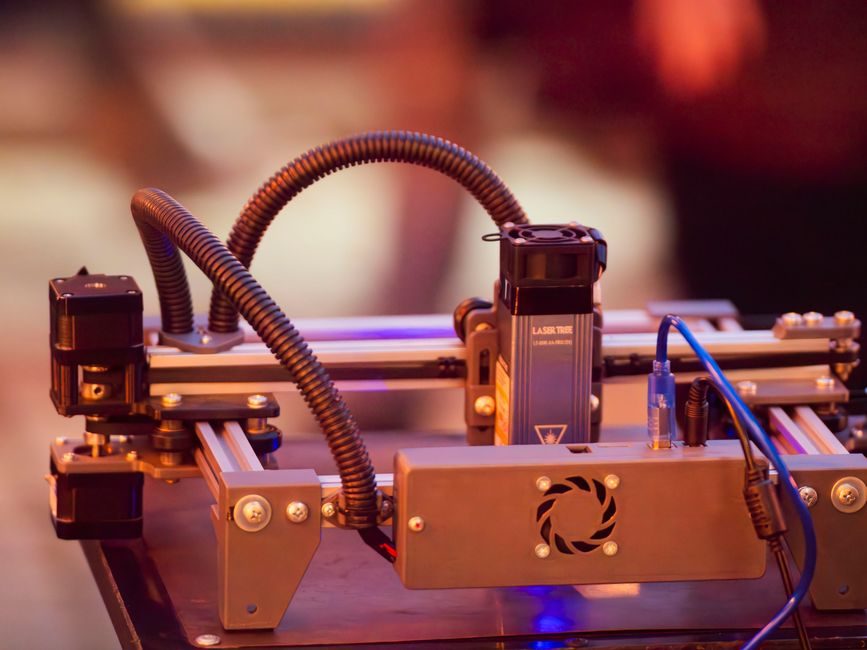
Specifying a laser displacement sensor starts with the measurement principle, because triangulation and time-of-flight sensors solve different problems on the same factory floor. Triangulation units use a CMOS or CCD linear array to compute distance from the angle of the reflected spot, which keeps them compact and sub-micrometer repeatable, but limits the working envelope to tens or low hundreds of millimeters [S5].
Time-of-flight units pulse the laser and time the return, trading the sub-micrometer class of triangulation for standoff ranges that reach geotechnical distances, with the trade-off visible in published accuracy figures and weather sensitivity [S1]. Within a single procurement, mixing both principles is normal: a short-range triangulation head on a vibration stand, a time-of-flight unit on a tailings dam.
Triangulation vs. Time-of-Flight: Which Principle for Which Duty
Triangulation CCD sensors from the Keyence LK family carry ±0.1% of F.S. linearity across all models and 1-µm repeatability with a 30-µm diameter beam spot, which is the envelope to expect for high-precision short-range work [S3]. The faster LK-G3000 series pushed sampling to 50 kHz, accuracy to ±0.02% of F.S. on the LK-G10/15 heads, and repeatability to 0.01 µm on the same heads [S2].
Time-of-flight pulsed sensors, in the Encardio Rite NexaWave configuration, are non-contact units that monitor displacement between two points over distances typical of settlement and geotechnical installations, with the datasheet explicitly stating that mist, fog, and smoke can degrade precision [S1]. The Encardio NexaWave unit is designed around LoRa RF data transport with a 200-node-per-gateway mesh and AES-128 encryption, a configuration built for remote civil sites rather than for sub-micron bench work [S1].
Range, Standoff, and Beam-Spot Geometry
Working range and standoff are not the same number, and confusing them is the most common spec-sheet error. The LK-2500 head is positioned for long measuring distance within the Keyence LK line, while the LK-G3000 series documents 50 kHz sampling with six sensor heads sharing two optical system types, indicating the manufacturer has split the catalogue by standoff and spot geometry rather than by a single range figure [S2][S3].
For a 30-µm beam-spot triangulation head, the practical floor on feature size is roughly the spot diameter, so any target detail below that is filtered by the optics before it reaches the CCD array [S3]. Time-of-flight units, by contrast, resolve only the centroid of a much larger illuminated patch, so spatial resolution at 100 m of standoff is fundamentally coarser than any triangulation head can deliver at 100 mm.
Linearity, Repeatability, and Sampling Speed
Linearity is the published full-scale error band; repeatability is the dispersion on a fixed target; sampling speed is the maximum output rate. The Keyence LK family publishes ±0.1% of F.S. linearity across all heads, while the LK-G3000 series narrows that to ±0.02% of F.S. on the LK-G10/15 heads, with 50 kHz sampling as the headline number [S2][S3].
Repeatability on the LK-G10/15 reaches 0.01 µm, a figure that puts the head in metrology class rather than process-control class [S2]. A buyer writing a datasheet comparison should always pin the repeatability figure to a stated sampling rate, because 0.01 µm at 50 kHz and 0.01 µm at 1 kHz are not equivalent production data streams.
Surface Behaviour, Colour, and Stray Light
Triangulation heads are sensitive to specular vs. diffuse reflection; the LK family is documented as giving measurement "unaffected by colour, surface texture or stray light," which is a vendor claim for its LFTC measuring technology and custom CCD rather than a generic property of triangulation [S3]. Glossy metals, transparent films, and hot-rolled steel each demand an oblique-incidence mount or a filter, and the displacement sensor family page covers the general material-handling trade-offs in more detail.
Time-of-flight units can read most diffuse surfaces without mounting gymnastics but their published accuracy already absorbs the larger spot, so there is little headroom left for low-reflectivity targets [S1]. For shiny or transparent workpieces, a confocal displacement sensor is the more robust principle because it filters specular reflection at the chromatic optics rather than at the detector.
Enclosure, Interface, and Field Integration
Industrial heads for shop-floor duty are commonly rated IP67 for weatherproof, dust-protected installation, and the NexaWave datasheet carries that rating explicitly with a compact enclosure for confined-space mounting [S1]. LoRa-based units add a gateway layer: 200 sensor nodes per gateway in MESH configuration, with battery life of 6–60 months depending on transmission rate and optional solar power via the ESP-12V1A panel [S1].
Factory-side triangulation heads typically expose analogue 4-20 mA, RS-232/RS-422, or Ethernet, and the LK-G3000 ships with a multifunctional controller plus menu-driven setup software rather than a bare analogue output [S2]. When a sensor must coexist with PLC-controlled lines, the modular PLC selection guide covers slot count and fieldbus constraints that drive the controller-side decision.
Options Compared on Selection Criteria
A direct four-criteria comparison lines the realistic options against the points a procurement engineer actually has to score. (1) Short-range precision — Keyence LK-G3000 with ±0.02% F.S. and 0.01 µm repeatability on the LK-G10/15 heads [S2]. (2) Mid-range shop-floor — Keyence LK series with ±0.1% F.S. and 1-µm repeatability across the family [S3]. (3) Long-range geotechnical — Encardio NexaWave time-of-flight unit, non-contact, IP67, LoRa telemetry, weather-sensitive [S1]. (4) Reflective or transparent targets — confocal chromatic heads, which sacrifice speed for surface-independence.
Buyers who do not need a micrometer should not pay for one: the LK-G3000's 50 kHz throughput is wasted on a 10 Hz PLC analogue input, and a 200-node LoRa gateway is over-spec for a single press-shop cell. Conversely, anyone trying to read a settlement prism at 200 m with a triangulation head has simply picked the wrong principle.
Who Should Not Pick the Mainstream Option
Triangulation is the default in catalogues, but it is the wrong call when the target is hot, vibrating, or physically inaccessible for a short standoff, because the geometry collapses. Time-of-flight should be skipped when sub-millimetre class accuracy is contractually required, because its published accuracy is not competitive with triangulation on short range [S1].
Plants that need a single sensor to read multiple colours, mirror-finish steel, and rubber profiles on one line should evaluate chromatic confocal heads rather than force-fit a triangulation unit with software compensation, since the laser distance sensor class does not bridge that gap by itself. Civil sites with heavy fog, dust storms, or smoke plumes should re-spec the time-of-flight head with a wider optic or a radar fallback, because the NexaWave datasheet explicitly lists those conditions as precision-degrading [S1].
Field Use Cases and Sourcing Signals
Triangulation CCD heads dominate semiconductor wafer profiling, PCB thickness, and roller-gap measurement, where the 30-µm spot and 1-µm repeatability of the LK family fit the duty [S3]. High-speed lines that need 50 kHz feedback for run-out or vibration use the LK-G3000 class, with the LK-G10/15 heads carrying the headline accuracy and repeatability figures [S2]. Time-of-flight units like the NexaWave are specified for dam, tunnel, and slope settlement monitoring, with LoRa RF gateways, AES-128 encryption, and a Proqio cloud platform for 24/7 data access [S1].
Before signing a PO, three signals are worth tracking: (1) confirm the published linearity and repeatability against the sampling rate your controller can accept, because a slower acquisition degrades the dispersion figure; (2) verify enclosure rating on the actual part number, since the IP67 designation is in the datasheet but the head variant on the quote must carry it; (3) request a controlled-target demonstration on the worst-case surface, because laser level calibration drifts and surface-dependent error are not visible from headline numbers alone.