
A modular PLC is a CPU plus a swappable set of I/O and communication modules on a common backplane, and the right unit is the one whose slot count, supported fieldbus, and IEC 61131-3 language set match the panel, machine, or skid you are actually wiring [S1][S3].
For 2026 builds, modular controllers span 14 I/O micro-modular bricks (Wecon LX3V 1212M, AC85-265V supply, 14 DI/12 DO, 2 × 100 kHz high-speed pulse outputs) up to 1 GHz ARM Cortex-A8 CPUs with OPC UA + MQTT (Pixsys PL700) and 31-module expansion chains (OMC 8000) [S1][S3]. The selection math is straightforward once you lock the I/O count, the fieldbus, and the safety class — the rest is form factor and programming environment.
What "modular" actually means in 2026
A modular PLC differs from a compact or box PLC in that the CPU, power supply, discrete I/O, analog I/O, motion, and communication modules are separate parts snapped into a common rack — and that rack can be expanded later without replacing the controller [S1]. Pixsys sells a parallel PL500/PL700 line built on ARM Cortex-A8 1 GHz with on-board RS485, RS232, Ethernet, CAN, and a slot pattern that accepts expansion I/O cards [S1][S3]. The Productivity3000 (AutomationDirect) is the textbook modular frame: discrete, analog, and specialty I/O modules auto-discover, no module placement restrictions, no power budget calculation, and free Productivity Suite programming with unlimited user tags [S5].
The modular form factor overlaps with two adjacent families, and confusing them is the most common spec error. A box or compact PLC (Schneider Zelio SR3B101FU "modular smart relay", Wecon LX3V) is one housing with a fixed I/O map and a limited expansion bus — it is "modular" only in the relay-stack sense [S1][S2]. A safety PLC (Fiessler FMSC, BBH SMX 100-1/2) is a separate category with safe digital inputs, safe relay outputs, and dual-channel pulse outputs certified to functional-safety standards; it is built modularly but lives under a different compliance regime [S1]. A PAC (programmable automation controller) blurs into the modular PLC at the high end — usually when CPU cycles, motion axes, or C++/C# user code push past classic PLC limits [S1].
Sizing the rack: slot count, I/O, and expansion limit
Start with the I/O count from your electrical drawing, then add 20-30% headroom for revisions before you size the backplane. The Mect TPLC100 family expands by stacking MPNC006, MPNC030, MPNC035 (analog) and MPNC020 (digital) modules off an ARM9 base [S1]. LS Electric's XGB XBC-DR32H supports up to 10 expansion modules and up to 704 I/O points with an 83 ns/step CPU [S1]. The Pixsys PL700 family uses a similar 10-12 expansion slot pattern with CODESYS Control SL v3.5 as the runtime, exposing CANopen, EtherCAT, EtherNet/IP, J1939, Modbus TCP/Serial, and PROFINET through one CODESYS project [S3].
If you are crossing the 64-128 I/O boundary, modular becomes non-negotiable — the wiring density on a compact PLC becomes unmanageable and hot-swap becomes a real selling point. The Productivity2000 micro-modular line targets exactly that niche with RS-485 connector, terminal block, and motion accessories as separate line items [S6]. Productivity2000 relay-output modules give you a third option (electromechanical dry contact) alongside sink/source and analog, which matters when you are switching solenoids, contactors, or older instrumentation that needs a dry pair [S7].
Fieldbus and protocol coverage: the 2026 checklist
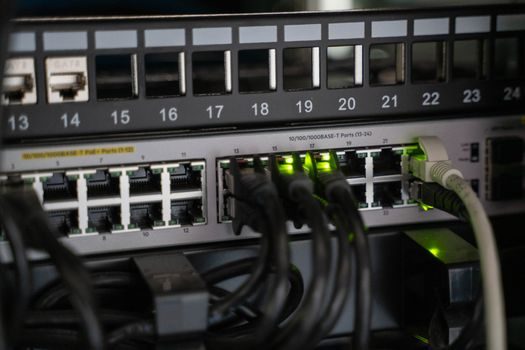
Match the fieldbus first, the brand second. EtherCAT and PROFINET dominate high-speed motion; EtherNet/IP and Modbus TCP dominate North American process skids; CANopen and J1939 dominate vehicle and mobile equipment; RS485/Modbus RTU still rules low-cost sensor networks [S1][S3]. A controller that supports all of them in software (CODESYS-based Pixsys PL700) is cheaper to stock than three different fieldbus-specific PLCs, provided your team can write IEC 61131-3 in CODESYS [S3]. The Productivity3000 ships with a different set again — Modbus, EtherNet/IP, and Productivity's own protocol stack on the CPU, with serial and specialty modules behind it [S5].
OPC UA Server (full version for data exchange) and MQTT (as a function block) are now baseline on mid-range modular PLCs that target Industry 4.0 / IIoT retrofits, and CODESYS-based units expose both as standard runtime add-ons [S3]. If your edge gateway speaks MQTT, picking a controller with native MQTT cuts out a protocol converter box. For a wider spec context on instrumentation that sits behind these PLCs — transmitters, meters, and field devices — the flow meter and pressure transmitter entries in this encyclopedia are useful cross-references when you are specifying the analog input modules that read those sensors.
Safety, motion, and the modular boundaries
Modular PLCs are not interchangeable with safety PLCs. Fiessler's FMSC is a configurable modular safety controller with 14 safe digital inputs, 2 safe relay outputs, 2 pulse outputs, 2/4 pn-pp-switching outputs, 2 auxiliary outputs, and integrated drive monitoring [S1]. BBH's SMX 100-1/2 is the same idea: free programmable and configurable modular safety controller, designed to be integrated into a machine safety circuit rather than the standard control loop [S1]. If your application needs SIL/PL-rated stop circuits, overspeed monitoring, or safe I/O, you are selecting a safety PLC and the standard modular line is the wrong tool, even if the form factor looks similar.
For motion, the modern modular frame splits the work between a fast PLCopen-compatible CPU and dedicated motion modules or external axes. The b maXX-drivePLC, for example, claims a 100 μs cycle time for 1000 lines of STL and is targeted at applications that combine sequential control with demanding motion [S1]. Delta's AS Series AS500 sits on the compact modular mid-range end with positioning control and accurate axis control as headline features [S4]. Productivity3000 supports coordinated motion through PS-AMC motion controllers added to the same backplane, again without module-placement restrictions [S5]. When the motion task dominates (more than ~8 synchronized axes, electronic gearing, CNC-style interpolation), a PAC-class modular or a dedicated motion controller usually beats a general-purpose modular PLC.
CPU, scan time, and programming environment
Scan time is set by CPU architecture and instruction mix, and modern modular CPUs are rarely the bottleneck below 256 I/O. 83 ns/step puts the XGB XBC-DR32H in the mid-range bracket [S1]. 1 GHz ARM Cortex-A8 (Pixsys PL700) and the Productivity3000 CPU are an order of magnitude above that and are limited by fieldbus cycle time long before instruction rate becomes an issue [S3][S5]. What matters more is the programming environment: CODESYS (PL700), Productivity Suite (P3000), ISPSoft (Delta AS), and the vendor-proprietary tools each lock you into a tag database, a library set, and a version-management workflow. Mismatched toolchains across a plant are a real lifetime cost; the typical rule of thumb is to standardise on one environment per site.
High-level language support (C/C++, structured text, object-oriented IEC 61131-3) is increasingly common in modular mid-range CPUs and is the practical differentiator versus a smart relay. The Zelio SR3B101FU is a modular smart relay aimed at sub-30-I/O panels and does not run full IEC 61131-3 — it is correctly sized for that duty and is the wrong choice the moment you need reusable function blocks across machines [S1][S2]. For deeper coverage of how a PLC fits next to a machine's drives and feedback sensors, the PLC and safety PLC encyclopedia entries sit well alongside this guide.
Decision matrix: which modular PLC family fits which duty
Match the controller to the duty rather than to the brochure. Below is the shortlist logic a panel builder or controls engineer would actually run: [S1]
• Micro/smart-relay modular (Zelio SR3B101FU, Wecon LX3V 1212M, Boot & Work SPARTAN 19R): under 30 I/O, single-machine, 24 VDC or 85-265 VAC supply, Modbus RTU only. Do not pick this if you need EtherCAT, OPC UA, or more than ~64 I/O [S1][S2].
• Compact modular mid-range (Delta AS500, LS XGB XBC-DR32H, Productivity2000): 64-512 I/O, 1-3 fieldbuses, motion from 2-8 axes, IEC 61131-3 with structured text. Right for standalone machines, skids, and OEM cells [S1][S4][S6][S7].
• Full modular rack (Productivity3000, Pixsys PL700, B&R, ABB AC500): 256-2,000+ I/O, hot-swap I/O, OPC UA + MQTT, multi-protocol, redundant-CPU options. Right for line control, process cells, and any build that has to talk to SCADA/MES [S3][S5].
• Safety modular (Fiessler FMSC, BBH SMX 100-1/2, Pilz PNOZmulti class): safe I/O, certified to ISO 13849 / IEC 61508, integrated drive monitoring. Right only when the application has a defined safety function; do not mix standard and safe I/O on a non-safety CPU [S1].
Selection checklist and what to verify before you buy

Before you sign the PO, walk this list: (1) I/O count today + 25% spare slots available on the chosen backplane. (2) Fieldbus and protocol coverage that matches both the remote I/O and the SCADA/HMI on this site, not just on the demo. (3) IEC 61131-3 languages supported and whether the programming tool licenses are per-seat, per-CPU, or free (Productivity Suite is free; CODESYS is per-seat; vendor proprietary tools vary) [S3][S5]. (4) Operating temperature, vibration, and ingress rating — IP67 and mining-spec PLCs such as the SPC-SFMC-X2214A exist for a reason, and a Tier-1 office-rated CPU will fail in a quarry [S1]. (5) Power supply — AC85-265V wide-range, DC24V, or both — and whether the power budget is calculated by the vendor or by you (Productivity3000 explicitly states no power budget calculation; other platforms do require it) [S1][S5]. (6) Functional safety class and whether the chosen family has a safety variant or requires a parallel safety controller [S1].
For ancillary selection logic in the wider plant, this spec-first walkthrough of temperature monitoring device selection and the best pressure reducing valve for HVAC guide cover the analog-input and pneumatic side of the same I/O map. Cross-link these into the controls engineering spec so the field device list and the PLC I/O list stay in sync.
Track these signals over the next two quarters: (a) CODESYS-based mid-range modular PLCs expanding native OPC UA + MQTT function blocks versus protocol-converter gateways; (b) safety-PLC vendors adding more pre-engineered drive-monitoring blocks as servo/AMR adoption rises; (c) micro-modular lines (P2000-class) growing analog and motion options to compress the gap with full modular racks.