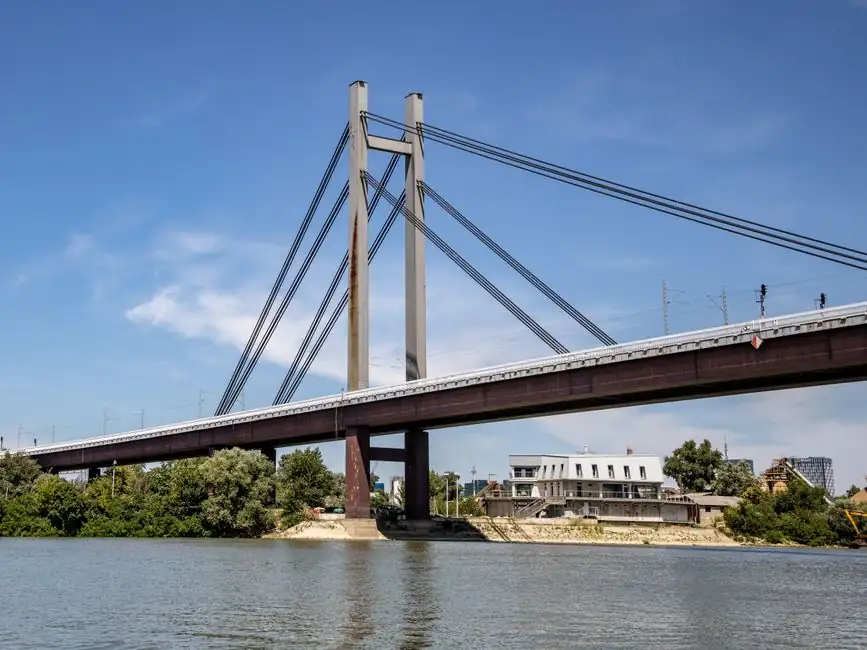
Bridge deck and approach-slab concrete placement demands ride-on or boom-type laser screeds with vibration widths of 2,500-4,000 mm, leveling thickness of 50-500 mm, and programmable slope heads to hit the 1-2 percent drainage gradient standard on pier approaches, expansion-joint transitions, and box-girder soffits [S3][S4].
Selection breaks on three criteria: structural element (deck vs approach slab vs parapet base), pour width (single-lane 3-4 m vs full-deck 8-12 m with cantilever overhangs), and grade complexity (uniform cross-fall vs variable transitions at drainage inlets and expansion joints) [S1][S2].
Why Bridge Work Sits Outside the Standard Warehouse-Floor Spec
Bridge construction imposes constraints a logistics-center floor does not: rebar congestion from top and bottom mat layers typically 40-60 mm cover, embedded shear studs at piers, post-tensioning ducts that cannot be disturbed, and closure pours between precast segments where access is asymmetric [S1]. A ride-on screed with a 4,000 mm vibration head and 8,500 kg operating mass (model class YG-ZP40) is too heavy for suspended deck falsework rated below 1,500 kg/m² and will overload the formwork; a 1,000 kg walk-behind unit (YG-CL300 / YG-CL300A) fits a 2,500-3,000 mm pass and is the usual box-girder choice [S3]. For full-width pours on staging, the heavier 4 m ride-on class becomes viable because the deck slab distributes load directly to the girders. Engine power scales accordingly: 22-22.8 kW (30-31 hp) for the walk-behind pair, 35.5 kW (48 hp) for the 3,100 mm mid-range, 63.9 kW (86 hp) for the 4,000 mm production class [S3].
Selection Criteria: Vibration Width, Thickness Range, and Engine Tier
Three data points drive the model decision on a bridge job. First, vibration width: 2,500 mm is the minimum for single-lane rebar-mat pours, 3,000-3,100 mm covers a standard traffic lane plus worker margin, 4,000 mm is reserved for full-width deck pours on highway overpasses with two or more lanes placed in one pass [S3]. Second, leveling thickness range: 50-300 mm covers most cast-in-place deck slabs, 60-300 mm handles approach-slab thickenings, 100-450 mm and 100-500 mm ranges belong to composite deck-pour applications and haunched sections near piers [S3]. Third, engine and hydraulic class must match the pump supply rate; a 4-8 km/h travel speed on the heavier ride-on models (ZP30, ZP40) lets the screed keep pace with a boom pump delivering 60-80 m³/h without leaving cold joints [S3][S1]. The walk-behind 0-4 km/h range is acceptable for small pours under 30 m³/h. For a wider comparison of laser screed selection logic across floor types, the same engine-versus-width logic applies in warehouse slabs but with different load-rating constraints.
Slope Programming for Drainage and Cross-Fall on Bridge Decks
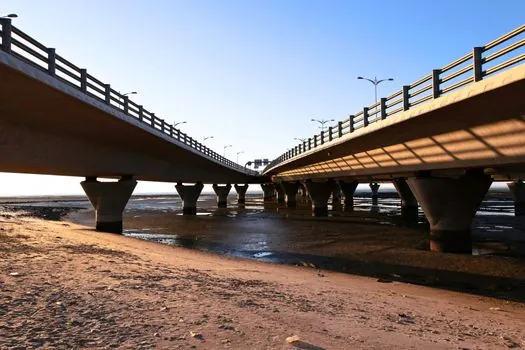
Bridge decks need a cross-fall of 1-2 percent to shed rainwater to drainage inlets at the curb line, which corresponds to 10-20 mm of fall per linear meter, the same range used on flat roofs, parking decks, and balconies [S4]. A laser screed with total-station or 3D-profiler integration can pre-program a variable cross-fall that transitions from 2 percent at the high point near the median to 1.5 percent approaching the inlet, then back to 2 percent past the drainage grate, all without stopping the pour. Walk-behind units rely on manual strike-off references and are limited to uniform cross-falls; ride-on machines with hydraulic valve modulation handle the transitions [S1]. For approach slabs at abutments, a tapered thickness of 300-500 mm is common, and only the 100-500 mm thickness-class machines can hold grade across the taper in a single pass [S3].
Comparison: Walk-Behind vs Ride-On vs Truss Screed for Bridge Elements
Bridge elements break cleanly into three machine classes. (1) Walk-behind laser screed (YG-CL300 / YG-CL300A): 1,000 kg, 2,500-3,000 mm vibration width, 50-300 mm thickness, 22-22.8 kW engine, fits box girders, parapet bases, and pier-cap closures where formwork rating is the limiter. (2) Mid-range ride-on (YG-ZP30): 5,500 kg, 3,100 mm vibration width, 100-450 mm thickness, 35.5 kW, suits approach slabs and single-lane deck pours. (3) Heavy ride-on (YG-ZP40): 8,500 kg, 4,000 mm vibration width, 100-500 mm thickness, 63.9 kW, 86 hp, used on full-width highway overpasses and bridge decks cast on permanent staging [S3]. A truss screed, by contrast, uses vibrating aluminum or steel beams rolled along form rails, has no laser reference, and is the right call only for narrow 2-3 m closure strips between segments or for topping overlays 30-50 mm thick where laser-screed precision is wasted [S2]. Compared on cost, the walk-behind is the lowest capital outlay, the truss screed the lowest operating cost, the ride-on the highest throughput per labor hour, and the choice flips again on which constraint binds: access width, rebar congestion, or production rate [S2].
Fuel, Hydraulics, and Service Logistics for Remote Bridge Sites
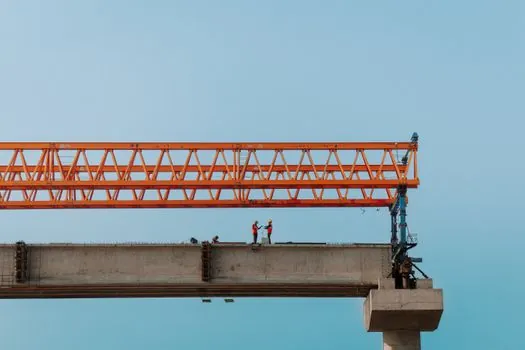
Bridge projects often sit hours from the nearest dealer, so fuel-tank capacity and parts logistics dominate uptime. Walk-behind units carry 20 L tanks, enough for roughly one shift of intermittent use; the mid-range and heavy ride-on classes carry 100 L and 140 L respectively, supporting 8-10 hour shifts without refueling stops on a remote pier [S3]. Spare-parts access matters: machines arriving through Shanghai, Qingdao, Rotterdam, or Singapore typically need local commissioning, wear-part kits (screed plates, vibrator motors, receiver cables), and operator instruction before first concrete is placed [S1]. Bridge contractors should also verify hydraulic-system filtration ratings, since deck pours generate rebar-scale contamination that a warehouse-floor machine rarely sees; specifying 10 µm absolute filtration on the return line is common practice, though the research sources do not name a specific ISO 4406 cleanliness target for screed hydraulics. For comparison, the construction-tools selection framework used on civil-infrastructure jobs applies the same uptime-and-logistics logic when equipment is staged far from the dealer network.
Limitations and Failure Modes Specific to Bridge Pours
Three failure modes hit laser screeds on bridge work more often than on slabs. First, formwork deflection under a heavy ride-on: an 8,500 kg machine on undershored staging produces visible sag between girder lines, and the laser plane cannot correct for a moving reference. Second, rebar interference: top-mat congestion at 150 mm centers leaves less than 80 mm clearance for the screed plate, and the machine must be set to a 60-100 mm minimum thickness on the deck or the head will ride up on the mat. Third, weather exposure: bridge decks are open to wind and sun, and a 1-2 percent cross-fall tolerance is meaningless if the slab surface crusts before final pass; a 4-8 km/h travel speed on the ZP40 lets the crew finish faster than a 0-4 km/h walk-behind, but only if a curing compound is applied within 30 minutes of final pass [S3]. Operators should also confirm that the laser receiver has line-of-sight to the transmitter across the full pour width; a 4,000 mm head on a 12 m wide deck needs the transmitter elevated on a tripod at mid-deck or the receiver will lose signal at the far edge [S1].
Specification Table: YG-CL300 / CL300A / ZP30 / ZP40 vs Bridge Element
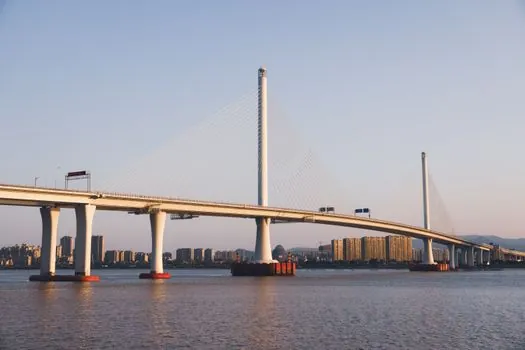
Cross-referencing the four-machine spec band against typical bridge elements: model YG-CL300 (22 kW, 1,000 kg, 2,500 mm width, 50-300 mm thickness, 0-4 km/h, 20 L tank) fits pier caps, box-girder interiors, and parapet bases. Model YG-CL300A (22.8 kW, 1,000 kg, 3,000 mm width, 60-300 mm thickness) covers the same elements with a slightly wider pass. Model YG-ZP30 (35.5 kW, 5,500 kg, 3,100 mm width, 100-450 mm thickness, 4-8 km/h, 100 L tank, 6,000 mm telescopic) is the workhorse for approach slabs and single-lane decks. Model YG-ZP40 (63.9 kW, 8,500 kg, 4,000 mm width, 100-500 mm thickness, 4-8 km/h, 140 L tank, 6,000 mm telescopic) is specified for full-width highway overpasses cast in a single continuous pour [S3].
Standards and Specification Anchors
The 1-2 percent slope target (10-20 mm per linear meter) for water-shedding surfaces is the controlling geometric spec for bridge decks, parking structures, balconies, and flat-roof screeds alike, per general technical rules cited in screed-planning guidance [S4]. No specific ISO or EN standard number is named in the research material for this gradient, so the figure is presented as common practice rather than a code citation. For a deeper cross-reference on how the same laser-level receivers used in screed masts are specified in industrial metrology, the tolerance discussion is similar but tighter (sub-millimeter over 30 m, versus 3-5 mm over the same baseline on a concrete pour). Buyers evaluating machine control and automation architecture may also find the laser screed spec map for electrical-installation floors useful as a parallel reference for tolerance-driven floor geometries.
Trackable signals for the next six months: any OEM release of a sub-1,500 kg ride-on class for suspended-deck work, which would close the gap between walk-behind precision and heavy-ride-on throughput; and any update to 3D-profiler or total-station integration on the YG-ZP platform, which would shift the cost calculus for variable-cross-fall pours on curved interchange ramps [S1][S3].