
Laser trackers and optical comparators both sit inside the dimensional-metrology toolbox, but their measurement envelopes, accuracies and operating environments do not overlap, so the wrong pick burns days of setup and produces a result no auditor will sign [S2][S6].
A laser tracker is a portable interferometer-based instrument that follows a retroreflector (or an active target) in 3D space, with working volumes that commonly span tens of meters and resolution down to the micrometer class when paired with high-end systems like the API Radian Plus [S1][S4]. An optical comparator — sometimes still called a profile projector — projects a magnified shadow of a 2D part onto a screen and reads dimensions off glass scales or a digital encoder overlay; its envelope tops out at a few hundred millimeters of part size.
Working volume and accuracy envelope
Working volume is the first hard separator: API markets the Radian Plus as a portable, wireless, battery-powered distance meter that breaks the design concept of traditional trackers by integrating the control box and a temperature-compensation system in one head [S1][S4], and FARO publishes specification formulas for its v1 and v2 tracker models that let users convert stated accuracy into expected volumetric performance at any standoff distance [S5]. Optical comparators, by contrast, are bench instruments with stage travels of roughly 100–300 mm and a fixed optical magnification; the part must be brought to the machine, not the other way around.
Typical laser-tracker point-to-point accuracy lands in the ±15 µm + 6 µm/m range for premium portable units, with laser-interferometer distance resolution well below a micrometer; an optical comparator reads the projected edge at screen-magnification resolution of 1–5 µm on a 200–500 mm screen, but its measurement uncertainty is dominated by the profile sharpness, edge detection, and operator focus, not by the encoder.
What each instrument is actually FOR — and what it is NOT for
A laser tracker is the right call when the part cannot move: large generator rotors, turbine casings, machine-tool geometry, jigs and ship-propeller shaft alignments. PFTS Precision Alignment lists hydro generation, manufacturing, industrial plants and law-enforcement forensics as core application areas for its tracker-based measurement services, and Digital Precision's service offering covers pulp-mill alignment trains, gearboxes, motors, pumps, large shafts and drums using a 3D tracker workflow [S2][S6]. Field service providers in 2026 still run tracker crews because transporting a multi-ton rotor back to a metrology lab is the more expensive option.
An optical comparator is the right call when the part is small, the critical dimension is a 2D profile, and throughput matters more than volumetric accuracy: threads, stampings, gaskets, turned parts, connector pins, small stamped sheet-metal forms. A shop running 200 inspection batches per shift does not want to lock a tracker onto a 30 mm part; it wants a comparator with a quick-release fixture, a chart overlay, and a 3-second cycle.
What each instrument is NOT for: do not buy a laser tracker to measure the diameter of a turned pin — the target sphere and locking procedure will cost more time than a thread-measuring wire on a bench microscope. Do not use an optical comparator to check a 4-meter shaft straightness — the projected field of view cannot reach the second end, and stacking multiple profiles introduces stitching error that no glass scale will catch.
Criteria-based comparison of the two options
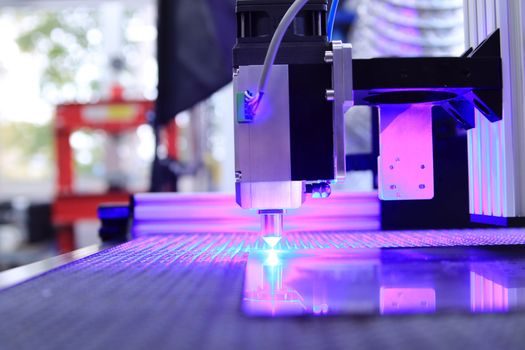
Lining the two up against the same decision criteria makes the choice auditable: [S1]
Working envelope — laser tracker wins on meters, optical comparator caps out at hundreds of millimeters of stage travel. Portable / field deployment — the tracker is battery-powered, wireless, and designed to be carried to the part (API Radian Plus explicitly markets the wireless, battery-powered package) [S1]; the comparator is bolted to a bench. Best-resolution dimension — the comparator gives the cleaner 2D edge profile at micrometer class on a stable screen; the tracker gives 3D point clouds with absolute position referenced to a weather station or kinematic nest. Operator skill — a comparator is teachable in an afternoon; a tracker requires certified operators who understand laser interferometry, SMR nest calibration, and environmental compensation. Throughput on small parts — comparator is the right answer; throughput on large assemblies — tracker is the right answer. Cost of ownership — a service-grade tracker plus its sphere nest, weather station and software lands in the high five figures USD; a digital comparator is a fraction of that, but a CNC comparator with edge-detection software can climb into mid five figures.
Standards, calibration and audit trail
Both instruments live under the same ISO 10360 family umbrella for length-measurement uncertainty, but the clause numbers and acceptance tests differ because one is a 3D coordinate system and the other a 2D optical projection. A tracker needs a verified laser-beam wavelength (commonly traceable to a frequency-stabilized HeNe or an internal compensator with a published spec) plus a sphere-bar artifact run daily; FARO's knowledge base publishes the exact specification formulas users should cite on a calibration certificate so an auditor sees the same numbers the manufacturer published [S5].
An optical comparator needs a stage-scale calibration (glass scale or linear encoder linearity), reticle / chart verification at each magnification, and a focus check against an optical flat. Both sit under ISO 9001 / IATF 16949 inspection-system control, and both should be cross-checked periodically with gauge blocks or a laser interferometer for the metrology lab's master reference. If a CMM is available, treat the tracker and the comparator as specialized tools that feed CMM-traceable workflows, not as CMM replacements.
Failure modes and limits engineers actually hit
Trackers fail in three classic ways: environmental (air-temperature gradients bending the laser beam across long stands), geometric (line-of-sight obstruction when one tracker position cannot see the target), and human (an SMR bumped off the nest during a long session invalidates the entire measurement run) [S2][S4]. API's Radian line addresses the first with an integrated temperature-compensation system and the second by allowing quick re-stationing with an automated re-orientation routine, but the third is still on the operator [S1][S4].
Comparators fail differently: edge ambiguity on a non-back-lit surface, parallax on a glass scale read by eye, screen distortion at the edges of the optics, and contamination on the projection lens. A digital comparator with edge-detection software solves most of these; a 30-year-old horizontal projector with a ground-glass screen does not, and any shop still running one will see its measurement uncertainty drift well past the original spec. There is also a hard limit: an optical comparator cannot measure a hidden internal feature without sectioning or amatching probe, while a tracker with an active probe can reach inside a fixture.
Sourcing, vendor reality and 2026 availability
API (Automated Precision Europe GmbH) is currently promoting the Radian Plus and Radian Core as a single-head redesign that integrates control box and temperature compensation [S1][S4]; FARO continues to publish tracker specification formulas and software links for v1/v2 hardware on its knowledge base [S5]; service-only suppliers such as PFTS (Manitoba) and Digital Precision (Canada) actively take on hydro, pulp-and-paper and general industrial alignment contracts using tracker-based workflows as of mid-2026 [S2][S6]. Chinese distributors such as Huao 3D carry the API line and a laser marker / laser level ecosystem for buyers sourcing in Asia [S4].
On the comparator side, Mitutoyo, Nikon, Starrett, Optical Gaging Products (OGP) and a tier of Chinese manufacturers still ship horizontal and vertical projector units; digital CNC models with edge-detection cameras have largely displaced purely analog screens in IATF-certified shops over the past decade. Buyers who need a 2D profile on a small part in 2026 should spec a digital comparator with linear-encoder scales, not a used analog unit, and they should budget for a programmable XY stage if the inspection is high-mix. The two product families also overlap indirectly with laser profiler and laser screed lines in the broader laser-metrology catalog, so a buyer consolidating vendors should check whether the same OEM offers cross-training.
For engineers evaluating a process-rig stack, the adjacent selection question in the same family is mechanical-strength test hardware — the recent write-up on load cells vs electronic scales for mechanical-strength tests covers the force-sensing side, and the gauge block vs roundness tester calibration artifact piece covers the artifact side that both tracker and comparator labs rely on. None of these overlap with the tracker-vs-comparator decision itself, but they tend to sit in the same metrology budget cycle.
Decision signal for 2026: if the buyer can describe the worst-case part in one sentence and that sentence contains a dimension above ~1 m, order a tracker evaluation with a portable, battery-powered, wireless head such as the Radian-class unit and a tracker-experienced service contract; if the worst-case part is described in millimeters and the critical dimension is a 2D profile, order a digital optical comparator with edge-detection software, a programmable stage, and an ISO 10360-traceable calibration plan. Either way, lock down the calibration artifact chain and the operator-certification path before the equipment shows up on the dock.