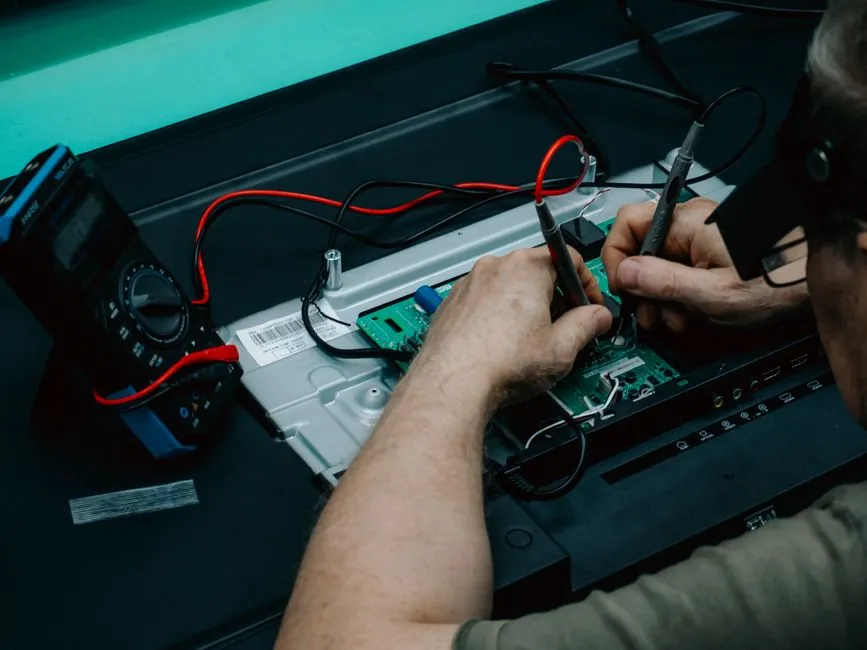
An LCR meter selection in 2026 is driven by four hard numbers: test-frequency span, basic impedance accuracy, AC drive level (voltage/current) and source output impedance, with form factor and interface bus as tie-breakers [S4][S8].
Across the 22 manufacturers indexed for benchtop and 13 for portable form, the typical 2026 benchtop unit covers 20 Hz to 200 kHz with 0.05% basic accuracy, while premium RF-capable models reach 5 MHz and 0.08% basic accuracy [S2][S4]. Handheld units are tightly constrained to five discrete frequencies (100/120 Hz, 1/10/100 kHz) at 0.1% basic accuracy and exist mainly for field troubleshooting of L, C and R [S3][S9].
Test Frequency Span and Frequency Resolution
Benchtop LCR meters in 2026 split cleanly into three frequency tiers: low-frequency component test at 50 Hz to 100 kHz, mid-band at 20 Hz to 200 kHz, and RF-extended at 42 Hz to 5 MHz [S4][S2]. The Anbai AT2811 sticks to a fixed four-point 100 Hz/120 Hz/1 kHz/10 kHz set for cost-driven incoming-inspection desks [S7].
Continuous-frequency tuning is now standard on precision models: the AT3818 sweeps 10 Hz to 300 kHz with 0.001 Hz resolution, and Chroma's 11022 lists nine discrete steps from 60 Hz to 100 kHz, which is enough to match the Agilent 4263B SCPI command set on legacy ATE racks [S8][S1].
Basic Accuracy, Impedance Range and Display Digits
Basic accuracy on 2026 benchtop LCR meters clusters at 0.05% for the Sourcetronic ST2830/ST2832 and Tonghui TH2830/TH2832 families, with the Chroma 11022 quoting 0.3% on the sub-100 mΩ range but tightening above it [S4][S1][S10]. Handheld instruments cap out at 0.1% (Tecpel LCR-615, UT612) and are unsuitable for tight-tolerance passive sortation [S2][S3].
Wide-range impedance coverage is now a near-universal claim: Chroma 11022 quotes 0.01 mΩ to 99.99 MΩ at 4½ digits [S1], the Tonghui TH2830/TH2832 family claims 0.01 mΩ to 100 MΩ for Z/R, 10 pF to 10 F for C and 0.01 nH to 100 kH for L [S10], and the HIOKI 3532-50 covers 100 mΩ to 100 MΩ across 42 Hz to 5 MHz [S2]. Sub-milliohm resolution matters for shunt resistors, DC bus bars and inductor winding DCR checks; if the DUT includes a power inductor or current-sense shunt, require 0.01 mΩ resolution and DC resistance (DCR) mode as separate line items on the datasheet [S1][S8][S10].
AC Drive Level, Source Resistance and DC Bias
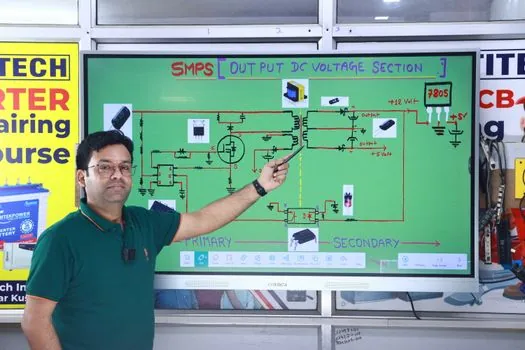
AC test signal level is a frequently glossed-over spec: the AT3818 covers 0.01 Vrms to 2.00 Vrms and 100 µA to 20.00 mA with selectable 30 Ω/100 Ω source resistance, while the cost-focused AT2811 only offers 0.1 V/0.3 V/1 V at 30 Ω/100 Ω source resistance [S8][S7]. Tonghui's TH2830/TH2832 matches 10 mVrms to 2 Vrms and 100 µA to 20 mA across the same 30 Ω/100 Ω source options [S10].
Source output resistance of 30 Ω versus 100 Ω changes the effective stimulus on non-linear DUTs (MLCCs under DC bias, ferrite inductors near saturation), and on the Chroma 11022 four discrete output resistance modes are selectable specifically for non-linear inductor and capacitor measurement [S1]. Internal DC bias is a separate option: the AT3818 ships ±2.5 V internal bias, while higher-tier units may need the 1320-series external bias current source to drive biased inductance measurements above 2.5 V [S8][S1]. If the application is Class-2 MLCC sortation or bias-dependent ferrite characterisation, require a stated DC bias range and confirm whether bias is internal, external, or both [S8].
Form Factor: Handheld, Benchtop, or ATE-Rack
Form factor maps directly to test environment: 13 manufacturers offer portable LCR meters from €299 to roughly €500 for field service, while 22 offer benchtop units from €1,090 to €3,490+ for lab and production line use [S2][S3][S4]. The Sourcetronic ST2830/2832 lists from €1,090 with 4.3" TFT LCD, and the higher-spec ST2829 lists from €3,490, signalling that 0.05% basic accuracy plus full interface bus typically costs more than 2x the entry benchtop [S4].
ATE-rack selection hinges on interface bus and SCPI command compatibility: the Chroma 11022 is explicitly Agilent 4263B SCPI-compatible, and the ST2830 family ships RS232, RS485, USB, HANDLER and GPIB simultaneously for handler/probe integration [S1][S4]. The AT3818 goes further with RS232, RS485, USB-232, HANDLER, GPIB, LAN, SCPI, MODBUS, data logger and USB-disk [S8]. For a bench that talks to a PLC, a HANDLER interface is the practical must-have; for a USB-only lab, a USB-disk and SCPI are the minimum [S1][S4][S8].
Comparison: Mainstream 2026 LCR Options Against Selection Criteria

Four representative 2026 LCR meter classes line up as follows against the four core decision axes [S2][S4][S7][S8][S10]:
- Handheld (e.g. Anbai AT2811, Tecpel LCR-615): frequency 100 Hz/120 Hz/1 kHz/10 kHz fixed; basic accuracy 0.1% to 0.3%; source 0.1 V to 1 V at 30/100 Ω; portable form. Use for field troubleshooting and incoming-inspection, not tight-tolerance sortation [S2][S3][S7].
- General benchtop (e.g. Sourcetronic ST2830, Tonghui TH2830): frequency 50 Hz to 100 kHz; basic accuracy 0.05%; source 10 mVrms to 2 Vrms, 100 µA to 20 mA at 30/100 Ω; benchtop. Use for R&D, QA lab, and standard production line [S4][S10].
- Precision benchtop (e.g. Anbai AT3818, Sourcetronic ST2832, Tonghui TH2832): frequency 10 Hz to 300 kHz (AT3818) or 20 Hz to 200 kHz (ST2832/TH2832); basic accuracy 0.05%; AC level 0.01 Vrms to 2 Vrms with ±2.5 V internal DC bias option; benchtop with full interface bus. Use for tight-tolerance passive sortation and MLCC Class-1/Class-2 testing [S4][S8][S10].
- RF-extended benchtop (e.g. HIOKI 3532-50): frequency 42 Hz to 5 MHz; basic accuracy 0.08%; 100 mΩ to 100 MΩ; benchtop. Use for RF inductor, ferrite core, and piezoelectric resonator characterisation [S2].
Who Should NOT Pick a Handheld LCR
Handheld LCR meters are the wrong pick for three common 2026 use cases: tight-tolerance passive sortation (handheld accuracy is 0.1% to 0.3% versus 0.05% for benchtop), DC-biased inductor or capacitor measurement (handhelds rarely offer internal DC bias), and ATE integration (no HANDLER/GPIB/LAN on most portable units) [S2][S3][S8]. The Tecpel UT612 portable meter, for example, is CE/UKCA certified but specifies only 100 Hz and 120 Hz, and is configured around a fixed-frequency 20,000/10,000-count display rather than ATE throughput [S2][S3].
The 1320-series external bias current source on the Chroma 11022 is another line item that is easy to miss: the main unit directly controls the 1320, but the source itself is a separate purchase, so a budget quote for biased inductor testing must include both [S1]. Buyers who only spec the main unit end up with a non-functional test cell for power inductors and bias-dependent Class-2 MLCCs [S1][S8].
Sourcing, Calibration and Standards
Manufacturer-direct sourcing through OEM sites (Anbai, Sourcetronic, Tonghui, HIOKI, Chroma) is the standard procurement path for 2026 LCR meters, with DirectIndustry catalog listings providing a 22-manufacturer/60-product index and a 13-manufacturer/18-product portable-only index for cross-reference [S2][S3][S4][S7][S8][S10]. Calibration and traceable accuracy are governed by the OEM's own procedure; the Advanced Energy TEGAM Model 252 datasheet explicitly positions the unit for component inspectors and manufacturing operators performing manual testing of L, C and R [S5].
For comparison-shopping against a wider 2026 spec map, buyers can cross-reference related selection guides such as the flow meter selection criteria 2026 spec map or the caliper vs micrometer vs dial indicator spec-first guide to see how frequency/accuracy/interface rules translate across metrology categories. Buyers also reference our LCR meter encyclopedia entry alongside conductivity meter and energy meter pages when the test cell spans impedance plus AC power or impedance plus DC current sensing [S2][S4].
Trackable next nodes: (1) the Chroma 11022 datasheet confirms Agilent 4263B SCPI compatibility for legacy ATE retrofit work, a real continuity signal for plants standardising on 4263B code [S1]; (2) NF Corporation's ZM2371/ZM2372/ZM2376 specifications page (2025-07) remains the reference for ZM-series replacement, useful for any 2026 bench refresh from a Japanese OEM [S6]. Buyers in the next quarter should pin the four-axis datasheet (frequency range, basic accuracy, AC drive level + source resistance, form/interface) before shortlisting any specific model.