An LED lighting fixture molding program has two distinct categories that engineers routinely conflate: the functional LED aluminum channel/housing plus polycarbonate lens produced on a precision molding line, and the architectural crown or cove molding that hides the fixture and is produced as decorative millwork. Specifying the wrong line for either category wastes both capex and cycle time.
The functional category uses injection molding and aluminum extrusion; the decorative category uses PU, polystyrene, or wood-PVC composites on a separate automatic molding line. Mixing the two toolchains is the most common spec mistake on lighting build-outs in 2026.
Two distinct molding families for lighting fixtures
Functional LED lighting housings, heat-sink channels, and optical lenses are injection-molded or aluminum-extruded components sized to the LED strip and driver envelope [S1][S3]. Stock aluminum channels ship in 2.5 m lengths and accept flexible or rigid LED strip inside, with the polycarbonate diffuser snapped into the extruded aluminum body [S1]. Optical-grade polycarbonate (PC) is the dominant lens resin for injection-molded LED lenses because its transmittance stays above 88% at 3 mm wall thickness across the visible band.
Architectural cove, crown, and indirect-lighting moldings are decorative millwork that hides the LED strip and provides the reflective surface. Stock heights span 3-1/2", 16-1/8", 36", and 56" with multiple projection depths to control the beam cutoff against the ceiling [S4]. The named style families on the market in 2026 include Sunrise (concise/modern), Eclipse, and several large elegant profiles designed specifically for indirect uplighting [S5]. These are not the same part as the LED housing and they are not built on the same production line.
Selection criteria for the LED housing line
For the functional housing, the molding line is sized around three numbers: profile tolerance on the aluminum extrusion, shot repeatability on the PC lens press, and the bend radius the channel must hold for curved runs. Flex-grade aluminum channels are specified to a minimum bend radius of 150 mm so the LED strip inside does not kink or shadow, while the diffuser can be continuously flexed to match the curve [S1]. A tolerance band of ±0.1 mm on the channel cross-section is typical for premium architectural-grade extrusions and is required for the diffuser to snap-fit without light-leak gaps.
For the heat-sink portion specifically, 6063-T5 aluminum remains the default alloy because it extrudes cleanly into thin-wall channel sections and conducts heat at roughly 209 W/m·K, which is enough to keep LED junction temperatures inside the 85°C rated limit at common residential drive currents. Die-cast zinc or magnesium heat-sink housings are used on higher-power commercial downlights, but they require a static pressure molding machine class die-cast cell rather than an extrusion press, and the cost-per-part is typically 3-5× the extruded aluminum equivalent at moderate volumes.
Selection criteria for the decorative cove/crown line
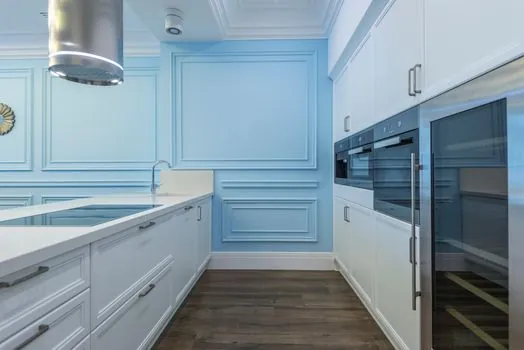
For the decorative cove/crown profile, the dominant materials are PU (polyurethane), expanded polystyrene (EPS), and wood-PVC composite foamed on an automatic molding line with a single-cavity profile die. Selection is driven by fire rating, paintability, and projection depth rather than by thermal conductivity. PU profiles accept all standard architectural paints without primer, while EPS requires a hard coat for paint adhesion and shows bruise damage on handling. [S2]
Indirect-lighting profiles must be specified by both height and projection because the projection controls the cutoff angle of the light wash on the ceiling. Stock projection depths offered by a major US distributor span 3/4" to 6" across the 3-1/2", 16-1/8", 36", and 56" height families [S4]. For a typical 8-9 ft ceiling with a 4-6" projection, the cutoff angle lands in the 30-45° band, which is the range that reads as a soft cove wash without a visible hot spot on the drywall.
LED linear light source sizing and lumen equivalence
Inside the molded housing, the LED strip is the engineering reference for everything else. A 2,600-lumen LED linear strip replaces a 150-watt incandescent equivalent at roughly one-sixth the input power [S2]. Design selection is done in lumens and kelvins, not in watts: lower kelvin numbers (2700-3000K) read as warm, 3500-4000K as neutral, and 5000K+ as daylight. Dimmable drivers are now standard on residential-spec cove lighting because the lumen output of the strip has to be tunable once the housing is sealed behind the crown.
Because LEDs rarely need replacement once installed behind a sealed cove, the dominant reliability spec on the molding line output is ingress protection, not lumen maintenance. An IP65-rated lens/heat-sink assembly is the typical target for kitchen and bath cove runs, where steam and cleaning splash are expected. Lower IP ratings are acceptable in dry living-room crown channels where the LED strip is fully enclosed by the aluminum body.
Comparison: functional housing line vs decorative cove/crown line
The two lines are not interchangeable, and the table below lines them up against the four decision criteria a spec engineer actually weighs at order time. [S2]
Criterion 1, process: the functional housing uses aluminum extrusion plus injection molding of PC optical lenses; the decorative profile uses PU/EPS/PVC foam molding on a single-carriage shell molding machine or continuous PU pour line. Criterion 2, dominant tolerance: ±0.1 mm on the functional housing for snap-fit and thermal contact; ±0.5 mm is acceptable on the decorative profile because it is a paint-and-trim surface. Criterion 3, thermal load: functional housing must dissipate 1-3 W per 300 mm of LED strip at 85°C junction; decorative profile is purely cosmetic and sees no thermal load. Criterion 4, fire rating: functional PC lens typically targets UL94 V-0 on commercial fixtures; decorative PU/EPS profiles target ASTM E84 Class C (flame spread 76-200) as a minimum for residential code compliance.
Use cases and failure modes
The functional molding line is the correct spec for OEM fixture builders, lighting retrofit contractors installing under-cabinet or stair tread LED channels, and any application where the aluminum channel is itself a visible trim piece. The decorative molding line is the correct spec for residential crown cove retrofits, commercial lobby indirect uplighting, and hotel headboard wall-wash effects. Mixing the two toolchains (e.g. trying to use a decorative PU profile as an LED heat-sink) is a failure mode: PU foam has a thermal conductivity below 0.05 W/m·K, roughly 4000× worse than the 6063-T5 aluminum it would replace, and the LED junction will overheat within minutes of operation. [S2]
Conversely, trying to use a rigid functional aluminum channel as a curved cove molding is the inverse failure: rigid 6063-T5 channels need a minimum bend radius that, on tight-radius coves, exceeds the geometry of the ceiling/wall junction, leaving a visible kink or light gap. Flex-grade channels solve the curved-run problem but they cost roughly 2× the rigid equivalent and require hand-forming on site [S1].
Standards, sourcing, and procurement signals
Functional LED housings for the North American commercial market are typically sourced to UL 1598 (luminaires) and UL 8750 (LED light sources for use in lighting products), with lens materials meeting UL94 V-0 or V-2 flammability ratings depending on end-use. Decorative crown and cove profiles are not governed by luminaire standards; they fall under interior finish standards such as ASTM E84 for surface burning characteristics, and under local building code for clearance to combustibles around the LED strip. [S2]
Procurement signal to track in 2026: linear-LED retrofit demand is pulling 2.5 m aluminum channel stock length into standard distribution, with US-market suppliers listing flex-grade and rigid-grade SKUs in the same 2.5 m cut [S1]; architectural cove profile distributors are consolidating height options around the 3-1/2", 16-1/8", 36", and 56" standard heights [S4]. The next signal worth tracking is whether lighting equipment and electric lamps OEM catalogs start publishing IP65-rated cove-profile SKUs as a stock item, which would shift the cost curve on sealed bathroom and kitchen cove runs. Related spec-first guides worth reading next cover automotive molding line selection for comparison on injection vs additive process choice, and aerospace molding line selection for the higher end of the certification spectrum that the same aluminum extrusion houses also serve.
