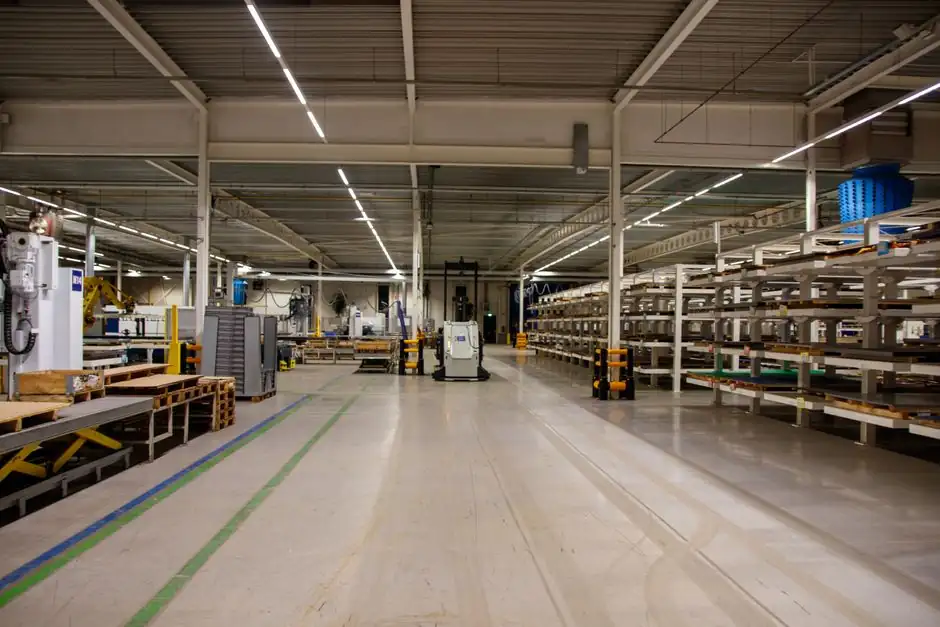
Lightweight partition panels for cold storage warehouses are almost always factory-laminated sandwich panels with a closed-cell foam core (PUF or PIR) bonded between pre-painted steel facings, sized in the 80-150mm thickness band to hit temperature targets from +15°C chillers down to -40°C deep-freeze rooms [S2].
Cold room temperature ranges span +15°C to -40°C depending on the load, and a single panel decision drives both compressor duty and long-term electricity cost: efficient panel insulation is documented to cut refrigeration load by 25-35% versus a poorly sealed envelope [S2][S5].
Core Material Options: PUF vs PIR vs Rockwool vs EPS
PUF (polyurethane) panels deliver thermal conductivity as low as 0.024 W/mK, making them the most energy-efficient insulation choice for industrial walls, roofs, and cold storage applications, and are produced in nominal density 40±2 kg/m³ with widths of 1000/1150/1160mm using CFC/HFC/HCFC-free foam [S2][S1]. PIR (polyisocyanurate) panels use a modified polyol blend that pushes conductivity lower to about 0.022 W/mK and reaches a B-s1,d0 fire-rating class with minimal smoke and no burning droplets, which is why pharmaceutical, data-centre, and high-value industrial builds gravitate to PIR for compliance margin [S2].
Rockwool and EPS cores are alternatives but trade thermal performance for cost or fire behaviour: rockwool is non-combustible but heavier and more hydrophilic; EPS is the cheapest per m² but delivers markedly worse k-values, so it generally loses on total installed cost once refrigeration energy is amortised over 10+ years [S3][S2]. The 40-60% faster construction speed versus brick-and-mortar is the same across all four cores because it is a function of prefabrication, not chemistry [S2].
Temperature Band vs Panel Thickness: A Sizing Rule
Cold rooms constructed using high-thickness PUF or PIR sandwich panels (80-150mm) with airtight joints, specialised cold storage doors, and refrigeration systems are the documented working envelope for storage from +15°C chillers down to -40°C deep-freeze rooms [S2]. The commonly cited band: chiller +15 to 0°C, frozen -10 to -20°F (-23 to -29°C), deep cryo -40 to -80°F (-40 to -62°C) for vaccine and biological storage [S4][S5].
A 100mm PUF partition is a reasonable starting point for chilled goods (0 to +5°C); stepping into frozen storage typically means 120-150mm PUF or 100-120mm PIR to hold heat gain to a level the compressor cycle can manage. Industry guidance explicitly ranks PIR above standard PUF for fire-sensitive cold storage, pharmaceutical facilities, or high-compliance projects, while recommending PUF for general cold rooms where the priority is excellent thermal insulation, lightweight structure, faster installation, and cost-effective performance [S1].
Joints, Fire, Hygiene, and the Failures That Drive Operating Cost

Lightweight partition panels in cold rooms are not just about R-value: the joint system, sheet finish, and sealing determine whether the room holds its temperature band over a 10-15 year service life. Poor panel selection is documented to cause heat gain from outside, higher compressor running time, temperature fluctuation, moisture entry, condensation on walls and ceilings, ice formation near joints, higher electricity consumption, reduced product shelf life, and hygiene and maintenance problems [S1].
Cold room panels are commonly used for chiller rooms, freezer rooms, deep freezer storage, food processing areas, dairy storage, pharma cold rooms, clean rooms, controlled-atmosphere storage, and cold chain logistics warehouses; in cleanroom-adjacent partitions the same panels are sometimes paired with HEPA-filtered HVAC and flush-finish doors to meet ISO 14644 [S2]. For a process engineer, the decision to step up from PUF to PIR is rarely about conductivity (the 0.022 vs 0.024 W/mK delta is small); it is about the B-s1,d0 fire-rating margin and the smoke/droplet behaviour that pharma and battery storage insurance carriers ask for in writing [S2].
Comparison: PUF vs PIR vs ICF on the Decision Criteria That Matter
Where lightweight sandwich panels win on speed and reconfigurability, Insulated Concrete Forms (ICF) win on thermal mass and airtightness for permanent deep-freeze or cryo facilities; the relevant trade is documented across both delivery systems [S3][S4]. ICF is pitched as perfect for cold storage warehouse construction because it combines insulation, structural strength, and air barriers into a single pour, but the same source warns that managing complex foundation insulation steps (high-density sub-slab foam, integrated under-floor heating, glycol lines) and weather risks (delayed concrete pouring phases, compromised insulation adhesives) can erase the schedule advantage that sandwich panels deliver by default [S4].
On a four-criterion view, the practical comparison reads: thermal performance (PIR ~0.022 W/mK > PUF ~0.024 W/mK > ICF wall, comparable on steady-state R); fire performance (PIR B-s1,d0 > PUF, unrated by default; ICF concrete non-combustible); install speed (PUF/PIR factory panels, 40-60% faster than masonry; ICF slower, weather-dependent); reconfigurability (PUF/PIR demountable, can be re-levelled; ICF permanent) [S2][S4]. Partition panels in this segment are commonly installed alongside storage racking systems in high-density layouts, where panel flatness and point-load tolerance at the wall interface determine whether the rack can be anchored to the panel skin or has to be free-standing.
Spec Sheet Checks Before You Sign the PO

A usable cold-room panel data sheet should state: declared thermal conductivity in W/mK (target 0.022-0.024 for PUF/PIR), nominal core density (40±2 kg/m³ is the common PUF benchmark), facing material and thickness (PPGI or galvalume, both pre-painted), fire classification (Euroclass B-s1,d0 for PIR, or national equivalent), CFC/HFC/HCFC-free foam statement, joint profile (tongue-and-groove with cam-lock or slip-joint for airtightness), and panel thickness matched to your lowest operating temperature band [S1][S2].
Confirm production consistency: manufacturers running 7 fully automated production lines with 10 lakh+ sq. mtr monthly capacity are documented in the Indian market, and a multi-line, in-house lamination process is the practical hedge against batch-to-batch density variation that shows up as cold spots two winters into service [S1]. For a partition that will be opened, re-closed, and reconfigured (a common scenario in third-party-logistics cold storage), also pin the cam-lock action and the gasket compression set on the data sheet rather than trusting the brochure photograph; the field failure mode is almost always joint shrinkage, not core degradation [S1][S3].
Where Lightweight Partitions Are the Wrong Tool
Lightweight sandwich partitions are not the right answer for every cold envelope: deep cryo storage at -40 to -80°F (-40 to -62°C) for vaccine and biological preservation is documented to demand sealed climate compartments, and the storage handling workflow around them usually requires a heavier envelope to manage thermal mass and minimise temperature swing during door-open events [S4].
ICF or hybrid steel-frame + high-thickness PIR is the more defensible spec for very low temperature, very high racking density, or any facility where the building will not be reconfigured in 10 years; conversely, a PUF partition in a 80-100mm thickness is the better economic answer for chiller-plus and standard frozen storage where the priority is fast build, light structure, and the option to dismantle and relocate if the cold chain shifts upstream or downstream. If the project also touches cleanroom or pharmaceutical-rated zones, cross-reference the panel spec with the cleanroom partition panel spec map so the same panel line can serve both clean and cold zones without a separate BOM. Trackable next signals: revised PIR core pricing (PIR sits on MDI/isocyanurate supply that has been volatile through 2024-2025) and any tightening of cleanroom-adjacent cold storage fire codes in pharma hubs, both of which will move the PUF-vs-PIR crossover point on the next bid cycle.
Detailed specification references: lightweight partition panel.