
A linear actuator converts rotary motion from a motor — DC, AC, stepper, servo, or piezo — into straight-line push/pull force via a lead screw, ball screw, or belt drive, with published force bands spanning 50 N (miniature) to 15000 N (heavy-duty industrial) on 2026 OEM line cards [S2][S3][S4].
Selection collapses to four binding inputs the spec sheet cannot fudge: peak/holding load in newtons, stroke in millimetres, duty cycle as a percentage of a 10-minute window, and the IP rating demanded by the installation environment — everything else (feedback, voltage, speed) is secondary to those four [S2][S4].
Force and Stroke Bands Across the 2026 Product Lines
Jointway Leader's 2026 product tree splits the line into four mechanical classes — micro, heavy duty, high speed, and tubular — each tied to a load band rather than a market segment: micro units cover 50–500 N at 10–100 mm stroke, standard units cover 500–2000 N at 50–600 mm, heavy-duty units reach 2000–8000 N at 100–1500 mm, and the tubular class extends to 15000 N for agricultural and solar-tracker duty [S2].
Progressive Automations' IP65 mini line lists 1600 N and 2000 N force variants in its 12V/24V DC high-load PA-HD1 family at USD 265.99 list, a price band that defines the commodity floor for general-purpose industrial actuators in mid-2026 [S4]. Stroke on the same family extends to 600 mm with optional feedback (potentiometer or Hall-effect) for position-loop integration [S4].
Duty Cycle, Speed and Voltage Logic
High-speed variants (lead screws with 2–4 mm pitch and low-ratio gearheads) push no-load linear speed to 30–50 mm/s on 24V DC, while standard-pitch units run 5–15 mm/s under the same voltage — speed roughly halves under full rated load for a given drive electronics class [S2][S3]. Where continuous or near-continuous operation is required (≥50% duty), a 220V AC unit, a servo-driven ball-screw actuator, or a pneumatic cylinder should replace the DC commodity unit, and a ball screw upgrade from the default trapezoidal lead screw is the standard escalation path — see the ball screw spec bands reference for the matching load/lead/accuracy envelope [S2][S3].
IP Rating, Feedback and Mounting Envelope
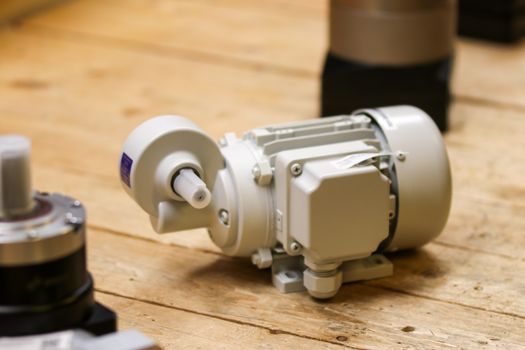
IP65 is the de-facto industrial baseline for outdoor or washdown service on 2026 catalogues, with IP66 and IP67 available on the high-load and tubular families for marine or food-grade lines [S2][S4]. A linear actuator sitting in a clean, dry cabinet can run at IP54 or even IP41, but specifying below IP54 outdoors guarantees water-ingress failure within the first year in most climates.
Feedback options gate PLC and closed-loop control: a potentiometer (analog 0–10 V or 4–20 mA via an external board) gives absolute position; Hall-effect pulse counting gives relative position with a home-reference routine; and encoder-equipped servo actuators close the loop at sub-millimetre repeatability [S2][S4]. For nanopositioning and semiconductor-class work, piezo-driven linear actuators in the linear-actuator.net catalogue deliver sub-nanometre resolution but trade off stroke (typically <1 mm) for stiffness and bandwidth [S3].
Drive Type Comparison: DC Lead-Screw vs Ball-Screw vs Pneumatic
The decision matrix below lines the three main drive families against the four binding criteria a spec engineer has to balance — load capacity, stroke, duty cycle, and installed cost — and shows where each family wins or loses on a real factory floor [S2][S3][S4].
Trapezoidal DC lead-screw actuators (the commodity 12V/24V class) handle up to 2000 N at ≤25% duty for USD 150–400 list, but backlash runs 0.2–0.5 mm and efficiency stays below 40%. Ball-screw DC or servo actuators push load to 8000 N, raise efficiency to 70–90%, drop backlash below 0.05 mm, and hit 100% duty, at a 2–4× cost premium and tighter sealing needs. Pneumatic cylinders beat both on raw load-per-dollar above 5000 N and on intrinsically safe (no-spark) environments, but they need a compressor, air prep, and direction valves — see the pneumatic vs vacuum actuator engineering logic for the source-air trade-off [S2][S3][S4].
Linear Guide and Bearing Integration

Any actuator pushing more than 500 N or running a stroke beyond 300 mm almost always needs a parallel linear guide or linear bearing to carry the moment load — a cantilevered actuator will bind, wear the lead screw, and fail prematurely under side load above roughly 10% of the rated axial force. [S1]
For multi-axis gantries and pick-and-place cells, integrating a linear actuator onto a linear module (a pre-engineered base combining a guide rail, bearing block, and ball-screw drive) is the standard escalation: it shortens mechanical design from weeks to hours and delivers verified stiffness and travel-parallelism figures that a discrete build rarely matches [S2][S3].
Position Feedback and Encoder Pairing
An actuator with no feedback is a blind actuator — fine for on/off valve duty, unacceptable for any process that needs to know where the rod actually is. The 2026 OEM line cards all expose three feedback tiers: potentiometer (absolute, 1–2 mm typical linearity), Hall pulse counter (incremental, requires homing), and external encoder (sub-micron on servo units) [S2][S3][S4].
For closed-loop servo applications, the encoder pairs with a linear encoder on the load-side axis to compensate for backlash and lead-screw compliance — a configuration detailed in the linear encoder encyclopedia entry and on the high-precision actuator overview at linear-actuator.net, where piezo and servo stages target 0.1–10 µm positioning accuracy [S3].
Sourcing Signals: Lead Time, MOQ and Supplier Cluster

Jointway Leader (Ningbo, +86-0574-86133338, [email protected]) publishes a multi-class catalogue with no MOQ on standard SKUs, with export documentation to EU, US, and ASEAN and a 7–15 day production window on non-stocked stroke/force variants as of 2026-07-08 [S2]. Progressive Automations ships from North American stock with same-day dispatch on PA-HD1 SKUs at USD 265.99 list for the 2000 N IP65 variant, and exposes 1 item per force-band listing as a stocking depth signal [S4].
For Shandong and East China sourcing of integrated ball-screw actuators, the ball-screw supplier cluster map tracks the 2026 maker map, price bands, and lead-time signals against the same force/stroke window this article covers. Specifying a vendor against a published load/stroke/duty envelope and a stocked IP rating is the cleanest way to avoid the 30-day customs-warehouse stall that catches first-time buyers.