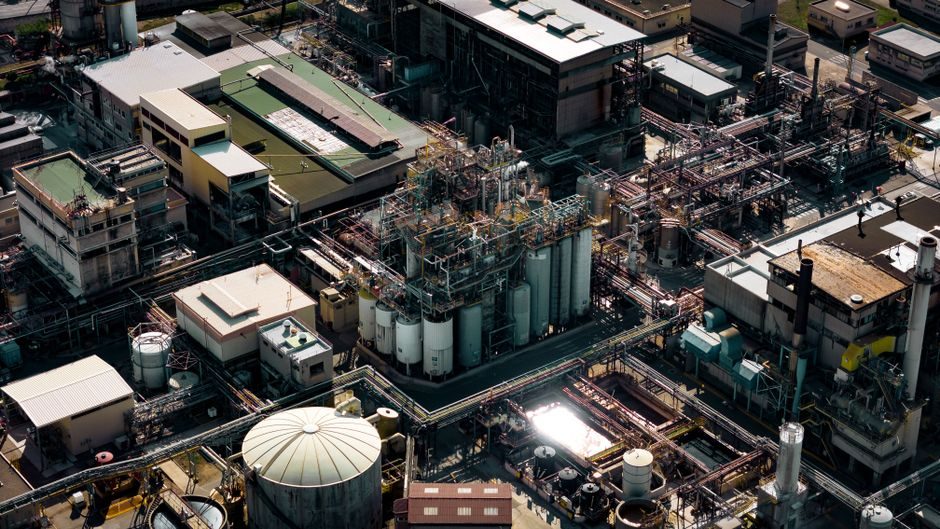
Ball screws in chemical plants fail on corrosion long before they fail on fatigue, so the winning build is ground steel (DIN 1.4125 / 440C or DIN 1.4542 / 17-4 PH) with a stainless or polymer nut housing, EPDM or FKM wiper seals, and a grease or solid-film lubricant that survives acid wash-down [S1][S5].
Specifying engineers typically land on flanged, zero-backlash, high-rigidity ground screws such as the Steinmeyer 1516 family for valve stems and dosing slides, or belt-driven aluminium-profile ball-screw modules (FUYU KK-series geometry) when a guided linear stroke is needed next to the reactor [S1][S2]. Buyers in 2026 also have a viable US repair base — Rockford Ball Screw and Express Ball Screw both rebuild chemically exposed screws with swapped seals and re-ground nuts — keeping spares off the critical-path list [S3][S8].
Material Bands That Survive Caustic, Acid and Solvent Splash
Martensitic 440C (DIN 1.4125) takes ground raceways down to better than 0.01 mm/m lead accuracy and resists water-based chemicals, but its chloride threshold is roughly 60 °C in still brine, which is why sour plants jump to 17-4 PH (DIN 1.4542) or full 316 austenitic for hot acid service [S1][S5].
For non-immersed duty — clean-in-place slides, reagent-dosing pump arms, jacketed-reactor valve actuators — 440C ground screws with hard-chrome or electroless nickel plating (0.01–0.02 mm) bridge most sodium-hydroxide and weak-sulphuric service at ≤ 80 °C, and they remain rebuildable by regrinding the nut raceway rather than scrapping the shaft [S5][S8]. Polymer nuts (PEEK or PTFE-filled) eliminate the grease-purge interval but cap continuous sliding speed near 0.25 m/s versus 1.0 m/s+ on steel-on-steel, so use them on low-cycle dosing rather than high-speed CIP rotary-to-linear converters [S1].
Seal and Lubricant Stack for Wash-Down, CIP and Solvent Service
EPDM wipers handle caustic soda, sodium-hypochlorite and steam-sterilised lines up to about 150 °C; FKM (Viton-class) is the default for hydrocarbon, aromatic and chlorinated-solvent exposure to roughly 200 °C, and nitrile is the wrong pick for either extreme and is dropping out of chemical-spec sheets [S5][S8].
Two wiper stages (a felt excluder plus a rubber contact seal) plus a PTFE bellows over the exposed shaft are the field-proven stack for wash-down, and they ride alongside solid-film graphite or MoS₂ grease so the screw survives a 30-day lube-out window after a process upset [S1]. Express Ball Screw and American Ball Screw Repair both list chemical-seal retrofits as a standard rebuild line item, which means worn wipers are no longer a scrap reason on legacy reactors [S5][S8].
Form Factor: Flanged Nut, Integrated Module or Repair-Replacement Sleeve
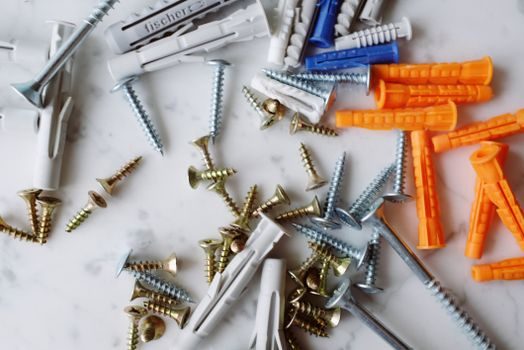
Flanged, zero-backlash nuts (DIN 69051 / ISO 3408 mounting patterns) are the default for valve-actuator brackets and pump crossheads because the four-bolt flange keeps the screw aligned within the 0.02 mm/m tolerance the actuator expects [S1].
When the duty is a guided linear slide rather than a thrust axis, a belt-driven KK-series ball-screw module pairs an aluminium profile carriage with an integrated linear guide — useful for sampling-probe carriages and CIP nozzle positioners where the load is small but the stroke is long (commonly 300–1,500 mm) [S2]. For end-of-life and emergency spares, third-party rebuilders in the US (Rockford, Express, American Ball Screw Repair) routinely swap in stainless shafts and chemically rated seals, returning a screw inside a 1–2 week window in most 2026 service quotes [S3][S5][S6][S8].
Decision Matrix: Steel vs Stainless vs Polymer-Nut Screws in Chemical Duty
On four criteria — corrosion envelope, sliding speed, cost-per-metre, and rebuildability — the picture is clear: 440C ground steel wins on speed and price, 17-4 PH / 316 stainless wins on chloride and acid envelope, and PEEK/PTFE nut assemblies win on dry-running but lose on duty cycle [S1][S5].
For caustic-only CIP lines at ≤ 80 °C, 440C with EPDM seals and food-grade grease is the cost baseline; for hot acid or sour-service skids, jump to 17-4 PH (H900-aged for ~44 HRC) with FKM seals and MoS₂ film; for cleanroom or oxygen-enriched reagent rooms, specify a polymer-nut, stainless-shaft screw with no grease and a graphite-impregnated wiper, accepting the 0.25 m/s speed cap as the engineering trade [S1][S8]. This mirrors the material trade-offs discussed for NBR grades in oil and gas service, where the elastomer seal is what limits the envelope long before the metal does.
Standards, Sourcing Signals and 2026 Lead-Time Reality

ISO 3408 governs ball-screw mounting and accuracy classes (C0–C10), DIN 69051 covers the nut flanges engineers actually drill to, and most rebuilders will re-grind to the original class if the spec sheet still exists [S1][S8].
On the supplier map, German precision houses (Steinmeyer 1516 family) cover high-rigidity ground screws, Chinese OEMs (Nanjing Shuntai, Nanjing Technical Equipment / Yigong, established 1991) cover the 1000+ part-number, aluminium-profile and standard-ground categories at shorter lead times, and the US rebuild base — Rockford, Express (operating since 1989), American Ball Screw Repair, plus the Ball-Screw.net aggregator — is the fastest path back from a chemically damaged unit [S1][S3][S4][S7][S8]. 2026 lead-time signals: ISO-certified builders (Rockford holds ISO certification) are quoting 6–10 weeks on stainless ground specials, while standard 440C ground screws from the Chinese OEM base ship in 2–4 weeks — a gap that argues for keeping a 440C spare in store and ordering 17-4 PH to plan [S3][S4][S7]. Sourcing pressure on stainless and on the EPDM/FKM seal compounds echoes the upstream squeeze visible in steel section suppliers in 2026, so lock the mill certificate with the PO.
Verification node: confirm the screw carries the ISO 3408 accuracy-class stamp on the data plate and that the wiper elastomer is cross-referenced to a published chemical-resistance list — without both, the rebuild will not survive the next CIP cycle [S1][S8].
For component-level specifications, see ball screw, chemical anchor, and chemical reagent.