
Packaging-line buyers comparing 15-65 mm linear guides in August 2026 should anchor the decision on three numbers: sustained stroke speed, dynamic load rating, and IP rating, because packaging machinery spends most of its life at cyclic high speed with intermittent stops rather than at peak thrust [S2].
Across horizontal form-fill-seal (HFFS), vertical form-fill-seal (VFFS), and case-packing cells, the dominant cross-section remains a 20-25 mm rail on the moving carriage, with a 45-65 mm rail reserved for case-erector arms and palletiser slides [S1]. Miniature 7-15 mm MG-class rails serve end-of-line labelling and small-format pick-and-place where envelope is the binding constraint [S1].
Three rail families map cleanly to packaging duties
The HG, EG, and MG cross-families cover roughly 90% of packaging-line guide demand in 2026, and each is engineered for a different operating envelope [S1]. HG (flange-type, square block) spans 15-65 mm, crosses to HIWIN HG15-65, THK HSR15-65, PMI MSA15-65, and TBI TR15-65, and takes preload classes Z0, ZA, ZB, and ZC for rigidity tuning [S1]. EG (low-profile, narrow block) spans 15-35 mm, drops into HIWIN EG15-35 and THK SSR15-35 footprints, and accepts Z0, ZA, and ZB preload, which is the reason VFFS machine builders reach for it on jaw-sealing carriages where headroom is thin [S1]. MG miniature rail spans 7-15 mm and crosses to THK SRS7-15, sized for label applicators and small pick-and-place heads [S1].
Speed, acceleration, and preload selection
Packaging machinery spends its duty cycle accelerating and decelerating rather than running at constant velocity, which is why light preload (Z0 or ZA) is the common pick for high-speed pick-and-place cells to keep friction drag below the servo torque budget [S2]. For HFFS film-draw carriages running at 300 packs/min, ZA preload on an HG20 block is the documented production reference, holding ±0.01 mm positional accuracy and rail straightness ≤ 0.02 mm per 1000 mm, equivalent to HIWIN Grade H precision [S1]. If the axis is load-dominant (case erector arms lifting corrugated stacks, palletiser strokes), step up to ZB or ZC preload on a 25-45 mm HG block to control deflection under peak load [S1]. Buyers who need a deeper motion-control primer on rail sizing can use the linear guide reference page to cross-check block geometry and load-life calculation methods.
Precision grade and straightness options
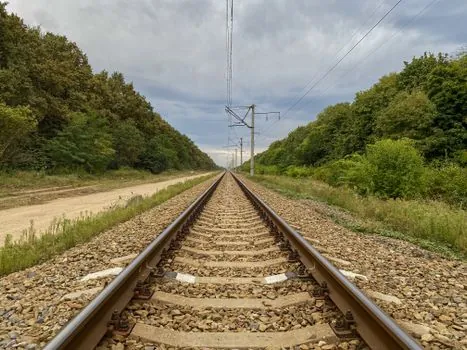
Two precision grades cover almost every packaging cell: P5 as the default and P4 where repeatability of the sealing or cut-off axis is a scrap driver [S1]. Rail straightness ≤ 0.02 mm per 1000 mm on P5 stock means a 3 m single-piece rail can be installed without shimming on most packaging frames, and single-piece rails are stocked up to 4000 mm so most HFFS and VFFS frames avoid joiner-induced step errors [S1]. Where the cell is over 4 m, plan a verified rail joint and accept a small step at the seam, or split the axis into two driven carriages. The wider logistics context, line balancing, pack-format changeover, and the interface between the rail axis and the upstream conveyor, is covered in the logistics packaging entry for cross-reference.
Sealing, lubrication, and washdown realities
Packaging plants are not cleanrooms and not foundries, but they sit somewhere in between, with paper dust, adhesive mist, and occasional washdown on food lines. Optional IP65 sealing with end seals and oil-felt retention pads is the right baseline for most HFFS and VFFS cells, and is field-installable on HG and EG blocks [S1]. Where the line runs in a cold-chain or dairy-rated room, drop the seal spec to IP65 and add food-grade grease; the block geometry does not change, so cross-vendor equivalents (HIWIN, THK, PMI, TBI) accept the same seal kits [S1]. Under-describe the sealing and you replace the block in 12 months instead of 36; over-spec IP67 and you pay 2-3× the seal-kit price for no measurable life gain in a dry packaging hall.
Mounting, footprint, and machine-build integration
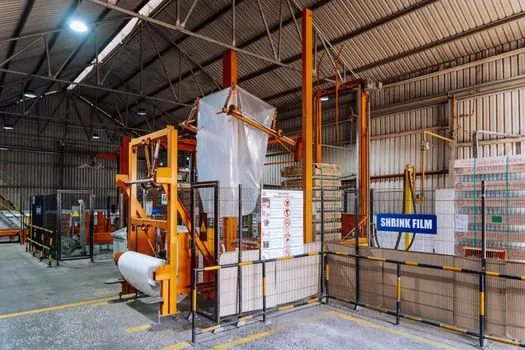
Two footprint decisions quietly drive 80% of packaging machine rebuilds: rail height (block + rail) and tapped-hole pattern. HG series blocks use a square flange and a tapped-from-top pattern, which suits T-slot frame builds and most extruded aluminium machine beds [S1]. EG low-profile blocks shave roughly 30% off the block height versus HG at the same width, which is why VFFS jaw-sealing carriages move to EG20 specifically to keep the sealing stack short and let the operator reach the heater band without a stool [S1]. MG7-15 miniature rails accept M2-M3 mounting hardware and pair with NEMA 8 or NEMA 11 stepper-driven carriages on labelling axes. Builders selecting a packaging cell end-to-end will also weigh the upstream and downstream packaging stations; the packaging machine reference catalogues the machine classes these rail sizes typically support.
Comparison: HG vs EG vs MG on packaging-line decision criteria
On four buyer-facing criteria, the three families line up as follows. Size range: HG 15-65 mm, EG 15-35 mm, MG 7-15 mm [S1]. Preload options: HG has four classes (Z0, ZA, ZB, ZC), EG has three (Z0, ZA, ZB), MG has Z0 only [S1]. Cross-vendor fit: HG maps to HIWIN/THK/PMI/TBI four-way, EG maps to HIWIN/THK/PMI three-way, MG maps to THK/PMI two-way [S1]. Typical packaging duty: HFFS draw, VFFS jaws, case packer arms for HG; VFFS seal and cut-off carriages for EG; label applicators and small pick-and-place for MG [S1]. A buyer picking HG25 ZA for a case erector versus EG20 ZA for a VFFS jaw is making a load-versus-footprint trade, not a brand decision.
Who this spec path is for, and who it is not for

This HG/EG/MG cross-reference is for OEM machine builders and line integrators specifying drop-in rail-and-block guides for new packaging cells or retrofitting carriages on existing HFFS, VFFS, and case-packing frames [S1][S3]. It is the right fit where the line builder wants HIWIN/THK/PMI/TBI interchangeability and a 1-piece MOQ for prototyping [S1]. It is not the right fit for fully integrated linear stages with motor, drive, and controller bundled into one module, where the buyer should evaluate stage-level assemblies from a systems integrator rather than a rail-and-block cross-reference [S3]. For buyers also weighing shrink-wrap end-of-line equipment, the packaging material and shrink-wrapper specification paths in the shrink wrapping machine selection guide sit adjacent to the rail-sizing problem and often share a single project timeline.
For demand-planning context behind these line-level selections, the 2026-2030 sizing and mix-shift outlook in Linear Guide Rail Demand 2026-2030 maps the same HG/EG/MG families against projected packaging-machine build volumes. The two signals to track next are: (1) whether lead times on 20-25 mm HG blocks in ZA preload stay inside 6 weeks, since that is the canary size for HFFS and VFFS cell retrofits; (2) whether IP65 seal-kit pricing stabilises, because a 2-3× premium on sealed blocks versus unsealed is the swing factor on food-grade line budgets.